Politics
The Coalition’s woes – or the Liberal Party’s woes
The Liberal Party is in dreadful strife, but there is a way out if they can pop out of their far-right bubble and forget about One Nation and the National Party .
There is no shortage of informed commentary on the Liberal Party’s problems.
Although Taylor (at last) has distanced the party somewhat from One Nation, there is still a vocal movement within the party calling for an ideological and organizational merger with One Nation.
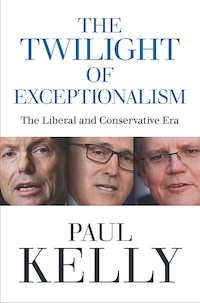
That topic was prominent in Taylor’s appearance on the ABC’s 730 program on Tuesday night, where he was responding to Paul Kelly’s warning that “the Liberal Party has lost its psychological and political hold on Australia”, and probably cannot recover. His book The twilight of exceptionalism: the Liberal and Conservative era, was launched on the same day.
Sarah Ferguson asked him several times if he would rule out doing a deal with One Nation to form government, but he was evasive on the issue, saying that he has “no plans” to do so – the usual way politicians keep options open. And the Liberal Party always leaves open the possibility of recommending that voters preference fringe and unsavoury candidates over more responsible parties.
The Liberal Party’s president, Tony Abbott, wants to keep the party on the hard populist right. By contrast Andrew Hastie is firm and clear in his view that the Liberal Party should have nothing to do with One Nation.
Taylor has his own problems in relation to an investigation by the New South Wales Commission Against Corruption: it has nothing on Taylor himself, but it is investigating his close political associates.
These problems are described in detail in two Saturday Paper articles -– Karen Barlow’s Antic’s new power base: “MAGA–Farage populism”, and Jason Koutsakis’ The “Operation Catapult” plan to sink Taylor.
Ever since journalists re-discovered the word “existential” a couple of years back they have been over-using it (Jean-Paul Sartre would be horrified). The word has been beaten almost to the point of losing meaning, but the ideological distance between the federal party’s parliamentary survivors and its traditional voting base is so wide, and its primary vote is so low, that its survival must be brought into question. (Opinion polls have the Coalition’s primary vote at between 21 and 23 percent, and some of that would be for the National Party rather than the Liberal Party.)
Factional conflicts, personal animosities, and hints of corruption commission investigations provide a reliable feed for journalists. Questions of ideology tend to be overlooked, but it seems that within the party there is no question that it should place itself on the hard right; it’s just a question of what particular model – MAGA-Farage-Abbott populism, or the right’s traditional neoliberalism stance. Hastie’s platform adds in some traditional conservative values, but he seems to be in the same “small government” neoliberal camp as Taylor.
The unifying aspect of both factions is an appeal to the party’s base – or what used to be the party’s base, because it’s literally a dying base. There was a time when parties on the right could be assured that as their aged supporters died they would be replaced by the next cohort, because as we age we become more supportive of conservative parties.
But, as pointed out in ANU’s major Australian Election Study, that model no longer holds. As we age we may indeed become more conservative, but that doesn’t attract us to the economic policies of the Liberal Party.
Kos Samaras, in an article on Pearls and Irritations – Gen Z is not ageing into the old Australia – fleshes out this development. His article is about the Australia in which Gen Z – people now aged 14 to 40 – have grown up. It explains why they find no attraction to the populist policies of One Nation or the neoliberal policies of the Liberal Party. “On climate, on gender, on multiculturalism, on sexuality, the debates that consumed their parents are simply settled questions for them”, he writes.
He describes Gen Z as “the most socially progressive generation in Australian history, but he goes on to define that progressivism more precisely:
… their progressivism is not primarily cultural. It is economic. This is a generation psychologically predisposed to economic populism: hostile to concentrated wealth, cynical about corporate power, convinced the housing market is rigged (because it is, against them) and increasingly comfortable with state intervention that would have made their Gen X parents flinch. They want someone to name the enemy, and the enemy they recognise is not the migrant or the welfare recipient. It’s the landlord, the bank, the supermarket duopoly.
Gen Z is not a voting majority, but Samaras’ general point is about the drift of the electorate. Readers of these roundups will be aware that I have been tracking the drift of the Coalition vote over the last 12 years, covering 29 federal, state and territory elections. Only in 4 of those 29 elections has their primary vote risen, and that has only been in partial recovery to previous severe wipeouts. The trend is clear – an annual loss of primary vote between 0.7 and 0.8 percent depending on the measurement technique. That happens to be about the same as the nation’s crude death rate, demonstrating the dismal demographic arithmetic for the Coalition Party. Labor is losing too, but only at a quarter of the rate the Coalition is losing, and the support for the Greens is holding up, perhaps even rising.
That doesn’t necessarily spell doom for the Liberal Party. There is enough in voting records, the Australian Election Study, opinion polls, demographic data and in Samaras’ analysis to write a broad platform for a centre-right party that’s serious about winning government.
Such a party would have an economically responsible policy on energy, pushing the government to move faster on renewable energy. It would explain the policy complexity and trade-offs related to migration, with a view to developing a settled policy on population and immigration. It would drop its “small government” obsession, abandoning its silly notion that the private sector is the only contributor to our welfare. It would acknowledge that inequality, particularly inequality in wealth and opportunity, is an economic drag on Australia, and would develop policies that improve the link between contribution and reward: that’s a traditional principle of the centre-right that the Liberal Party has forgotten.
The present Parliamentary caucus of the Liberal Party may be too immersed in their bubble to think this way, however. That’s a consequence of its slow loss of “moderates”, going back to Howard’s time. Those who remain are the survivors of those losses. And even if they could come together with an economically responsible platform, they would find they are electorally burdened by the National Party, and the hard-right combined National-Liberal parties in Queensland and the Northern Territory.
That’s why a completely reconstituted new party is the most realistic option. The Liberal Party as we know it would go the way of the Democratic Labor Party, the Communists, and the Democrats. And there is the 1944 precedent when the Liberal Party itself replaced the United Australia Party. The National Party may or may not survive, but there would be no coalition with a capital “C” burdening the country with poor public policy.
One Nation under scrutiny
Pauline Hanson faces assessment from an economist and from the public. She scores poorly on both tests.
An economist’s assessment
The ABC’s Gareth Hutchens has a post What would Australia’s economy look like under One Nation?. His assessment is more informative than Taylor’s “eternity of pain”, but he comes to much the same conclusion. He doesn’t find it easy to assess a platform that isn’t bound by a consistent ideology and that keeps trickling out policy thought bubbles.
He pays particular attention to One Nation’s weird and radical ideas on monetary policy – ideas that make Modern Monetary Theory look boringly orthodox in comparison.
That’s all strange enough, but the even more crazy stuff is about Gina Rinehart’s plan for northern Australia, which seems to be making its way into Pauline Hanson’s ideas. Gifts of land for the Israelis to develop their military weapons systems, gifts of land to Elon Musk.
In 1964 Russell Braddon wrote the book The year of the angry rabbit, involving the Australian government leasing remote parts of Australia to other countries to conduct their wars. It went down well as dark science fiction comedy. The Hanson-Rinehart platform is in much the same style, but without the humour and it is better classified as fantasy than fiction.
The public’s reaction
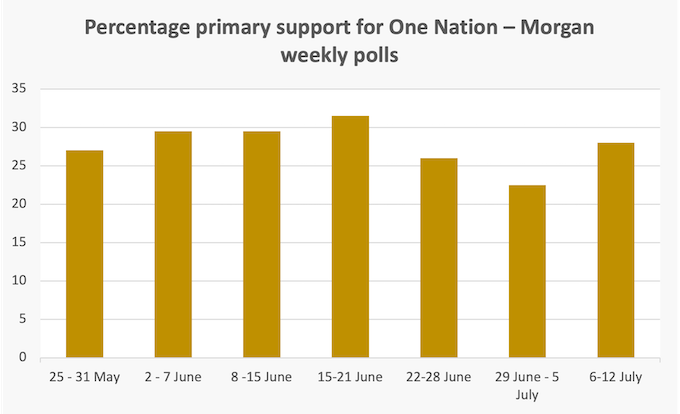
Shane Wright of the Sydney Morning Herald writes about Pauline Hanson’s fast rise and subsequent fall in popularity: The varnish has come off: Support slips for Hanson.
That was on Sunday. By Tuesday there was another Morgan poll suggesting there has been some recovery in One Nation’s support. Then on Friday we learn she has been in some distant foreign country telling a far right activist that she laments the end of the White Australia policy.
But the real value in Wright’s story is in his presentation of people’s responses to 13 views that Pauline Hanson presented at her Press Club session.
Wright’s article lists them all, and in order to give some sense of the relative strength of responses, I have represented them in order of net agreement (“agree” minus “disagree”). For most questions there is about a 30 percent ”undecided/neutral” response.
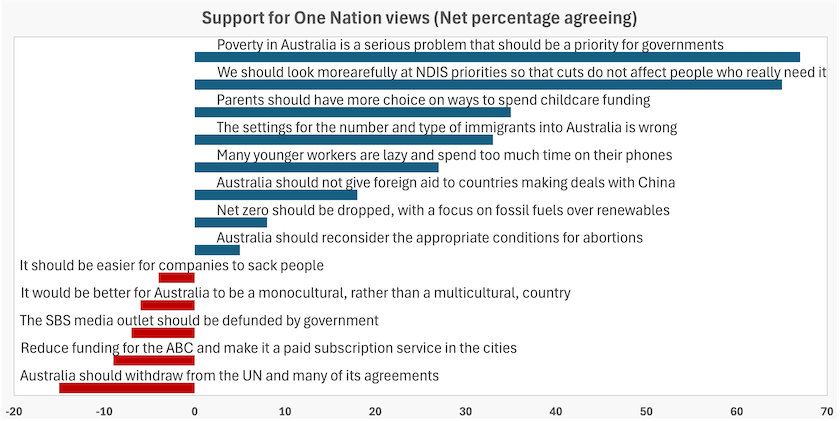
These are the main points of Hanson’s speech, a strange mixture of assertions and policy proposals. Can we wring anything out of them to indicate the public’s acceptance or otherwise of One Nation policies?
The statement on NDIS, for example, is so uncontentious that it tells us nothing about people’s preferences.
The statement on the UN doesn’t tell us much about public opinion, because there has been hardly any public discussion about international agencies. But the MAGA movement has made it an issue in the USA: this suggests some of One Nation’s platform is a MAGA platform without much consideration of local issues.
Wright notes that the same poll shows that women are turning away from One Nation, and that this may be to do with her views on abortion. The statement itself is uncontentious, but she has awoken a sleeping dog, presumably to connect with those who seek to restrict access to abortion.
Notably she seems to have misjudged the mood on public broadcasting. The ABC and SBS may not have large audiences, but many people would feel that a public broadcaster is an important protection against bad government, in the same way as they may value the government auditor although very few people would ever read an ANAO report.
Similarly her statement on sacking people missed the mark. If her advisers really were mixing with “ordinary Australians” it would have been left out.
Some commentators have expressed surprise at the extent of public agreement with her views on net zero. We should remember that this is not just Hanson policy: it’s also the policy of the National and Liberal Parties, and the view repeatedly pushed by the Murdoch media.
Her statements on multiculturalism and immigration have given rise to most public discussion. Wright notes that they may have helped turn away people born overseas. It is notable that while we are positive towards multiculturalism, our views on immigration are more mixed. There is an assumption that anyone who came to Australia since the end of White Australia will be in favour of a high rate of immigration, but why should a third-generation Chinese- Australian have a different view than a third-generation Italian-Australian?
Australians rejoicing
At first sight that statement presenting poverty as a serious problem is striking, because most politicians duck the issue. There are Australians suffering long-term and even intergenerational poverty, largely overlooked by political parties. Perhaps Hanson is treading ground others have avoided.
But when one digs into her speech it’s more about a rise in demand for services provided by charitable organizations such as the Salvation Army. And she cannot help mentioning “energy poverty”.
The conditions to which she rightly refers are symptoms of a country with a problem in inequality, particularly inequality in wealth and opportunity. But she doesn’t go to that level of policy, choosing instead to join the “cost-of-living-crisis” bandwagon. A cheap and meaningless stance.
Gambling reform
The government’s intransigence on gambling reform gives a chance for the Liberal Party to resurrect itself, but it probably won’t take it.
Once again, the figures on gambling losses: we’re the world’s biggest losers – $1 600 a head in 2022, probably around $2 000 by now (assuming losses track nominal GDP). That’s roughly $5 000 a household, and it’s concentrated among poorer households.
Once again, the figures on public opinion: the Australia Institute reports that at least three quarters of Australians want to see a total ban on gambling advertisements, as recommended by the 2023 Senate report You win some, you lose more (the “Murphy report”). This has been covered in these roundups, most recently on May 16, and more comprehensively on April 25 – The government’s insipid gambling “reforms”. The same research by the Australia Institute finds that at least 80 percent of Australians want to see a ban on gambling advertisements in social media and online generally.
At the same time researchers studying the rise of populist insurgencies against established political parties are finding that people have lost patience with governments that claim reform is too hard. In this regard the Albanese government should feel emboldened by its success in tax reform and be willing to go on to gambling reform.
In fact, because of the concentration of losses among the poor and the vulnerable, gambling reform should come easily to government from a centre-left tradition. But political observers are stunned by Albanese’s intransigence. In his fortnightly contribution to the Saturday Paper, John Hewson writes:
I find it particularly difficult to accept that a Labor government, traditionally defined by a focus on the welfare of individuals, can allow itself to be swayed on gambling by vested interests that knowingly take advantage of the vulnerable.
Similarly Mike Seccombe, also writing in the Saturday Paper, is at pains to understand the Albanese government’s stubbornness, and similar reluctance by Labor state governments to confront the gambling lobby. He writes:
The curious thing is that it is the disadvantaged people the Labor Party is supposed to represent who suffer most from gambling addiction, and yet it is Labor that has historically done most to further gambling interests, according to Cameron’s colleague, Tim Costello, the chief advocate of the Alliance for Gambling Reform. [The reference is to Stu Cameron of Wesley Mission.]

Under Labor Party protection
Seccombe’s article “Follow the money”: Next step in Albanese’s gambling reforms describes a situation where we would reasonably expect Parliament, if unshackled from party loyalties, would vote strongly for gambling reforms, including a ban on inducements such as “bonus bets”.
If they play their cards well the real winner in this issue could be the Liberal Party. The Greens and the Coalition have already succeeded in calling a Senate inquiry to go over the government’s weak “reform” bill. Seccombe refers to MPs across the spectrum calling for stronger action. Most have not identified themselves, but one who has is Simon Kennedy, Liberal Member for Cook, one of the few urban electorates held by the Liberal Party.
Here is a chance for the Liberal Party to show up the government on an issue of concern to Australians, re-establishing themselves as a centre-right party, and to show that they can stand up against big money. This would not only be the right thing to do, but also the politically smart thing to do, says Andrw Wilkie. It’s not often that the right thing and the politically smart thing align.
It’s a fair bet – 100:1 perhaps – that they won’t take this opportunity. Kennedy might be comfortable in a political space closer to the centre, but there aren’t too many Coalition Senators comfortable in that space.
Does anyone want to run a book on the outcome of the Senate inquiry?