Politics
What happened in Farrer
The search for explanations – beware of the one big theory.
The electoral success of a far-right populist movement supported by some of Australia’s richest people is a serious development. Most media see it in terms of a threat to the Coalition and a reshuffling of parties on the right. But Australia is not immune from the forces bent on undermining democracy that have had so much success in the USA and other countries.
This post is in seven parts presenting different ideas and theories that may help explain One Nation’s outstanding success in Farrer.
- One outcome, many causes
- The numbers – beyond expectations
- Farrer’s heterogeneity – from suburbia to the outback
- Theories – the protest vote
- Theories – One Nation as a serious political party
- Theories – the politics of grievance in another Australia
- Political reactions
1. One outcome, many causes
When an airplane crashes, the media are quick to identify the “obvious” cause. Air safety investigators by contrast painstakingly look for all the causal factors, and almost always find some combination – weather, fatigue, maintenance, pilot unfamiliarity, instrument failure and so on.
So it is with an event like the Farrer by-election. An all-explaining single theory, backed by evidence, can capture the headlines, and become the dominant story, displacing all other theories.
In last week’s roundup I drew attention to two theories for One Nation’s surge in recent elections and opinion polls.
One is about the politics of protest: support for One Nation in a by-election, in response to an opinion poll, or in an election where there is already a clear winner (South Australia), is a low-cost way to lodge a protest against the Labor-Coalition duopoly.
The other is about One Nation offering, or seen to be offering, something of substance. This means the party is here to stay, and could even form the nucleus of a far-right coalition.
There is no reason we should see these as conflicting or even competing explanations. As with airplane crashes, one outcome can have several contributing causes. Elections involve the choices made by thousands of individual voters. What attracts one group to a party may be quite different from what attracts another group to the same party: that’s Politics 1.
And more possible causes are being thrown into the ring – real or perceived injustice, revenge for the Liberal Party’s treatment of the electorate’s former member, Sussan Ley, the Coalition’s disunity, the Liberal Party’s inability to find its place in a multi-party democracy. All are worth examining and keeping open for scholars to examine.
This is not just about keeping academics employed on interesting projects, or providing material for aspiring PhD students. It’s about guarding against the simple theories that guide political parties towards bad policies, such as Labor’s misreading of its 2019 defeat that stoked its fear of addressing injustices in the tax system, or the Liberals’ interpretation of the defeat of the Voice referendum as incontrovertible evidence that Australia was ready for MAGA politics. Anyone who tuned in to the ABC’s Insiders on the Sunday morning after the by-election would have been aware of the quest for a simple explanation: to their credit Niki Savva and Melissa Clarke avoid the one big theory trap.
2. The numbers – beyond expecttaions
Having found in the South Australian election and the Nepean by-election a strong correlation between an electorate’s average level of education and the One Nation primary vote, I tentatively suggested that in Farrer it would pick up 28 percent of the vote.
That was spectacularly wrong – its primary vote was just on 40 percent. It seems that there was something in play in Farrer that wasn’t in play in South Australia or in Nepean. A possible difference, mentioned by Peter Brett in his Inside Story article on Farrer, is that in a by-election, particularly where there is a strong independent and the absence of one party (Labor), candidates’ individual campaigns are highly influential. In a general election, as was the case in South Australia, the contest is more about parties. Brett also mentions the considerable funding that flowed into this campaign.
The simple story is about a terrible loss for the Coalition, the Liberal Party in particular. The numbers are stark: just 12 months ago in the general election the Coalition’s sitting member, Sussan Ley, won 43 percent of the primary vote; last Saturday the combined vote of the Liberal and National candidates was 22 percent. That’s an easy story for the media, and a convenient one for Labor.
The other story is about a failure of the independent candidate, Michelle Milthorpe, to cut through. She won 20 percent of the vote last year. There was an expectation that she would benefit from the absence of a Labor candidate, who had 15 percent support in the general election, but in the end Milthorpe’s primary vote was only 28 percent.
I challenge this interpretation, because it makes too many assumptions about a similarity between Labor and Milthorpe. In rural Australia there is often a rump of old, rusted-on Labor voters – people who remember the shearers’ strikes of the 1950s, and former railway workers – who aren’t necessarily going to turn to a centrist independent.
As it turns out, the TPP outcome for Milthorpe (i.e. the outcome after preferences are distributed) was 42.5:57.5, only one percentage point poorer than her 43.8:56.2 outcome last year.
Few commentators noticed this, possibly because the count was looking much better for One Nation and much worse for Milthorpe late on election night, when journalists were filing their contributions, before large swags of pre-poll votes from Albury were counted. One of the oldest media biases is for the earliest story to have more traction than later, more considered accounts.
The size of One Nation’s primary vote was enough to dispel any idea that Milthorpe would have made it over the line had the Nationals and Liberals not put her last on their how-to-vote cards. As Casey Briggs explains, the National and Liberal primary votes were so low that even had they placed her higher it wouldn’t have helped (do the arithmetic – it would have taken a 100 percent preference flow to get her to 50 percent).
But that is not to say the Coalition parties’ preference decisions were inconsequential. In an interview on Monday morning Albanese reminded us of the message that preference deal sends to the rest of Australia: it’s OK to vote for One Nation because its and the Coalition’s values are closely aligned – more closely aligned than with the values of a centrist like Milthorpe. Also, to the extent that many followed the how-to-vote card, the preference deal, although not decisive, probably boosted the size of the TPP outcome and therefore the confidence with which One Nation will contest other elections. Brett believes that having set the precedent, it will be impossible for the Coalition not to do preference deals with One Nation.
It’s difficult to draw any general conclusions about the swings, because it was a by-election rather than a general election, because there were two Coalition candidates running (does this increase their chances or does it signal division?), because the former Liberal member was treated so badly by her party, because in the intervening 12 months the Coalition parties have been tearing themselves to pieces, because there is a story about One Nation’s resurgence, and because there was a different field of candidates.
Good luck to anyone who can find the independent contributions of these factors, but below is my rough gathering on a “right populist” vs “centrist” classification.[1] This suggests a somewhat more substantial move towards right populist parties than is implied in the small TPP shift, particularly when the fall of the Green vote is taken into account.
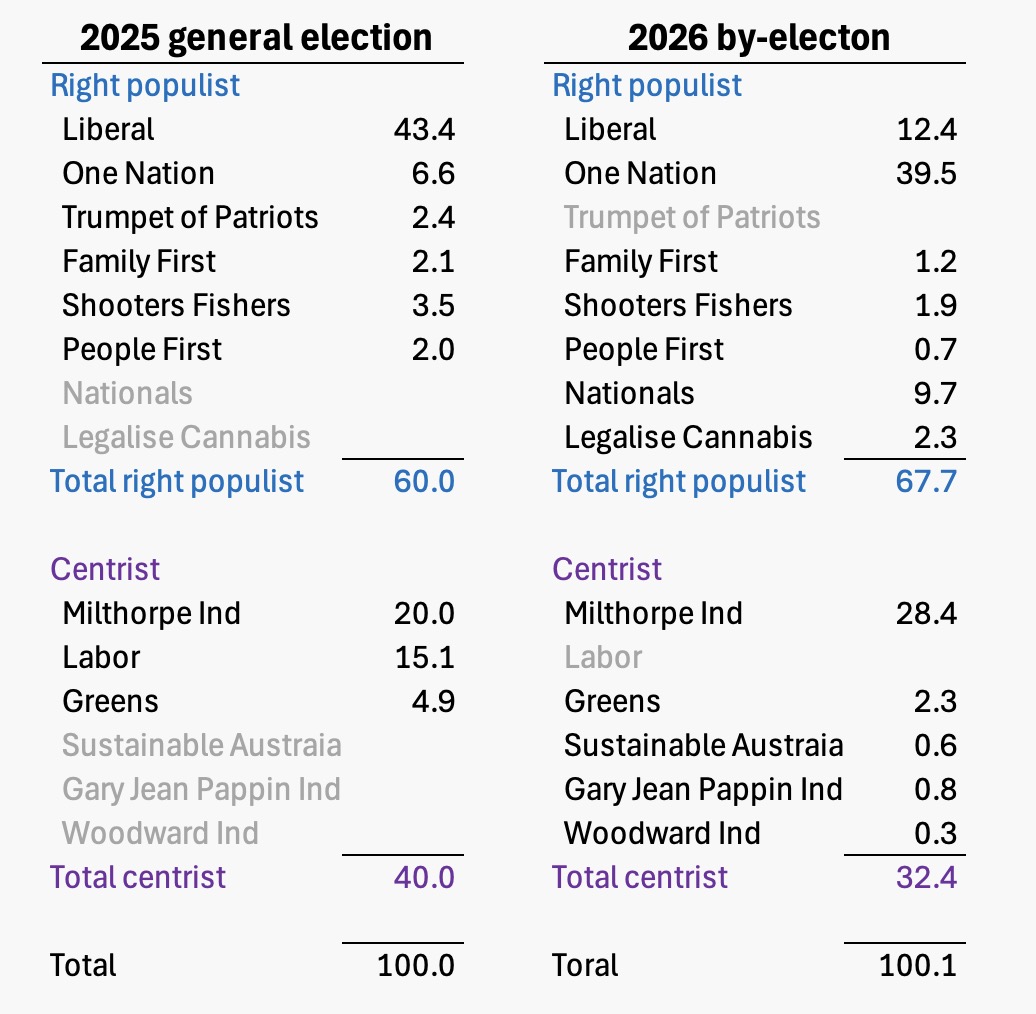
1. I make no claim to certainty. Some would classify Ley as centrist, but I don’t because in a general election the ideology of the parties rather than the political orientation is dominant, and the Coalition’s ideology was MAGA. Some would classify “Legalise Cannabis” as left, but I see it more in the bush libertarian, almost sovereign citizen, tradition. ↩
3. Farrer’s heterogeneity – from suburbia to the outback
Credit is due to the Electoral Commission for putting together rural electorates with some degree of heterogeneity: we’re protected from US-style gerrymandering which tries to pull together similar demographics in order to achieve wastage of concentrated votes. But its size, stretching from Albury to the South Australian border, makes it a hard electorate for a local candidate or local member because it has no place that could be called its centre. [2] It also suffers from the thoughtless decision by 19th century colonial administrators to assign the continent’s only large river catchment to four colonies, and to make the Murray the border between two of them. This means that water is an inevitable issue in the electorate which local politicians have to address, although their individual influence on water policy can only be minor.
Around a quarter of the electorate’s voters live in Albury, which is part of the Albury-Wodonga growth centre, with a population of just over 100 000. Not quite a conurbation, but much more than a pair of country towns. Charles Sturt University has a campus in Albury, and La Trobe University has a bigger campus in Wodonga. Public hospitals in the two cities operate as a single unit. The twin cities are growing in population, in a way that the rest of the Farrer electorate isn’t.
In Albury Milthorpe had a clear lead over the One Nation candidate – 37 percent to 29 percent on primary vote, and 56:44 on TPP. In the rest of the electorate she trailed 24 percent to 45 percent and 38:62 on TPP. There is a wealth of fine-grained information about the outcome on Antony Green’s Election Blog and on William Bowe’s Poll Bludger. If you click on his Booth Results map, you will see the general pattern – the further west you go, the higher is the One Nation vote.
One outcome that’s easy to miss is that in the 500 votes collected from hospitals, Milthorpe easily outpolled One Nation, and the Liberals did better than they did elsewhere. Votes taken from hospital patients generally have a right-wing bias: that’s a reflection of their age. But in this case they weren’t attracted to One Nation. Is that because of the party’s racism, that does not resonate with the care hospital patients experience from immigrant health professionals?
2. Sussan Ley was getting around the electorate in an elderly Grumman Tiger AA-5B. I was flying an almost identical and similarly-aged Grumman Tiger, when I met her at one of those western airports, as we both waited for the fuel agent to come from the pub to the airport to refuel our planes. The Grumman Tiger is a reliable old workhorse, which sells on the second-hand market for about the same price as a well-appointed 4WD and can be rented at a reasonable price. Neither of us had a benefactor offering a new Cirrus B7, which sells between $1 million and $2 million.. ↩
4. Theories – the protest vote
On the Insiders program Niki Savva distinguished between what may be called the “fuck you all” protest vote and the considered tactical vote. The former is based on gut feeling; the latter is considered. For example, there may have been people who, having observed the short shelf life of One Nation members in the federal Senate and the Queensland Parliament, believed that David Farley, the One Nation candidate, would be a useful placeholder until they get a better field of candidates, or that he may even have the good sense to break away from the toxic culture of One Nation. In fact there are tacticians in the Liberal Party who argue that they preferred a One Nation member to Milthorpe, because well-respected independents are so hard to dislodge. Plausible, but it comes across as a weak rationalization, and not enough voters have had a Jesuit education to consider anything so cunning. Such tactical voting is probably a minor contribution to One Nation’s success.
“Fuck you all” itself splits two ways. One, for which there is plenty of evidence, is about rejection of the Coalition-Labor duopoly. The Liberals, including Angus Taylor, don’t seem to realize that the two-party duopoly was a historical 40-year phenomenon that dominated the political landscape from 1944 to 1984. In such a duopoly politics is a zero-sum game: if you can convince the voters that the other mob are incompetent or corrupt, your side will benefit, particularly when they have to vote because of compulsory voting.
But that’s a dangerous tactic when there are more players, particularly when people don’t consider there to be much ideological difference between two main parties. It’s why, in the commercial world, Coles doesn’t try to trash Woolworths, because they know that to do so does damage to the whole big supermarket model. But there was Taylor on Saturday night, referring to politics as a zero-sum venture, and talking about the “rotten Labor government”. He doesn’t realize that such an approach results in politics becoming a negative-sum venture.
And that leads to the second, and more dangerous sentiment, where “you all” refers not just to the Labor-Coalition duopoly but to the entire political system. That’s where anarchists and communists used to operate, and it is now the approach of right-wing populists. They want to wreck the system, because the democratic system, with its checks and balances, its concern with fairness and respect for the law, does not serve the interests of the very rich. That’s where Trump’s MAGA movement operates, and so far is enjoying extraordinary success. It’s where One Nation, possibly unwittingly, is operating. Just as communists relied on “useful idiots” to mobilize the masses, so does the far-right oligarchy rely on populist movements to use the mechanisms of representative democracy to bring the system down.
5. Theories – One Nation as a serious political party
It is easy to criticize One Nation for their lack of realistic policy, and to classify them along with the Animal Justice and Legalise Marijuana parties as unlikely ever to hold government. A term that has recently popped up like Paterson’s Curse is the idea of a “party of government”, as if executive government is the only place from which power can be exercised. Every party and individual candidate can be influential: someone had better consider the consequences if One Nation is still enjoying its present support at our next Senate election.
In his election speech successful One Nation candidate David Farley announced his three policy priorities to do with water buybacks, net zero, and immigration. It’s easy for those with access to information, and the skills to process data, to know that the Murray-Darling system is already being exploited beyond its sustainable limits, that our tardiness in converting to renewables is responsible for power prices remaining too high for too long, and that immigration is a minefield of misinformation. But One Nation is resonating with a large portion of the electorate on these issues.
Perhaps if the Russian and Iranian ambassadors to Australia could be seen at a One Nation rally handing wads of folding money to its politicians the party’s supporters could start to understand who has the strongest interest in blocking Australia’s energy transformation.
As for immigration, the excuse that it’s about housing is the worst of disinformation, particularly in rural Australia. In Farrer their main problem is that they are losing population. Too few people, native or immigrant, want to live there. Outside Albury-Wodonga the towns are losing population and the small settlements are dying. If you want a four-bedroom house under $500 000, try Narrandera, David Farley’s base. Housing availability has nothing to do with One Nation’s expressed concerns about immigration.
David Farley is an experienced business person who surely understands the basic economics of energy supply, and who knows the terrible damage climate change is inflicting on our agricultural industries. He would be well aware of the contribution immigrant labour is making to our horticultural industries, and how our hospitals and clinics are so dependent on immigrant professionals. But the political stance of the party that has endorsed him is undeniably racist.
6. Theories – the politics of grievance in another Australia
Just off the Hume Highway lies Holbrook, a small town that cast 227 votes for Milthorpe, and 405 votes for One Nation. After preferences were counted the outcome was 63:37 in One Nation’s favour.
I mention Holbrook specifically because it is easy to get to – just take one of the exits on the Hume Highway. (Until 2013 the highway passed through the town carrying 5000 trucks every 24 hours, mainly at night.) And like so many country towns it has an excellent bakery.
Opposite the bakery is the Catholic Church, named “Our Lady of Sorrows”, built in 1955 when the town was still expanding. At the time the name would have seemed strange in a country enjoying the postwar boom, but it doesn’t seem so strange now. Holbrook’s population is in steady decline – 1337 in 2006 down to 1251 in 2021.
Holbrook is similar to many towns you will find in the western part of Farrer. The table below, by way of illustration rather than analysis, shows some basic data from the 2021 Census about Holbrook, and two other towns in the electorate – Narrandera, a larger town (population 4400), and Balranald, further west, with a population of 1100 – about the same size as Holbrook.
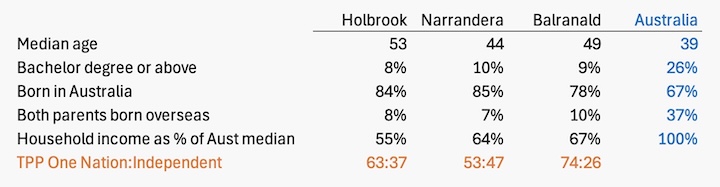
For all three places the ethnic composition, in comparison with Australia as a whole, stands out, as does the median age.
I have also chosen to draw attention to the education attainment level, in part because in these settlements it is in such strong contrast to the rest of Australia, and in part because it correlates (negatively) with One Nation’s support. For many commentators mention of education is an issue too delicate to handle, because it can be interpreted as judgemental – in the same light as Hilary Clinton’s mention of “deplorables”. But sensitivity is no reason to avoid pointing out the correlation.
Research suggests that education itself has a small but discernible effect on people’s political behaviour. A solid high-school education can help people to realise that what looks simple on the surface is actually more complex than it seems, and to have the scepticism to recognize political bullshit. Those are valuable assets, particularly when for so many, social media have displaced professional journalism as a source of information – and misinformation.
Otherwise education is a proxy for many other things that are hard to measure – parents’ valuation of learning, norms about the way to conduct a civilized discussion when there is disagreement, and respect for knowledge.
To a certain extent data showing a region has a low level of education attainment is simply a reflection of the region’s age, which, in turn, is partly influenced by the exodus of young people to the capital cities, or to large inland cities such as Wagga (just outside the electorate) or Albury.
And then there are the figures on income which are much lower in rural Australia than in urban Australia. Some may rationalize these figures, pointing to the lower cost of housing in non-metropolitan regions. But that’s only part of the story, because there are other costs not incurred by city dwellers, such as long trips for banking and health care, and very expensive utilities such as water and electricity.
Those are the material conditions fuelling a sense of grievance. But grievance is about more than physical conditions, or quantifiable indicators such as income. In the Sydney Morning Herald Bob Harris writes about a sense of abandonment. It’s not just about the inconvenience and cost of driving 50 km to see a GP or 100 km to a Bunnings. In fact it’s not just about material inequality.
It’s about “disappearance” he writes. The pub closes, the priest moves to a bigger city leaving the presbytery boarded up, the numbers can no longer justify a football team, weeds grow in front of abandoned houses and businesses, no-one has had the time or inclination to clean up the graffiti in the long-closed railway station. It’s not sudden, as when a flood wipes out a complete settlement. Rather it goes on for years, one family moving out at a time.
And politically the sense of abandonment is real. Back 50 years ago there may have been a railroad employing unionized labour, and there may have been enough farm workers to support a branch of the AWU, which meant that in political terms these country settlements were contested political territory. But for many years they have been considered as “safe” Coalition seats – National or Liberal Party depending on the state – which means both the traditional parties disregard their interests.
They’re ready for a political predator who may not be able to offer much to restore life, but who is able, at least, to recognize that grievance and to echo their sense that there is a “system” controlled by elites who do indeed see them as “deplorables”.
7. Political reactions
The simple – and misleading – story is about damage to the Liberal Party, because it lost a seat it held since 1949, suffering a 30 percent loss in primary vote. But Ley wasn’t a typical Liberal: rather she was what a Country Party politician should have been. That is, before the Country Party became the party of the mining and fossil fuel businesses, and aligned itself with the Liberal Party, a party that has never seen poverty reduction as one of its main concerns. Ley knew rural Australia in a way desk-bound National Party members didn’t.
Her resignation was a sweet revenge on a bunch of people who set her up to fail by undermining her from the day she became “opposition leader” by the slimmest of margins.
Some are talking about an “existential crisis” for the whole Coalition. Patricia Karvelas, in her wrap-up of the election, writes about “an existential question about where its [the Coalition’s] heartland now resides”. On Saturday night Taylor suggested the outcome was an “existential” problem for the Coalition – but one he was ready to solve.
Antony Green, in his Farrer post-mortem, is less trapped by the idea that the Liberal Party and National Party must always suffer the same fate. He writes:
If repeated elsewhere, the Farrer result will come close to destroying the National Party and reduce its representation in the House of Representatives to a rump. The same existential threat applies to rural and regional Liberals.
If Liberal Party strategists could keep a cool head, they could even welcome the passing of the National Party. As a centre-right party they should be able to re-establish themselves in their traditional urban heartland. That would take time: independents, once established, have an extraordinary stickability.
But the Liberal Party itself is deeply divided along ideological lines – between those who want to follow a hard-right line and those who want to move to the centre-right. This rift, exemplified in the specific issue of how to deal with accusations against former soldier Ben Roberts-Smith, is covered in Jason Koutsoukis Saturday Paper article How the soldier split the Libs.
There is even disunity among the hard right in the party. Some want to take a Friedmanite line in Reagan-Thatcher style, while others want to move into One Nation’s territory of MAGA populism and racism, perhaps even amalgamating with them.
At the same time there is a contest for the Liberal Party’s presidency, between Alexander Downer and Tony Abbott, whose political styles are radically different. One is an old-school patrician Liberal, possibly nominated by the members of the Adelaide Club. The other is a gung-ho warrior against the Enlightenment, possibly nominated by Opus Dei and the Manly Surf Lifesaving Club. The tone of Taylor’s budget reply speech places him closer to the latter polarity.
Labor must surely be enjoying the show. The media story is that with 94 seats of the 150 seats in the House of Representatives, and with the Coalition holding only 41 (down one since Saturday), it’s in an invincible position, but that view ignores the reality that a government can hold a large number of seats on a slim margin. Labor holds 22 of its seats on a margin of 6 percent or less, and 9 of these are in outer-metropolitan regions (as classified by the AEC).
“Western Sydney, here we come” shouted Barnaby Joyce from the rooftops. Maybe, but former Liberal Party strategist Tony Barry, now of Redbridge, suggests that Joyce is overstating One Nation’s chances of picking up outer-metropolitan seats. Ola Hamed, Mayor of Cumberland, was obviously not one of the western Sydney people Joyce claims to have spoken with. You can hear her express her view on Radio National Breakfast: One Nation sets its sight on Western Sydney. (Content warning: the session starts with a flow of drivel from Joyce.)
One Nation has been buoyed by its success in Farrer, and by its strong showing in Adelaide’s northern suburbs. But its analysts would do well to look at the party’s poor showing in Albury, which has many characteristics of outer suburbia, and in those northern suburbs in Adelaide, where collectively Labor won 46 percent of the primary vote (against 27 percent for One Nation), and 69 percent of the TPP vote. Also, in terms of issues, River Murray water licences aren’t of much interest to the voters of western Sydney, and Hanson’s remarks about no “good” Muslims won’t find much traction.
For now, the Liberal Party – or more specifically the federal Parliamentary Liberal Party – seems to be stuck in indecisiveness. Any outside observer would find it hard to believe that the Liberal Party has not made it clear that it will never again come to any agreement with One Nation, and has not apologised for its mistake in its how-to-vote cards. That’s what most European centre-right parties would do in a similar situation: indeed it is exactly what the German Christian Democrats have done in relation to the Alternative für Deutschland. One Nation Senator Malcolm Roberts’ suggestion that the Bondi murders might have been a “false flag” operation, and Pauline Hanson’s offensive behaviour towards Muslim Australians should convince the Liberal Party to cut its connections.
Quite apart from consideration of the electoral consequences of dealing with One Nation, the question should be settled by the basic moral principle of rejecting any relationship with a party that seeks to divide Australia by race or religion – particularly in view of the Liberal Party’s claim that that it upholds Australian values.
But the federal Parliamentary Liberal Party, particularly its members in the House of Representatives, is suffering from what statisticians call “survivor bias”. In a process that started 30 years ago, with the election of Howard as prime minister, MPs of more centrist persuasion have been losing their place in the party caucus – initially through losing preselection contests, and in more recent times, losing their seats. The survivors are those whose political views are close to those of One Nation.
Sydney Morning Herald journalist, Peter Hartcher, in his article Australia teeters on the brink of a populist uprising led by a longtime racist, describes the path the party should take:
The way out for the Liberals is to build a strong edifice of their own beliefs and policies, to create an attractive electoral persona, rather than trying to be a feeble imitation of One Nation like a second-hand Hanson.
Similar advice is offered by Sussan Ley, who says the party must “change or die”.
While the Liberal Party is wallowing in indecisiveness, there is off-and-on talk about a new centrist party. The process is like planetary formation. Rocks circulate in space, sometimes coming together but generally failing to amalgamate – until at some stage a cluster of rocks becomes large enough to exert a gravitation pull to bring in other rocks. The timing of that amalgamation will take us by surprise, but when it happens it would be historically appropriate if its first general meeting is in Albury.
Pauline Hanson for prime minister?
A post-budget poll suggests One Nation would have a 50 percent chance of winning an election if it were held today.
A Roy Morgan poll has the heading Straight after the Budget – Federal Election too close to call: ALP 51% and One Nation 49%. Because those figures are within the margin of error of polls we may as well say that Hanson and Albanese both have a 50:50 chance of being our next prime minister.
At first sight the poll appears to be incredible (in the true sense of that overused word). But as we dig into Roy Morgan’s comprehensive explanation, it seems to make sense.
That 51:49 ratio is the TPP estimate for a Labor-One Nation final count. The same survey shows that a Labor-Coalition contest would see a 55:45 outcome in Labor’s favour. That’s in line with other published polls – probably on the high side.
The poll’s estimates of primary votes tell a more complete story. Labor is on 28.5 percent (down 6.1 percent since the election), the Coalition is on 16.5 percent (down 15.3 percent), One Nation is on 32.0 percent (up 25.6 percent), and the Greens are on 11.5 percent (down 0.7 percent). These outcomes are shown below, in order of the dates of the polls: all but this latest Morgan poll were taken in May.
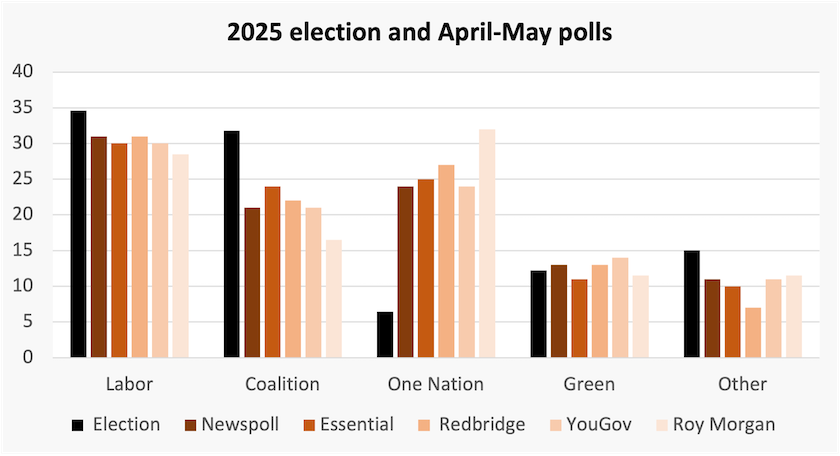
These polls show that support for the Coalition has collapsed, and that Labor’s support has been falling over April-May (confirming the tendency for the electorate to blame a Labor government for anything that goes wrong in the world). And they show an extraordinary leap in support for One Nation. At 32 percent that’s lower than their 40 percent in Farrer, but it’s much higher than their 23 percent in South Australia – a constituency that’s more similar to the country as a whole than Farrer.
It’s informative to dig into the poll’s reasons for people’s support for One Nation. Reducing immigration is the most attractive aspect of One Nation’s policies, and this is followed closely by dissatisfaction with the major parties, which are seen to be “corrupt, self-serving, disconnected from ordinary Australians and responsible for national decline”. More on this informative survey in next week’s roundup.
Does this mean there is an even chance of Australia electing a One Nation government in 2028? The poll has been taken during a hysterical scare campaign of lies about the government’s tax changes and its broken promises. There is heightened anxiety about the consequences of the Netanyahu-Trump war. There has just been an interest rate rise, and the Reserve Bank is suggesting that its assault on inflation is not over. And One Nation is clearly enjoying the bandwagon effect of its three election successes.
Much can happen in the coming months. If the benefits of lower wholesale electricity prices aren’t captured by the owners of powerlines and the “retailers”, people’s next electricity bills should show lower prices. There should be some significant improvement in oil supplies (although not a complete resolution). The US midterm elections will probably reveal a rejection of Trump’s policies – and by extension a rejection of the One Nation’s and the Coalition’s endorsement of those policies. The hysteria about tax changes will settle down as people learn that they actually encourage productive investment. And if history is any guide, One Nation has an extraordinary capacity to get into trouble. No one worried much about them when they were just an electoral irritant, but we can be sure that there are officials in three parties scrutinizing them very carefully.
And of course votes don’t turn into seats. The national electorate is heterogeneous. If an election were held today it’s a fair bet that One Nation would enjoy some massive, and wasted, winning margins in National Party electorates, and the occasional Liberal and Labor electorate, while they would struggle in the rest of Australia. Labor would probably be returned, possibly in a minority government. Note that national opinion polls, even when conducted by reputable companies like Roy Morgan, do a very poor job at picking up support for independents, who tend to benefit from the same disaffection with the main parties as One Nation voters do, but in a more reasoned way.
This doesn’t mean we can be relaxed about One Nation’s surge. It’s a dangerous movement, threatening to bring division to our nation, destroy our institutions of democracy, and put us on a path to South American type poverty. The country desperately needs a serious, competent centre-right party, guided by a firm moral framework and concern for the nation’s future.
What is “The Opposition”?
One Nation and others challenge our established “Westminster” conventions about governments and “oppositions”.
Ashlynne McGhee and Isabella Podwinski have a provocative Conversation contribution: One Nation is the official opposition.
Their short article is a lead-in to the six-part podcast The making of One Nation by the ANU’s Jill Sheppard.
In South Australia they came close to becoming the second-largest party elected in Parliament (after the re-elected Labor government), thus meeting the criteria for being recognised as “the opposition”. In its current surge of support, including its 40 percent primary vote in the Farrer by-election, One Nation politicians are talking about the party becoming “the opposition” federally.
Sheppard believes that the party is over-stating its chances of becoming large enough to be considered as “the opposition”. Like the Greens, One Nation’s support nationally will probably stabilize at a level well short of the possibility of become a large Parliamentary party in the House of Representatives. It will probably remain as an anti-establishment party, with a regional concentration of support.
But the article raises a further question about the idea of an “opposition”, a political entity not included in our Constitution, but which we have borrowed from one of Europe’s offshore islands.
It made sense in a political system with just two parties. But what does it mean in a multi-party democracy? Why should certain non-government politicians have a status not given to other non-government politicians?
What patterns of behaviour should a public broadcaster follow to ensure it is being impartial and fair? Whatever rules about exposure our public broadcaster adopts, its journalists should recognize that a party of disruption, like One Nation, relies on putting forward ideas that wouldn’t stand up to scrutiny.
It’s a luxury not enjoyed by a party in government or with a strong chance of being elected. Too often, however, ABC journalists allow One Nation spokespeople to get away with unchallenged lies and sophistry – about the cost of renewable energy and the level of immigration, for example. It should not be too hard for a journalist, even if he or she is not fully briefed, to ask questions such as “what evidence do you have for that?” or “on what do you base that claim?”.
Labor’s exquisite gambles on timing
The Albanese government is a master in strategic political timing – but it sometimes gets caught out by alert journalists.
Budget timing – use a rising tide to your advantage
One strange aspect of the budget is its timing. The politics textbooks suggest that a government with any appetite for change will bring in its toughest budget early in its electoral cycle.
In fact Tuesday’s budget is the first of the re-elected Albanese government, and it does include a number of politically tough measures, but it is presented long into the government’s term in office.
The 2025-26 budget was presented on 25 March last year, shortly before the election on 3 May, and it was pretty well just what you would expect from a government about to face its masters.
Over the period from late 2024 right up to election day, the general belief, confirmed in many opinion polls, was that the Albanese government was struggling to get returned. Plenty has been written about misleading polling over this period. But Labor strategists probably picked up the mood of improving support from unpublished polls, and as they watched the Coalition proceed with its idiotic MAGA-lite campaign.
So they delayed the election almost as long as the Constitution allowed, and that meant it would be close to impossible to present a budget before the start of the 2025-26 year, particularly, as many believed, that they would have to go through the slow negotiations with crossbenchers as Gillard had in 2010. Therefore they had to present a budget.
Because they presented the budget just before an election their platform and the budget had to align. Some may say that Labor should have included the tax reforms in its platform and in the budget, but that would have set off a fear campaign and a series of lies from partisan media, dominating the election.
Gambling timing – rely on the absence of journalists when you cave-in to rich lobbyists
On Tuesday afternoon, while most experienced journalists were subject to the Trappist isolation of the budget lockup, the government tabled its anodyne and gutless formal response to the Murphy review on gambling harm – a topic frequently covered in these roundups over the three years since it was published. (The government’s informal response in April was covered in the roundup of 25 April.)
In anticipation of its content Tim Costello, in his role as Chief Advocate for the Alliance for Gambling Reform, reminded us on Radio National of the damage sports betting is doing to young people, and of the government’s weak response to the Murphy committee’s recommendation to prohibit sports betting advertising and to appoint a national gambling regulator. In case we missed Costello’s reminder, the Alliance’s CEO Martin Thomas was on the ABC a little later with essentially the same message. On PM Charles Livingstone of Monash University and independent MP Andrew Wilkie provide details of some minor tweaks in the formal response that were not included in the informal response. Comments by others, including Monique Ryan, Kate Chaney and David Pocock, are on an ABC post by Nicole Asher: Government accused of 'burying' response to landmark gambling report with budget day release. Albanese and the grifters in the gambling houses must have wished that all ABC journalists were in the lockup.
Both Costello and Thomas drew our attention to a poll commissioned by the Australia Institute confirming that 77 percent of Australians want to see a ban on gambling advertisements. By voting intention a ban has the following levels of support:
- 81percent of Labor voters
- 78 percent of Coalition voters
- 88 percent of Greens voters
- 66 percent of One Nation voters
- 85 percent of independent voters
- 79 percent of other voters
The sports betting industry is best described as an exploitative enterprise conducted by a handful of very rich people, using threats against an elected government to shape public policy that preserves their power to go on enriching themselves by exploiting gullible and under-educated young people.
Does this resonate with anything else going on at the same time? The tactics of a populist party backed by the nation’s oligarchs perhaps.
Aged care – delayed reporting, delayed services
The budget also provided cover for the government’s release of a departmental report on waiting times for aged care, revealing that on average it takes a year to secure a place in an aged care home or in-home support.
The ABC’s Stephanie Dalzell and Paige Cockburn summarise the report and draw attention to the government’s timing of its release: Australians “literally dying” as aged care average wait times surpass 365 days.