Other economics
Wages are stuck in the slow lanee
Real wages are stuck at the same level as before the 2008 financial crisis, and won’t lift until productivity lifts. But there is progress towards closing the gender pay gap.
Ten days ago the ABS released its quarterly Wage Price Index with the headline “Highest quarterly wage growth since December quarter 2023”.
Yes, indeed, wages did rise by 1.1 percent in the September quarter, which means that wages rose by 3.4 percent over the year. That’s pretty much in line with budget projections for wage growth (3.25 percent in 2025-26, 3.50 percent in 2026-27).
But these are nominal figures. Over that same quarter the CPI rose by 1.3 percent and over that same year it rose by 3.9 percent. This means that real (CPI inflation-adjusted) wages actually fell a little: in fact they have been falling over the last five quarters, as is shown in the graph below.
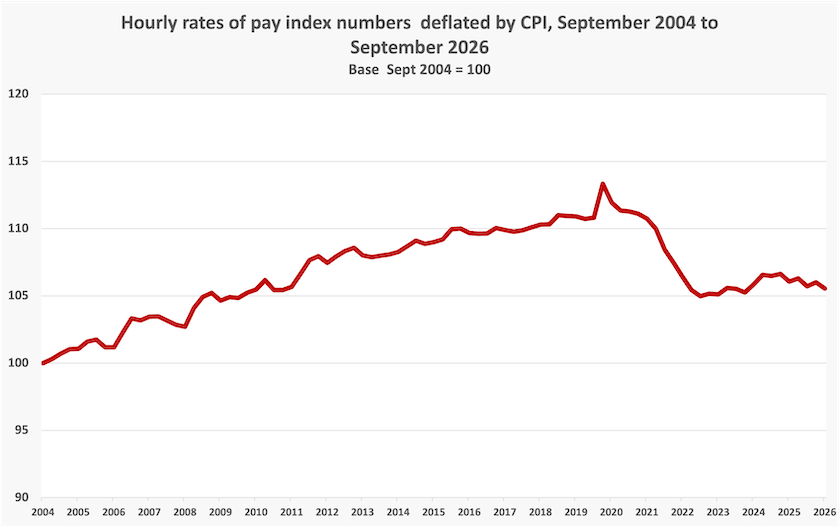
The bigger story, revealed in the graph. is that real wages are now at about the same level they were around 18 years ago.
The current partisan spin is that this is all due to Labor’s economic mismanagement because real wages are 1.8 percent lower than they were when Labor was elected in May 2022. The counter spin is that the biggest wage fall, 4.3 percent, occurred on the Coalition’s watch (a 6.8 percent fall if one measures from the Covid spike).
The less politicized story is that wages are back to where they were around the time of the 2008 global financial crisis, and that’s hardly surprising because productivity has been struck over the same period. Stimulatory spending after the GFC, eight years of lowering interest rates from 2012, and extreme stimulatory measures during the Covid pandemic all contributed to wage growth in the post-Covid period, but this was unsustainable and we have now been brought to earth.
These figures probably overstate the negative effect on living standards, particularly over the last few years. There probably has been some unmeasured improvement in the social wage stemming from reforms in health care. And nominal wage growth – 17 percent since interest rates started rising – has eroded the real value of the capital component of outstanding mortgage commitments. That benefit takes some time to show up, because the early years of mortgages are mainly directed to interest payments.
But the longer-term story is still about productivity. Productivity is stuck because of structural weaknesses in the Australian economy, and these weaknesses trace back to the way, after the structural reforms instituted by the Hawke-Keating government, we decided we had experienced enough change and disruption in our lives and elected a government that spent the benefits of a minerals boom on tax cuts, and neglected structural reform.
Even if we do lift our productivity performance, we’re not going to get back to a trajectory of continuously rising living standards. Writing in Pearls and Irritations– The thirty years that were never normal – Kos Samaras points out that the extraordinary rise in material living standards of the 1945-1975 period, the “postwar” period, was specific to the conditions of the time. As John Birmingham explains in his Quarterly Essay (covered in this roundup), many older Australians have a nostalgic yearning for a return to an Australia of high economic growth. Those times are not coming back, Samaras tells us, and “politics must stop promising their return and start deciding how prosperity is shared in a slower-growth world”.
The narrowing gender pay gap
The good news on wages is that the gender pay gap continues to close. The latest year of gender pay gap data published by the Workplace Gender Equality Agency reveals that the gap is now 19.7 percent, down from 26.3 percent ten years ago. That means for every $1.00 a man is paid, a woman is paid 80 cents.
That’s an average or mean figure. The Agency has also been reporting on the median gender pay gap for the last few years. That is now 15 percent. When the mean of such a series is larger than the median, it points to the influence of disproportionately large numbers at the top of the range. In the case of the gender pay gap, this probably reflects the presence of some extremely highly paid men in the workforce.
A jump in unemployment
The unemployment rate has already overtaken the Reserve Bank’s short-term forecasts, further undermining its credibility.
“The unemployment rate is expected to increase to 5.1 per cent by the end of 2028, which is around ¼ percentage point higher than previously expected”.
That’s an extract from the Reserve Bank’s Statement on Monetary Policy, issued earlier this month. It has a table forecasting that the unemployment rate will reach 4.7 percent in December this year and slowly rise to 5.1 percent over the next two years.
The only trouble is that the ABS released its Labour Force Bulletin in mid-November, showing that the unemployment rate had already reached 4.7 percent in September and had risen to 4.9 percent by October.
A comparison of the RBA forecasts and the actual unemployment rates (seasonally adjusted) is shown in the graph below.
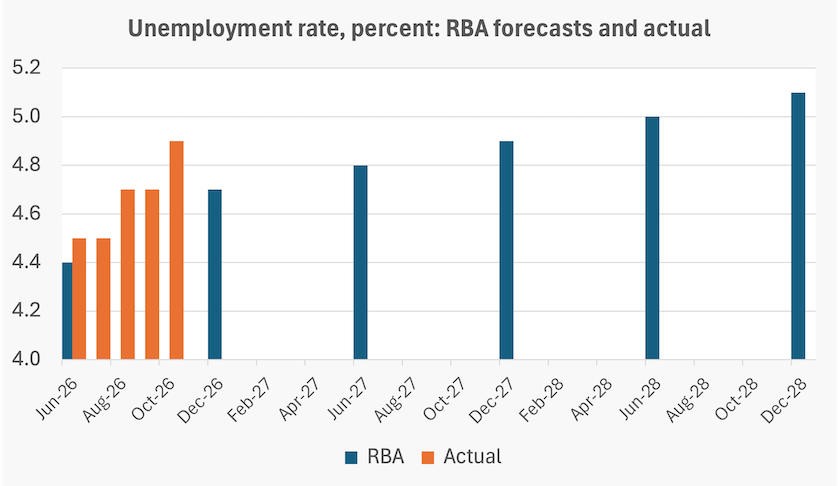
The two series are a little different: the ABS surveys the labour force monthly, while the RBA makes estimates for the average over a quarter, but those differences do not explain the glaring difference between the RBA’s expectations and the real world. The RBA staff aren’t clairvoyant, but by the time they completed their statement they would have seen that the ABS September figure already matched their December forecast.
In some defence of the Reserve Bank, the big layoffs at Wesfarmers (Bunnings and Officeworks), NAB, David Jones and Qantas were yet to be announced when they prepared their forecasts, and the October figure of 4.9 percent was yet to be revealed. But the RBA claims that its staff liaise with industry to pick up business sentiment: that’s a fairly standard public service practice. Did they not pick up the business mood? Or perhaps they did, and the senior managers didn’t want to hear the message.
That’s about their forecasts in the very short term, confirming the impression, covered in last week’s roundupthat they are quite out of touch with the real economy. How much credibility can we assign to their longer-term forecasts, including their forecasts on CPI inflation and therefore the usefulness of their decisions on monetary policy?
Waste in capital projects
The Victorian and Tasmanian governments compete for top place in wasteful expenditure. The latter government is largely exempt from media criticism because it is Liberal Party waste.
Mismanagement of Victoria’s “big build” is one reason Labor will almost certainly lose office in today’s state election. Geoffrey Watson, who has no partisan axe to grind, has estimated that corruption, extortion, inflated costs and general mismanagement of big- build projects have cost taxpayers between $15 and $30 billion.
We can imagine that in terms of roads and railroads not built, or in terms of cost per head – between $2 000 and $4 000 among 7 million Victorians, or $6 000 to $12 000 per household.
Gaining less attention is Hobart’s stadium, which had an initial cost estimate of $750 million. The latest cost estimate presented to state Parliament this week puts the revised cost at $1.1 billion, and that’s a partial estimate excluding certain necessary works. The overall cost estimate is now around $1.5 billion.
Using the same back-of-the-envelope calculation, that’s about $3 000 per Tasmanian, or $9 000 per household. And that’s an understatement, because as Roland Browne writes in his Saturday Paper report The true cost of Hobart’s stadium, the stadium has contributed to a downgrade in the state’s credit rating. which is now the worst of any state.
Watson’s report on Victoria is mainly about excess costs rather than the big build itself: Victoria has high population growth and a backlog in transport infrastructure. Planning experts have criticized the way the big build’s priorities have favoured parts of Melbourne with less need than others, but there has always been a strong case for public expenditure, particularly on its program of eliminating level crossings (which the Liberals intend to defer indefinitely) and its completion of the northeast freeway.
By contrast, there never has been an economically justifiable case for public expenditure on Hobart’s stadium. A stadium, like a golf clubhouse in Marrickville, is a “club good”, that people can finance for themselves. While there is some public health justification for public funding of community sport, there is no such justification for funding facilities for spectator sport.
There are many unmet needs for capital expenditure around Hobart, in roads, public transport, health care facilities, all fitting economic criteria for public funding.
There is a clear partisan message in this comparison of waste by Victoria’s Labor government and by Tasmania’s Liberal government. But the main message is that in both cases policymakers seem to have no coherent idea of value in public expenditure. In Victoria there has been woefully inadequate discipline in evaluating, planning, and supervising major projects. In Tasmania case there has been no notion of allocating funds in line with needs and justification for government involvement: it’s as if the Liberal Party State government, believing that all public expenditure is wasteful, couldn’t care whether it is spent on a stadium, a road, or a hospital.