Economics
Australia doesn’t have a public spending problem
Public spending is not the source of inflation, but fairer fiscal policies could do some of the work monetary policy is unable to do.
“The government must cut spending so that we can have more data centres”.
That, in 13 words, summarizes calls for the government to cut spending. The idea is that public spending crowds out private investment, and because all private spending is useful and prosperity-creating, and all public expenditure is wasteful, the case for the government to cut spending is self-evident.
A more deceitful variant of the argument is that the government has a loose fiscal policy that contributes to inflation, in response to which the Reserve Bank has had to inflict the pain of tight monetary policy by raising interest rate. As evidence of the government’s fiscal irresponsibility it is pointed out that government spending has risen above pre-pandemic levels, leading Angus Taylor to refer to “Labor’s addiction to spending” and its “spending spree”, forcing Australians to “tighten their belts”.
If Australia were running a large budget deficit, as the Trump administration is doing in the US, there would be some validity to Taylor’s argument. But as pointed out in the roundup of 3 October, the government is close to running a balanced budget. In fact, when one makes allowance for defence spending, much of which is for imported kit, its net demand on the Australian economy is probably negative. Government spending has indeed risen above pre-pandemic levels, but that spending is matched by an increase in tax revenue.
The government refrains from mentioning that it is actually running a conservative, balanced budget, presumably because much of that increase in revenue is from bracket creep in income taxes, and the Coalition has promised to eliminate bracket creep. The Albanese government hopes that the public understands the need for more public spending on health, education – and potholes – but is terrified to mention that to do so sustainably we have to raise our taxes to something approaching the levels of other “developed” countries.
Less forgivable is the failure of independent media, particularly the ABC, to point out the fiscal reality: because the Commonwealth is running a conservative balanced budget government spending is not contributing to an overheating economy.
John Hewson, one of the few competent and well-qualified economists ever to have passed through the Coalition’s ranks, clarifies the economics and politics of our fiscal situation in his Saturday Paper article The RBA’s misstep on the US midterms. He writes:
The opposition has been desperate to tag this Labor government and its spending as the major source of domestic inflation, which also sits well with the Coalition’s sycophancy towards the US president. That might be taking a beating about now. The opposition consistently ignores that government profligacy was indeed the source of the original inflationary pressure under the Morrison government’s binge in response to the pandemic, with public spending reaching a record of more than 31 per cent of gross domestic product, which the Albanese government has been at pains to claw back, while still finding scope for cost-of-living relief, ever since.
The same goes for the opposition’s statements on government debt, which stands at 19 percent of GDP (or 24 percent of GDP according to the meaningless gross debt figure that Tim Wilson chooses to use). Government debt is high by Australian standards, but it’s very low by world standards: many “developed” countries, including the USA, have government debt between 50 and 100 percent of GDP. Almost all of our 19 percent net debt results from the Morrison government’s stimulatory spending during the Covid pandemic.
It would be churlish to blame the Morrison government for this, but it is straight-out deceitful for Coalition spokespeople to give the impression that it was incurred by the Albanese government, and it is a case of serious professional neglect when journalists fail to challenge coalition spokespeople who lie about debt and spending.
Similarly, the Coalition often gets away with statements about how it will cut spending and cut taxes, without being challenged on specifics. They drag up a few minor cuts – spending on our energy transition is one of their pet hates – but they offer nothing of substance, because if they did they would have to be cutting programs that have direct benefits on people’s cost of living, including health, education and transport. People’s complaints against the government are generally about under-spending: there are no angry crowds demanding that governments cut spending on Medicare, schools, or potholes.
Nevertheless Max Grudnoff and Greg Jericho, writing in the New Daily, are able to offer Six ways to save the Commonwealth billions, fairly and efficiently. Spending that benefits the well-off – subsidies for private health insurance, support for private schools, superannuation tax breaks for the wealthy – feature strongly in their list. Others have suggested means-testing programs such as the solar battery rebate and electric vehicle incentives.
These proponents aren’t part of the right-wing chorus calling for “small government”. Rather they are seeking savings in order to fund programs that have suffered decades of underfunding.
Targeting the well-off makes a great deal of sense in the current environment where the economy is under some inflationary pressure (resulting from private, not public demand}. The Reserve Bank’s interest rate decisions have been largely ineffectual, because each rise in interest rates leaves the well-off untouched, or even in a better financial position, while they load the pain on those least able to adjust their consumption.
That’s where fiscal policy can play a part. But politically that will be difficult so long as we live with the story that there is a “cost of living crisis”, with the implied message that we’re all doing it tough, when the reality is that we have a worsening problem in the distribution of wealth and income. In rough terms about 30 percent of Australians – those with high mortgages, high tertiary study debt, poor prospects in the labour market, renters – are struggling under the sort of financial burdens no-one in a rich country should suffer. About 40 percent are experiencing the usual problems of bringing up a family, trying to manage a tight cash flow. And about 30 percent – professionals, people with trades skills in demand, and cashed-up retirees – are enjoying life free of financial concerns.
The government is making the tax system fairer, but is getting no thanks for it, in part because it is terrified about mentioning redistribution, in part because its reforms are incremental rather than radical, in part because its modest reforms have been met with a torrent of hysteria and misinformation from the opposition and partisan media, and in part because even our more neutral media have been hooked on this idea that we are suffering a general “cost of living crisis” rather than a problem of inequality.
Grudnoff’s and Jericho’s suggestions make a great deal of sense – although some need refining. Other suggestions about means testing need careful consideration, because they involve basic questions about the sort of society we shape for ourselves.
Should it be means-tested?
Maybe there is a case for means testing rebates for electric vehicles, for example. But when it comes to health care and education there is a strong case for universalism, because these are the programs that hold society together, and means testing often results in the development of dual systems – one for the well off, the other for the indigent – as has happened to health care in the US.
Perhaps the ABC could play its part in shifting the debate by docking its journalists a day’s pay whenever they mention the “cost of living crisis”.
Why has lending for housing fallen?
Speculators are deserting the housing market. That’s good.
The Reserve Bank, journalists, and politicians on the right keep reminding us that inflation is a terrible thing, particularly when Labor is in office.
Except when it comes to housing, when deflation becomes a terrible thing.

The November figures from Cotality confirm the impression that housing prices have peaked and are on the way down. Capital city prices are down by 5 percent in the latest quarter and have fallen by 6 percent over the year. These are nominal prices: real inflation-adjusted prices are down by about 9 or 10 percent over the year.
It appears that the housing bubble has finally been pricked. It hasn’t burst but is quietly deflating.
Prices are still high. As pointed out in the roundup of 22 August, house prices in real terms have risen by a factor of about 4.5 over the last 50 years, and most of that rise has been since the turn of the century. In that context recent price falls are almost insignificant.
Our housing bubble cannot be attributed to any one factor. First home owner grants and absurdly low interest rates between 2016 and 2022 played their part. So too did the Howard government tax changes, which encouraged people to put their savings into housing rather than into equities.
“Mum and dad investors”, were lured into that inflating market. For the most part they weren’t really investors, because they were simply buying existing assets, bidding up house prices generally. As has been the case with earlier speculative bubbles – Melbourne’s housing boom in the 1880s and the Poseidon nickel boom in the 1970s – naïve “investors” kept piling in, encouraged by property spruikers, by Liberal Party politicians, and by their own FOMO, as if the boom would never stop.
But to quote Yogi Berra, if something is unsustainable it probably won’t last, or as economists point out, positive feedback cycles generally collapse. Something has pricked the bubble – maybe it’s the government’s reversal of Howard’s tax changes, maybe a succession of rising interest rates has worked, or maybe people have come to realize just how absurd those prices were. It doesn’t take much to burst an over-inflated balloon. Unsurprisingly those left holding large debts are angry, and because there is no identifiable balloon pricker, the blame for their plight falls on the government in office.
So when the ABS last week reported a 16 percent fall in the value of new home loans in the September quarter, the Coalition and partisan media were quick to blame the government for wrecking the housing market, particularly when those same figures revealed that the value of loans to first-home buyers has also fallen.
It’s the composition of these changes that’s relevant, however, and it’s more meaningful to focus on the number of loans, than the value of loans. If, as seems to be the case, prices at the top end are falling faster than prices at the lower end, that shows up in strong falls in the value of loans. Policymakers, concerned to see what’s happening to affordability for first-home buyers, are better informed by looking at number of loans classified by buyer, and the ABS provides that data, presented below in graphical form.
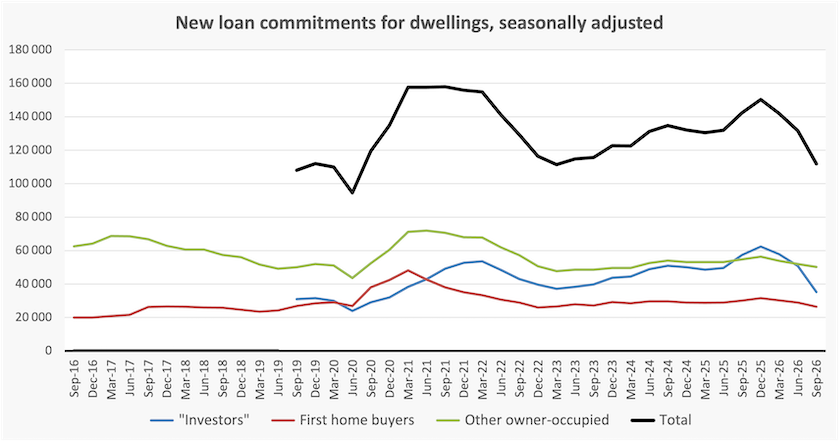
The big downturn has been in “investors” (blue line), and that is just what the government sought – to clear them out of the market because they have been pushing up prices, and to make room for people who want a house to live in. Those “investors” with funds to spare can put them to some use, in real investments in small business perhaps, or in Australian equities where they can share in the nation’s wealth.
As for first home buyers (red line), there has been a slight downturn in the number of loans, probably promoted by interest rate rises (the Reserve Bank is working against housing affordability) and many would be hanging out waiting for sellers to reduce their prices. There is a lag before sellers realise that the market cannot sustain the price they initially ask. Unlike equity markets, which move within nanoseconds (think of Nvidia’s share price), housing markets move slowly in a thin trade.
Unless Adam Smith was entirely mistaken, we should see some improvement in housing affordability in the near future. Some people who have bought houses in the last couple of years will find themselves with negative equity, but banks aren’t going to move in with a rush of repossessions: they have no incentive to lower the value of assets on their balance sheets. As for “investors” they may finally learn one of the basic laws of markets, that prices can rise as well as fall, and if they can remove their partisan blinkers they should be thankful that the Albanese government has made the capital gains tax system fairer for those whose assets fall in real prices.
Australians fail the Reserve Bank’s exam
Australians don’t understand how monetary policy works. For that matter does the Reserve Bank Board understand how it works?
Most Australians have flunked an exam on economic literacy – or at best have just scraped over the 50 percent mark. Only half of those who sat for the exam knew that high interest rates tend to slow down economic activity (in fact 30 percent believed that higher interest rates would boost activity and stimulate inflation). And only a quarter of Australians understood the basics of monetary policy: that is the theory that higher interest rates lead to lower inflation.
There wasn’t really an exam, but over 2025 and 2026, years in which monetary policy has been in the news, Reserve Bank staff conducted a survey of 9000 Australians to assess their economic understanding, particularly their understanding of how the RBA operates and the workings of monetary policy: Listening to Australians: A new RBA survey of the community, published in the July edition of the Reserve Bank Bulletin.
Should we be surprised by our low marks?
We know that the RBA has been raising interest rates, but we see that prices are still rising. Therefore we believe that higher interest rates drive higher prices. It’s the basic post hoc ergo propter hoc fallacy. That’s the same fallacy, unscrupulously exploited by Angus Taylor and his cronies, that the Albanese government is responsible for our poor economic performance because it has been manifest on their watch.
Those who are attuned to international developments find it hard to believe that anything the RBA does about interest rates is going to have an effect on oil prices. Iran’s Revolutionary Guard don’t check the RBA’s decisions before deciding to block the Strait of Hormuz.
Then there are personal experiences. Those who have a few thousand dollars in interest-bearing accounts know that high interest rates boost their purchasing a little.
Businesses in strong market positions – from coffee shops in country towns through to the corporate owners of electricity transmission lines – know that they can pass on a higher cost of capital in the form of higher prices – the coffee shop because of a loyal customer base, the transmission line owner because of permissive monopoly regulation.
There is the argument that when a business’s sales contract, they have to put up prices to cover their fixed costs. That makes sense. In fact, conditioned by experience in markets for software, electronic goods, appliances, airfares and cars, people generally observe that increasing demand is a precursor to lower prices.
Businesses planning to improve their productivity through new investment respond to higher interest rates by deferring the capital investment that would allow price reductions to be realized.
These reactions are observable and plausible, and they make much more sense than categorical statements in the RBA press releases about the relationship between interest rates and inflation, or their patronizing on-line “explainer” How do higher interest rates lower inflation?.
Perhaps higher interest rates do reduce inflation. That’s what you are taught if you study basic economics, in the hope of learning how the world works. In those classes one comes across models such as the Phillips Curve and ISLM analysis, relating economic activity to interest rates.
But according to the Reserve Bank’s own figures (Does it pay to study economics? in the September 2018 edition of the Bulletin) only about 73 000 Australians have degrees in economics, which means that 28 013 000, or 99.7 percent of Australians haven’t been exposed to those macroeconomic models.
Even those 73 000 graduates don’t learn much about the real world, because those models assume that “labour” is some fungible, undifferentiated commodity: occupational therapists, accountants, school dropouts, dog handlers, and nuclear physicists are all competing for the same jobs. Even more unworldly is the fact that these models are equilibrium models: they tell us nothing about the way the interactively complex system known as “the economy” reacts to the shock of a pandemic, a war, or a series of interest rate changes.
The response to such shocks may be immediate, or it may take many years. It may or not be self-correcting.
It is possible that the RBA doesn’t have a robust model of the way the economy responds to shocks: equilibrium models reveal nothing of a system’s path from one state to another.
You can gain some insight into the RBA’s lack of confidence in the transcript of the RBA Governor’s media conference following the Melbourne Cup Day decision to raise interest rates. Ian Verrender asked the Governor “You've already raised interest rates four times this year, and inflation continues to be a problem. What makes you think this time it'll work?”
The Governor acknowledged that “monetary policy does take time to flow through the economy”, but her response was vague, and it left one with the impression that the Reserve Bank has no theory or body of advice on which to draw.
It’s a serious issue, because system analysts, ecologists and engineers would see monetary policy as an intervention in a system with high gain and a slow response (think about steering an aircraft carrier or tanker), and such systems are prone to over-correction. Interventions designed to bring the system back to equilibrium, if impatiently applied, can actually drive the system into instability. Also making for instability, countering the stabilizing negative feedback mechanisms in conventional monetary policy, are destabilizing positive feedback loops, such as the way higher interest rates pass through to higher prices, described above.
There are robust models, based on the mathematics of Fourier analysis, that deal with the behaviour of complex systems over time – how they behave when subject to shock, and how the timing and strength of interventions can bring them to stability, or send them spiralling out of control if those with their hands on the controls misread the signals. It’s a core element of engineering degrees, and is quite relevant to monetary policy. But to what extent are these models incorporated in the Reserve Bank’s way of thinking?
It is notable that the RBA’s 9 member Monetary Policy Board comprises only economists: 12 hold undergraduate and postgraduate degrees in economics, and 5 in business, a closely-related discipline. There is not a single engineer, for example, even though engineers are prominent in the real economy, and have learned theories of the behaviour of interactively complex systems. It’s as if whoever designed the RBA board, probably an economist, believed that the more economists the better, forgetting the law of diminishing returns, and forgetting that a lack of diversity raises the risk of groupthink.
Those 9 board members comprise the governor and two senior staff, five members appointed in a competitive process, and the head of the Commonwealth Treasury. On The Economy Stupid Peter Martin interviewed recently-retired board member Ian Harper on the processes by which the board makes its decision: What happens inside the RBA boardroom?. The procedures are reasonably predictable, but as far as Harper’s description reveals, it appears that in their briefing papers and at the meetings, the board members are presented with the bank’s recommendation as whether to raise, hold or lower the interest rate. The board members are quite capable of reading economic data and making their own judgements. Surely it would be better if recommendations were omitted, just as it would be better if the executive members of the board didn’t drop media hints about the Bank’s coming decisions.
It’s hard to imagine the executive members disagreeing with one another, leaving the five independent members with the difficult task of arguing with some of Australia’s most qualified economists if they disagree. Gareth Hutchens, in his report on the Bank’s latest interest rate rise, has a table showing the voting pattern over the last 12 meetings since voting numbers (but not names) have been revealed. The last decision was on a 6-3 majority and it’s a fair guess that it was a 3-3 decision among the non-executive members. While the dissenters probably had their individual insights, the minutes of the meeting summarize their concerns:
A minority of members determined instead that the case to leave the cash rate target unchanged at this meeting was the stronger one. These members judged that, having tightened policy in September to mitigate the upside risks to inflation, it was prudent to leave more time to assess how the 100 basis points of tightening already delivered would affect the economy. They also placed somewhat less weight than the other members on the upside risks to inflation and somewhat more weight on the downside risks to economic growth. These members expressed their concern that the economy might be near the point of entering a materially sharper downturn and pointed to the costs in terms of unemployment.
Our Reserve Bank board is ideally placed to deal with world and Australian economies as they are described in economics textbooks. But the world economy is disrupted by maniacal and bellicose strongmen, the fallout of great power rivalry, and the emergence of political populism fed by the failure of neoliberalism. Climate change is requiring a complete redesign of energy-intensive industries. The strong growth of low or zero marginal cost industries, including AI, is upsetting traditional economic models.
Australia is subject to those developments, and is dealing with decades of economic mismanagement as the Howard government wasted the income from a resource boom, while allowing the economy’s human, physical and environmental capital to run down.
We need a Reserve Bank better equipped to deal with the hard reality of an economy that doesn’t align with the textbook models.
Small business matters
Doesn’t the Albanese government realise that in Australia small business is sacred?
Discretionary trusts – an open-ended tax rort
The Albanese government doesn’t seem to understand that an Australian Business Number carries an exemption from the mutual obligation to pay taxes – an obligation applying only to lesser mortals subject to the PAYG system? No wonder the small business lobby is outraged by the government’s plan to subject discretionary trusts to a minimum 30 percent tax.
That 30 percent is in line with most workers’ marginal tax rate, explains ACOSS in its short document Private trusts are used to avoid tax and new reforms are essential for business. (In fact, it’s lower than most workers’ 30 percent marginal rate, which includes the 2 percent Medicare levy.) Small business lobbies like to convey the impression that the government’s proposal will be tough on struggling small businesspeople, but as ACOSS points out “the wealthiest 10 percent of households, with net worth above about $2.3 million, hold around 90 per cent of private trust wealth”.
A more thorough cover of the tax savings enjoyed by those small business people who use discretionary trusts is in the most recent session of The economy stupid: How the wealthiest Australians use trusts to avoid tax, where Dale Boccabella of the University of New South Wales and Tom Crowley of the ABC explain the specific mechanism and the politics of discretionary trusts. The mechanism is simple: they allow the administrator of the trust to allocate its income to anyone they choose each year, usually family members with low notional income and therefore paying low marginal tax rates. The politics are also simple: unsurprisingly complaints against the government’s proposals are coming from the small business lobbies, but the worst tantrums are being thrown by accountants and so-called “wealth managers” who do very well helping multi-millionaires establish complicated mechanisms to avoid tax. For those multi-millionaires it’s quite OK to hand over large sums to accountants and lawyers in order to avoid contributing to the public purpose. Go figure the morality behind this attitude.
There is a weak rationalisation for these privileges. The idea that small business people should enjoy tax breaks unavailable to others is generally based on an assumption that businesspeople take risks, while workers just have to turn up and get paid. It’s a long-standing and superficially attractive argument, but it falls down when one realises that workers on PAYG arrangements also take on the risk of investment in their own human capital, and in their investment in housing which is heavily influenced by their employer’s location. And of course they can be fired at any time.
Credit cards – what sort of business would use a credit card to cover predictable expenses?
Discretionary trusts are not the only small business issue with which the government has been dealing. The government was thrown off-guard when the ATO decided that it would no longer accept credit cards as a means for businesses to make tax payments. It was an administrative decision – the sort of day-to-day decision that never comes to the attention of ministers. But it was insensitive, coming at the same time as regulations that require businesses to absorb the costs of card surcharges.
Many people would have been surprised to learn that any businesses resort to credit cards to pay tax. Credit cards are an expensive source of finance, carrying interest rates between15 and 21 percent. It is understandable that some businesses with cash flow problems may have to turn to credit cards to pay an unexpected outlay, but payments to the ATO – employees’ PAYG contributions and company tax – are predictable and can be incorporated in budgets. Use of a credit card to pay a predictable expense is a sign of desperation.
It is possible that the businesses who use credit cards to pay predictable expenses are trading when insolvent. Or some businesspeople may be using rewards cards, the cards with the highest interest rates, to extract personal benefits from the business.
Those who have raised a fuss over this issue have done a disservice to small business, because they convey the impression that small business is dominated by amateurs who cannot budget for their predictable expenses, and are paying far too much for finance. That impression is a warning to the wider community that one should be very cautious when supplying goods and services to small business, and should be extremely wary about paying a deposit for services.
But according to an informative article on the Law Society website that explains the issue in its widest context, only 5 percent of small businesses use credit cards to pay their tax bills: Some small businesses are paying tax bills with credit cards. What will happen when they can’t?. They remind us that “most businesses remain financially resilient. The evidence points to concentrated financial pressures, rather than an economy-wide, small-business crisis”.
These complaints about ATO payments follow on from the fuss about the prohibition on credit card surcharges, which has resulted in the government being forced to apply a cash acceptance mandate to supermarkets and motor fuel retailers. This means that late night servos stand out as bait for thieves, putting the lives of employees at risk. Another case of the small business lobby doing a disservice to its constituents.

There is no reason businesses should hold cash. Using cash involves extra security and insurance costs, the cost of the labour-intensive activity of reconciling cash registers, cash-laden trips to bank branches, and personal risk to all involved.
The only understandable reason businesses would knowingly bear all those costs and physical risks is to keep revenue off the books, for money laundering or tax evasion.
Some offer the pathetic justification that cash is required in remote regions. There are some places out of cellphone cover, but businesses in truly remote regions can use satellite services. The sign alongside, in an outback hotel, reminds us that remoteness is a hard excuse to take seriously. Perhaps there is the occasional outage, but businesses in remote regions who are so distrusting of their customers that they cannot cope with short outages by writing IOUs should have no place in the bush.
Small business lobbies should stop defending the indefensible, because they are contributing to an idea that small businesses are rough outfits, dominated by tax evaders and people who are so incompetent that they cannot prepare a short-term budget.