Politics
A Liberal is rebuked for talking about policy
Liberal Senator Andrew Bragg has upset his party bosses, presumably because he exposes the party’s neglect of public policy.
Senator Andrew Bragg really annoyed his Liberal Party bosses when he put forward policy ideas at his National Press Club address (YouTube, Transcript). Colleagues in his party accused him of “going rogue”; Angus Taylor rebuked him for not adhering to the “party view”, and 2GB shock jock Mark Levy urged Taylor to sack him.
There are many reasons he might have upset the party establishment. Perhaps it was simply for bringing policy into the political debate: Taylor’s political model is to maintain the Liberal Party as a policy-free zone, choosing instead to rant about the “rotten Labor government”. Perhaps it was because Bragg commenced his speech with an acknowledgement of the traditional owners and went on to celebrate our “flourishing multicultural character”. Perhaps it was about his statement “People want authenticity. They are over the spin”, and his criticism of those who “start a culture war”. Perhaps it was his guarded hint that we may need a “slightly bigger state” to cope with what the world has thrown at us. Perhaps his detractors have never forgiven him for respecting Aboriginal Australians, and his refusal to join in Dutton’s disgracefully deceitful campaign against the Voice.
The media focus has been on his statement about housing standards – covered in last week’s roundup – and his suggestion that Australia should set a net overseas migration target of 180 000, coupled with his mention of working holidaymakers as a category to be cut. That has not gone down well with the National Party, and it is far from clear why cutting that category would ease housing pressures. It has given the government the opportunity to hint that they might do the same, and has confirmed that the public argument has degenerated into the political impression created by a number, rather than a discussion about population policy.
There is much more in his speech than these two issues. Former Liberal Attorney General George Brandis, in his article While Liberals shoot their messenger, Labor squanders its chance for brave reform, comes to Bragg’s defence:
Bragg said nothing that should not be part of a serious discussion about policy options for the years ahead, at a time when the public has seldom been more pessimistic about the future, and Australia’s economic performance – most alarmingly reflected by the accelerating decline in productivity – has seen us fall from high on the OECD league table to towards the bottom. If now isn’t the time to challenge status-quo thinking, it’s hard to think when is.
In his speech Bragg comes across as a social liberal and as a hard-line defender of unregulated or lightly-regulated markets, but tempered with Menzies’ more pragmatic political philosophy.
He engages in all the usual partisan excesses in criticizing the Albanese government. If you were to accept his portrayal of the government you would believe Albanese is running a cabal of corrupt unions and industry superannuation funds. Bragg engages in the usual post hoc ergo propter hoc arguments, asserting that because some economic indicators went in the wrong direction after 2022 it’s all Labor’s fault.
It’s unfortunate that he has adopted that style, because it detracts from the instances where he makes a few reasoned criticisms of government policies, such as the 5 percent deposit scheme for home buyers and its neglect of fuel security.
He is a fiscal hawk, suggesting unrealistically that Commonwealth spending can be reduced to 23 percent of GDP, as it was during the Hawke-Keating government. In view of fundamental changes in factor costs and productivity (the “Baumol” effect), and population ageing, we now need a relatively larger public sector than we did thirty years ago just to sustain the same level of services. Few in the Liberal Party want to acknowledge this basic point of fiscal arithmetic.
But unlike those in his party who naively believe that fiscal management is all there is to economic policy, he understands the need for structural reform – a need the indolent Howard government ignored over its wasted 11 years in office. Bragg writes:
We need economic reconstruction to get Australian enterprise moving again to regain our competitive position.
The calcified, anti-competitive economy is a huge problem. Baked into this is a model of low productivity, high inflation, cronyism and redistribution, not growth.
Even though he fails to acknowledge the part played by a succession of Coalition governments in contributing to this situation, it’s a valid point.
Below that level of generalisation, however, he’s weak on detail. He goes along with the Coalition line of eulogising small business. He fails to acknowledge the government’s Future Made in Australia or its work towards decarbonising the economy, but at least he doesn’t engage in the Taylor-Canavan-Hanson assault on renewable energy.
He has some silly ideas on superannuation, such as allowing those with self-managed funds to borrow to finance investment: surely he knows what happens when naïve investors become over-leveraged.
When he refers to industry superannuation funds he is wildly off mark, because he suggests they have been responsible for high costs. In fact, because of their low cost structure, they have brought a discipline to competing private sector funds. It is possible that his dislike of industry funds stems from an ingrained anti-union bias – a bias often seen in politicians of the right who don’t understand unions’ positive role in a market economy.
But at least he is putting ideas into the public arena, and if Taylor and Canavan find that threatening, they should hand over to those who have some understanding of and passion for public policy.
That pathetic “bipartisan” gambling legislation
When it came to the vote, party loyalty dominated, but five brave Coalition Parliamentarians voted against the bill.
As the Prime Minister stated, the gambling bill as passed by Parliament struck a “balance”. That is a balance between the financial interests of gambling firms, the interests of ridiculously overpaid and privileged sports administrators, and the business fortunes of a few struggling free-to-air media so desperate for funds that they have turned to the gambling firms.
The bill passed the House of Representatives, in a 96 to 9 majority. Those 9 were:
Independents: Kate Chaney, Helen Haines, Monique Ryan, Allegra Spender, Zali Steggal, Andrew Wilkie.
Green: Elizabeth Watson Brown
Liberal-National: Andrew Wallace
National: Pat Conaghan.
The other independents – Nicolette Boele, Andrew Gee, Dai Le, Sophie Scamps – and Centre Alliance MP Rebekha Sharkie are not recorded among the 96 who supported the bill. Nor is Bob Katter on the “ayes” list.
In the Senate the Greens and David Pocock voted against the legislation. Also three Coalition Senators – Alex Antic, Andrew McLaughlan and Paul Scarr – voted against the legislation. (Note that Antic, unlike McLaughlan and Scarr, would be regarded as one of the Coalition’s most conservative parliamentarians.) All four One Nation Senators voted for the legislation.
In both houses all Labor parliamentarians meekly voted for the legislation.
A refreshing rural voice
Landholders allying themselves with One Nation and Coalition anti-renewable campaigns are giving farmers an undeserved bad name.
Anyone reading the mainstream press would believe that Australian farmers are a bunch of ignorant thugs.
They’re not: they’re some of the world’s cleverest at growing food and fibre in very tough conditions, and they have a respect for the life systems that sustain them.
But the negative image is perpetrated by journalists who pick up stories from rural yahoos, such as those who claim that farmers need more than ten firearms to run a farm (The actual number is two or three – an accurate rifle for control of feral pests, a pistol for the ghastly task of euthanizing stock and maybe a shotgun for croppers and orchardists.)
Then there are the Coalition parties, beholden to the fossil fuel companies, running on an anti-renewable energy platform in the buildup to the Victorian election, claiming that they represent the interests of farmers.
The Victorian Opposition has promised that if elected it will scrap the VNI Transmission project, a vital link that joins the New South Wales and Victorian grids. They acknowledge that this will cause a shortage in power supply, but they would fill that gap by investing in more gas and extending the life of coal-fired stations, while denying the fact that this would result in higher electricity prices.
The claim is that transmission lines take up good agricultural land. That’s rubbish: the towers have a small footprint and are well spaced: towers for a 500 KV line are typically 500 meters apart. Stock can graze under them, and crops can be planted around the towers, in the same way that farmers isolate rocky outcrops unsuitable for crops. Some farmers also complain about the aesthetics of power lines, panels and wind turbines – somewhat hypocritical coming from those who cleared the land.
A more likely explanation is that the complaints are coming from a small number of very well-off farmers whose prime concern is to help the Coalition win office, and who have no concern for the regions in which they live. The communities may be poor, and stand to benefit from the employment and business opportunities offered by renewable energy, but to the squattocracy that’s a disadvantage: they don’t want their bucolic paradise overrun by the riff-raff working class. There is still an attitude ranging from hardscrabble sovereign citizens through to farmers with huge holdings, that ownership of land is a title granting unlimited rights, rather than a licence to use the land for certain purposes.
As for the Coalition, they know that One Nation is running on an anti-renewable platform, and they want to claim that political space for themselves.
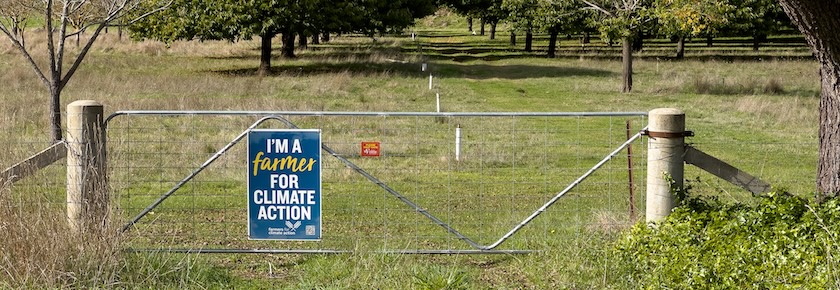
These rural loudmouths represent only a fringe of the farming community. Business-like farmers know that climate change is here, that their industry is the first casualty of global warming, that they can do their own part in reducing their environmental footprint, and that they can become profitable partners in helping to reduce the community’s dependence on fossil fuel and in driving down electricity prices. They’re not “woke” tree huggers, or socialists: they’re serious businesspeople who would probably vote for a centre-right party if there were one worth supporting.
You can hear one of them, Anika Molesworth, from a sheep station near Broken Hill, describing on the ABC’s Year that Made Me how she helped her farm adapt to the challenges of climate change and recounting how she became a strong voice for farmers calling for action on climate change, as director and co-founder of Farmers for Climate Action.
Confessional politics
The involvement of Catholics in Australian politics.
Australia enjoys the good fortune of Section 116 of the Constitution, which effectively entrenches a separation of church and state. In fact pre-federation attempts to establish the Anglican religion (then the Church of England) fizzled out under pressure from Catholics, Methodists and others.
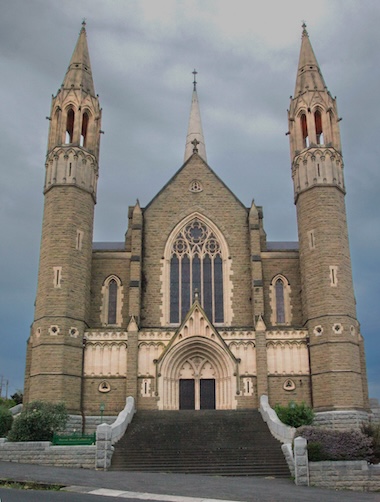
Bendigo
Similarly we have never had ostensibly confessional political parties – that is, parties defined by religious identification, such as Europe’s Christian Democrats. But as political parties developed in the late nineteenth century and in the first half of the twentieth century, Catholics gravitated to the Labor Party, while others were more likely to vote for parties on the right.
That is, until the 1950s, when the Labor Party split, with religion as a major contributing factor.
The Democratic Labor Party (DLP) was a breakaway party from the Labor Party, led by conservative Catholics, opposed to a supposed influence of communism on the Labor Party, but more basically opposed to the liberal and secular path the Labor Party was taking.
The DLP had a 20-year lifespan, from 1955 to 1974, when it lost its last Senate seat in the double dissolution election in that year. Its only achievements over that time were to deny office to Labor by using their Senate numbers and to secure federal funds for Catholic schools – an arrangement that has gone on to do terrible damage to the idea that education should be “compulsory, secular and free”.
Since then it has been a reasonable assumption that Catholics are no longer involved in politics as a movement trying to manipulate parliamentary representation.
But even though their numbers have fallen away, there has been a resurgence of Catholic political activism. We learn, through the operations of the New South Wales Independent Commission against Corruption, that there is a Catholic group known as the “Reformers” trying to stack Liberal Party preselection for next year’s state election.
Even more strangely it seems that although he is from the National Party, not the Liberal Party, Matt Canavan has had his hand in this putsch. It has come to the attention of ICAC because it appears that money for Catholic schools, contributed by parents and governments, has somehow found its way into Liberal Party preselection campaigns. The sordid story is in Karen Barlow’s Saturday Paper article “You must use all means possible”: how Matt Canavan sooled the Reformers on Liberals.
A history of Catholics in politics
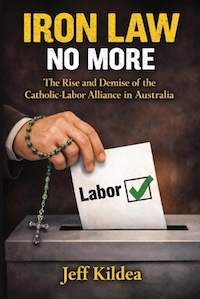
The longer story about Catholics in politics is in Jeff Kildea’s book Iron law no more: the rise and demise of the Catholic-Labor alliance in Australia, which he discusses in an interview on Radio National: Catholics and Labor: is the long affair over?
Kildea takes us through a history of Catholics and their political allegiances. Looked at from the perspective of class, it is hardly surprising that in Australia’s early days, when Catholics tended to be working-class from Ireland or of Irish descent, that they should have voted for the party of the left. But there were other reasons: he mentions issues around conscription and Irish nationalism during the 1914-18 War. He mentions the social morality of the 1891 papal encyclical Rerum Novarum that was to have such a strong effect in shaping Labor’s policies. Australia’s Cardinal Moran interpreted Rerum Novarum as support for workers’ rights, but not as an endorsement of any form of socialism. Many Catholics seem to have gone along with the right-wing conflation of socialism and communism, which is possibly another reason they threw their support behind the Liberal Party in the Cold War era.
Maybe that explains Catholics’ drift to the right as Kildea suggests. But there was also a shift in how Catholics saw themselves and as others saw them when Jack Kennedy was elected US President in 1960. Gone was the image of the beer-swilling poor Irishman. Suddenly it was OK for Catholics to be part of the glamorous establishment.
Kildea goes on to suggest that conservative Catholics were probably attracted to John Howard’s emphasis on “family values”. No doubt he is right, but did this have anything to do with morality, or was it about the attraction of socially conservative people to a socially conservative figure like Howard? After all the message in “family values” is that one’s concerns and affections should be directed to the immediate family – those inside the white picket fence – while they can ignore the conditions of those outside the fence. The poor, the old, the disabled, the downtrodden, the refugees, the victims of racism. It would be hard to find a moral philosophy further removed from the teachings of the Christian New Testament than the authoritarian creed of “family values”.
Kildea’s discussion is mainly about Catholics of Irish descent. But the Catholics of today are just as likely to be of Italian, Filipino, Vietnamese, or some other descent. If their religious faith is important to them, they will probably be inclined to friendships and alliances with those of other Christian and even of non-Christian faiths. And their political attachments can be anywhere – from anti-MAGA movements in New York, headed by the Sisters of Charity, through to the grotty manipulations of New South Wales politics.
Market freedom day
Look forward to September 12, when you can devote the rest of the year to the public purpose.
You may have missed it, but Matt Canavan declared May 9 this year to be “Tax freedom day”. It’s based on an American idea that because taxes make up X percent of one’s income, for the first X percent of 365 days you are working for the government. After that you can go on to work for yourself, “and your family” of course.
“Working for the government” is based on the idea that the government is some irresponsible and unaccountable monster, rather than as an agent of the collective interest and the custodian of the common wealth.
Canavan’s May 9 is based on his assertion that taxes take up a third of our income. In fact the actual figure on taxes is 29.9 percent according to the OECD, not 33.3 percent. We’re one of the most lightly taxed of all high-income developed countries.

Even if it were 33.3 percent, that would place his day at 2 May, not 9 May.
Let’s look at this concept through a more morally defensible framework.
If taxes are only 29.9 percent of our income, that means for 70.1 percent of the year we are working for our own selfish interest – nothing wrong with that. That takes up to day 256, or September 12, which is the day when for the rest of the year we are working for the public purpose, a noble task in any healthy commonwealth.
It’s coming up soon – perhaps we should call it “market freedom day”.