Housing
Alan Kohler on housing and interest rates
Short-term thinking about interest rates distracts us from considering the cause of mortgage stress. Kohler explains that the root of the problem is traceable to unsustainably low interest rates in the pre-pandemic years.
“We seem to have flipped from worrying about rising house prices to worrying about falling house prices” writes Alan Kohler in his post High interest rates are here to stay, but that’s only part of the house price story.
The first part of his post rebuts partisan framing of news about house prices – press reports that this dreadful Labor government is destroying your wealth because house prices are falling. They are indeed falling in some regions: Cotality data reveals that in July house prices fell in Sydney, Melbourne, Brisbane, Adelaide and Canberra. Over the last twelve months house prices, averaged across all capital cities, have just matched CPI inflation.
Kohler puts these figures into the perspective of the longer-term boom in house prices: even if there were a ten percent fall in house prices, they would still be overpriced in comparison with prices three, five, ten, twenty or fifty years ago.
And as is often pointed out in these roundups, a change in the market value of your house is close to meaningless. It’s an asset you rarely turn over, and even if you do sell – upsizing, downsizing or moving – you’re probably exchanging in the same market. Only if you’re about to die or emigrate may the market value of your house have some real meaning.
It would not be surprising if media predictions of a significant fall in house prices come to pass, particularly in our most overheated markets. Rising house prices create their own positive feedback loop because the fear of missing out stimulates demand. So too do falling prices create a mirror-image positive feedback, because fear of buyer’s remorse prompts house seekers to hold back until they believe the market has stopped falling.
The other part of Kohler’s article is about the likely endurance of high interest rates. He’s referring not to speculation about the Reserve Bank’s interest rate decisions to the end of the year, but to the longer term.
His reasoning is best explained with three graphs, showing the history of interest rates so far this century.
The first graph shows the Reserve Bank cash rate target – that is the rate set by the Bank, which it decided to leave on hold at 4.35 percent last Tuesday.
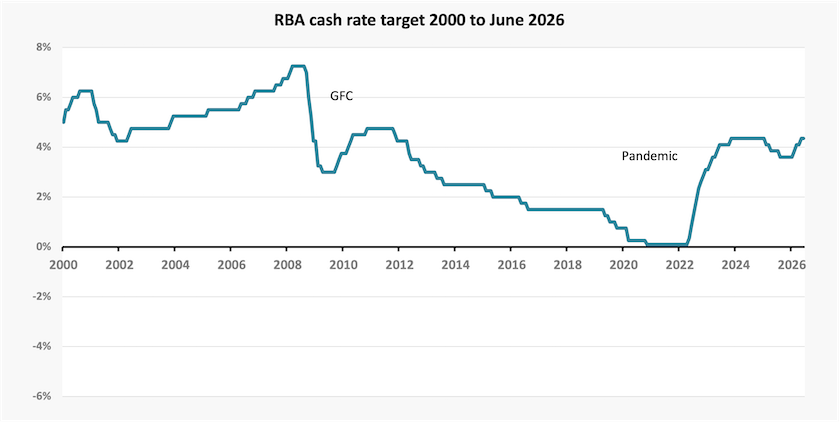
In fact, by comparison with the rate in the years leading up to the 2008 global financial crisis, the present rate of 4.35 is not particularly high. If we go back a little further, to the early years of the 1990s, the cash rate was between 10 and 17 percent, but that’s all part of a longer story to do with a global long-term decline in the return to capital.
It can be seen from that graph that the RBA responded quickly to the GFC, probably overshooting. It then raised the interest rate, and over the next ten years slowly lowered the interest rate as the economy failed to get back to its pre-GFC growth rates. Then the pandemic hit, to which the government responded with a massive fiscal stimulus, overheating the economy, to which the RBA responded in turn with rapidly rising interest rates. The rest is recent and well-known history.
An account of interest rates unaccompanied by any account of inflation is an incomplete story, because the Reserve Bank’s interest rate decisions are largely in response to inflation – or at least to inflationary expectations.
In judging the impact of interest rates, inflation counts, because in terms of the cost to borrowers the most important consideration is what economists know as the real interest rate, or the interest rate after accounting for inflation. In simple terms, if you borrow money at X percent a year, while general inflation is lifting your nominal income by Y percent a year, your real interest rate, representing the burden of repaying your loan, is X – Y percent.[1] Similarly if you’re a lender, what counts is the return after inflation: if your loan is earning 4 percent interest and inflation is 5 percent, your real return is minus 1 percent. You would be going backwards. You want a return that preserves the real value of the loan you have made, plus a reasonable real rate of interest.
As can be seen in the graph below, inflation, as indicated by the CPI (an inaccurate indicator of inflation but the main one used by the Reserve Bank) has been up and down over this century. We can largely ignore the jump in the CPI at the beginning of this century: that resulted from introduction of the GST, for which most consumers were compensated, but the big jump relates to the pandemic. Too much cash was injected into the economy in programs like “Jobkeeper” while the pandemic constrained the economy’s supply. The inflationary response was straight in line with the textbooks.
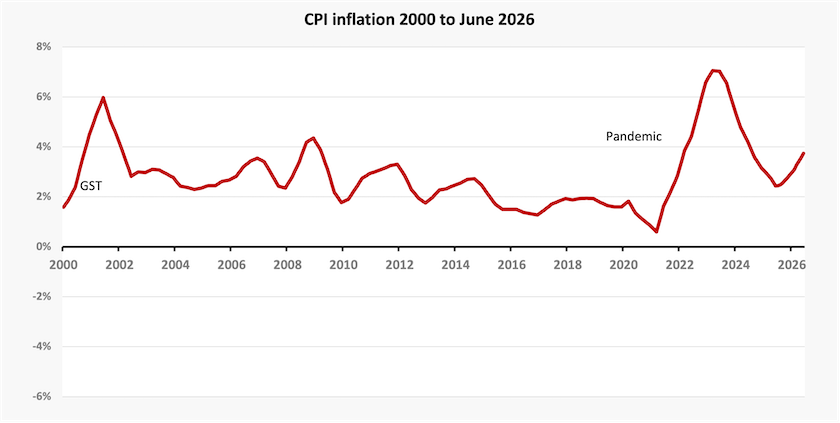
There are partisan comments on this history from the Coalition, its right-wing fellow-travellers, and the Murdoch media, but in terms of macroeconomic policy it is doubtful if any government would have pursued a significantly different path of monetary and fiscal policy in the post-GFC years and in response to the pandemic.
When we combine the interest rate series with inflation, we get a rough picture of the real interest rate, the green line, shown in the graph below.
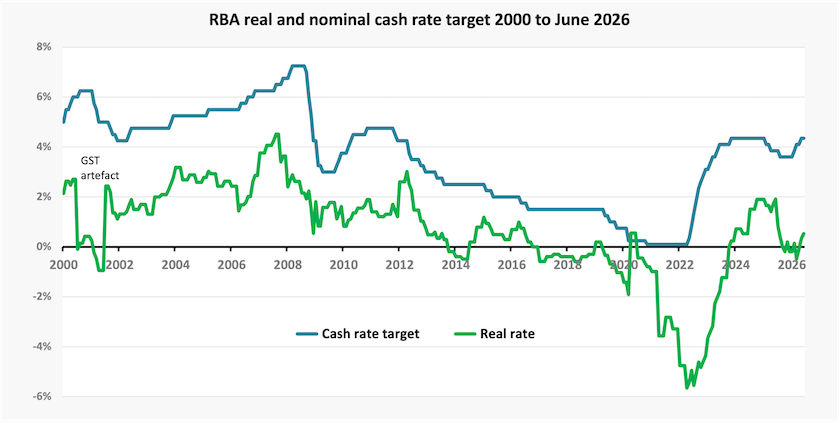
The most significant part of this story relates to the five years leading up to the pandemic, and to the time of the pandemic, when real official interest rates went to zero and then became negative as inflation picked up. Of course people’s borrowing rates for mortgages and consumer credit were several points higher, but the point is that it became easy to borrow – probably easier than it had ever been – and people did borrow, particularly to buy real-estate, and the fear-of-missing-out feedback boom kicked in, pushing up real estate prices and the amount borrowed as mortgages. No wonder the rise in interest rates has been painful for those borrowers.
That’s the problem many heavily-indebted households are living with. People see it in terms of high interest rates, even though they are not particularly high by historical standards. The real cause of the problem is the run of unsustainably low interest rates.
Many are hoping that interest rates might fall, but the Reserve Bank in its latest Statement on Monetary Policy suggests that the best one could expect is for a 0.1 interest rate percent reduction in two years’ time.
A likely path, barring another major economic disruption, is that the Reserve Bank will seek to return the real rate to around 2 percent as it was early in this century. If CPI inflation comes down to 2.5 percent – the mid-point of the target band – that would imply maintenance of around a 4.5 percent nominal rate. That’s seems to be the reasoning behind Kohler’s statement:
In general, though, the days of super-low interest rates that characterised the decade from 2012 to 2022, and which pushed house prices up by 60 per cent, are over — unless there is another GFC or pandemic.
The full story of that period – indeed the whole 20 years since the global financial crisis – is yet to be told with any detachment. It is still too recent to be told in the same way as we talk about the 1930s Depression, for example. Kohler’s account is a welcome attempt to get us thinking in that longer term.
1. It’s a little more complex, because the actual equation is Real rate = ((1 + nominal rate)/(1 + inflation – 1), and it should refer to inflationary expectations rather than inflation as currently estimated.↩
Who owns the house you live in?
Incautious interpretation of data leads us to overestimate the proportion of adults who own the houses they live in.
Do you recall that question on home ownership in the census you filled out last week? It asked whether you owned or rented the house you live in, didn’t it?
No, it didn’t ask about whether you owned or rented the house you live in. It asked about the house. It asked if it is owned outright, owned with a mortgage, rented and so on.
If you were answering this question as a couple sharing a life or as a single person, your answer would have indicated whether you were a house owner or renter. But what if you were a 25-year-old, living with mum and dad, if you were grandma, or any other adult in the house? You may be living in an owner-occupied house, but it isn’t yours.
The ABC’s Gareth Hutchens deals with this question in his post Are you really a “home owner” if you're living at your parents' place?. At first sight that might appear to be a bit of statistical semantics, but in fact he alerts us to a bias in the way we interpret home ownership data – a bias that feeds the idea that around two-thirds or 66 percent of Australian adults own their home. That’s a significant overstatement.
When the ABS comes to count all these responses (they’ve probably done it already), they will collate them, finding that about 66 percent of homes are owned by people who live in them. But that doesn’t mean 66 percent of adults own their home, because there will be all those adult children, grandmas and others who live in a house owned by a family member.
If we were to count all adults, asking them if they owned a house, we would get a much lower percentage of house owners – probably around 50 percent based on calculations provided to Hutchens by economist Karl Fitzgerald of the Grounded Community Land Trust. The difference is particularly strong among younger adults – “millennials” now aged 30-45.
The difference is largely accounted for by adult children, rather than grandparents and strays, and the gap has been opening up. The home occupancy rate – the percentage of homes in which their owners live – has been comparatively steady, while the home ownership rate – the percentage of adults who own the home in which they live – has been falling fairly quickly as Hutchens’ article demonstrates.
It’s little wonder that housing is the most pressing concern among young people: the regular Monash University Youth Barometer, released this week, found that among Australians aged 18 to 24, 82 percent believe that affordable housing is the issue most demanding of immediate attention from policymakers. That’s up from 60 percent in 2022.
Hutchens quotes Fitzgerald pointing out that it’s important to bring the true home ownership rate to policymakers’ attention, because it highlights the extent to which people, particularly young people, are locked out of the housing market, and it dispels the myth that about two thirds of adult Australians are home owners – a myth sustained by incautious interpretation of data.
Energy standards
The Liberal Party puts forward a creative plan to develop low-density slums on our urban fringes.
Let them wear sweaters
The Liberal’s frontbencher Andrew Bragg made housing a major theme at his Press Club address on Wednesday. In fact he spoke about much more, which will be covered in next week’s roundup.
Apart from the supposed link between housing demand and immigration (the evidence is weak), the main issue related to housing is his suggestion that the National Construction Code should be cut from more than 2000 pages to 80 pages, with an emphasis on scrapping or weakening energy standards. The Guardian’sAdam Morton covers this aspect in his article Coalition plan to scrap energy rules for new houses condemned as “cost-of-living timebomb”.
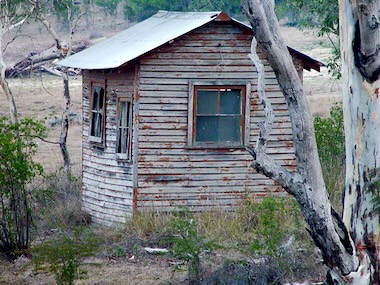
The idea is that people buying their first house should be prepared to put up with poor thermal comfort, as a trade-off for better affordability and shorter construction time. Wearing another sweater is the thoughtful advice of Liberal Treasury spokesperson Tim Wilson, forgetting that the growing problem in our urban fringes is warming induced by climate change.
Bragg’s idea is flawed on several grounds. The reasons for housing unaffordability relate mainly to capacity in the building industry, zoning, local infrastructure, taxation and monetary policy. Construction costs are a minor component, and inclusion of ducting, insulation, and double-glazing is much cheaper at the time of building than when these improvements are done as a renovation. A reversion to the 1950s period of light regulation would means that the suburban fringes where houses are now being built will probably become low-density slums in a couple of decades.
The idea that young people should be paying high energy bills to compensate for their poorly insulated houses, however, has some justification in terms of Liberal Party policy. Someone has to provide the 24/7 demand to justify those nuclear power plants!
Crime and housing
Expect a fall in the top end of the market as new laws make it harder for criminals to park their money in luxury real estate.
What would you do if you had $50 million in your bank account that you wanted to shift somewhere before the authorities become too nosy?
A luxury apartment is not a bad place to park your money. And it’s a good base to bunk down when you’re back in Australia between your business trips to London, Baghdad, Dubai and Moscow, where you’ve been helping people to overcome their problems with Australia’s nanny-state restrictions on cigarettes, firearms and recreational substances.
Because it’s your own pad you won’t be touched by those changes in property taxes, and you can be reasonably assured that it will hold its value, because there are plenty of other adventurous businesspeople like you looking for somewhere to park their money. These recent falls in real-estate prices are only at the bottom half of the market.
But that wretched socialist Albanese government has it in for you, because from the start of this financial year, the work of real estate agents comes under the Anti-Money Laundering and Counter-Terrorism Financing Act, and even if you don’t use an agent the financial crimes watchdog AUSTRAC will be after you.
Writing in the Sydney Morning Herald Colin Kruger asks What happens when crime is no longer paying for our real estate?.
The answer, according to AUSTRAC, is that prices of the properties favoured by spivs will fall, but as Kruger points out the turnover of such properties is low.