Politics
Can our government have a policy on Islamophobia?
Should a secular society have policies directed to people of particular religious beliefs?
It is now ten months since Australia’s Envoy to Combat Islamophobia, Aftab Malik, handed his report to government – A national response to Islamophobia: a strategic framework for inclusion, safety and prosperity. It has 54 recommendations for the Commonwealth government, aimed at countering Islamophobia. The report, including its recommendations, was widely supported by Australian Muslim organizations.
Much has happened in those ten months, bringing ethno-religious hatred and discrimination to our attention. Most prominent has been the murder of 15 Jewish Australians celebrating Chanukah in December. This was followed by an attempted bombing of an Invasion Day demonstration in January. And in the last few weeks Pauline Hanson has been unleashing a vile torrent of bigotry towards Muslim Australians and other immigrant groups. All the time there has been the background of unchecked socially divisive content on so-called “social media” (the old term “gutter press” is more fitting).
Within this heightened awareness antisemitism has been the prime concern, because of three developments. Chance was the main factor directing our attention: had the police deployment at Bondi been a little different, and had the Perth bombmaker been a little more competent, our concerns would now be very different (but concern for Islamophobia would still have been crowded out). Another was the way some prominent Jewish Australians, and some vocal supporters of Palestinians, conflated the Jewish religion with the policies of the Israeli government. And third was the disgusting way Pauline Hanson and Barnaby Joyce tried to turn a memorial service at Bondi into an anti-Labor rally, hoping that no-one noticed that a One Nation Senator voiced the possibility that the Bondi attack was a “false flag” operation.
It’s little wonder therefore that the government, so distracted, has taken so long to respond to the report on Islamophobia. But many are disappointed by the government’s response, announced last Saturday. The government spells out its response in a short document – Combatting Islamophobia – replete with fine words, generally echoing the findings and the sentiment of the Islamophobia report, but it’s weak on specific measures. The government’s responses generally read as the sort of initiatives public servants in education, health care and policing, sensitive to problems of anti-Islam sentiment, would take on their own initiative without the need for an official inquiry.
Australian Islamic organizations have politely welcomed the government’s response. but as Guardian reporters note, they draw attention to “one glaring omission” – or a set of omissions really – which are the more substantive recommendations of Malik’s report.
The Sydney Morning Herald’s Mike Foley summarises the areas where the government has held back:
It [the government] did not respond to Malik’s call for a ban on religious discrimination; to protect Muslims in racial discrimination laws; an independent review into counter-terrorism laws; and a commission of inquiry into Islamophobia and anti-Arab racism.
The government also rebuffed Malik’s push, outlined in his submission to the antisemitism royal commission, for a change to terrorism laws that would reduce reliance on religious and ideological motivation “as a central criterion to the offence” of terrorism.
A similar but less detailed account of the government’s response is in an ABC article by Lexie Jeuniewic, David Lipson and Keane Bourke.
At the same time the Parliamentary committee on Aboriginal and Torres Strait Islander Affairs, prompted by the attempted bombing in Perth, has an Inquiry into racism, hate and violence directed at Aboriginal and Torres Strait Islander people. Keane Bourke, who is the ABC’s Western Australian political reporter, describes how the issues raised at that inquiry resonate closely with those raised at the “Royal” Commission on Antisemitism and Social Cohesion: .
This similarity brings into question the rationale for the government having a compartmentalized approach to hate crimes, social division and the safety of those subject to attack.
The risk of separatism and exceptionalism
Older Australians are surprised to hear some witnesses appearing before the Commission on Antisemitism speaking as if antisemitism is something that suddenly became manifest after the terrorist attack on October 7, 2023.
Religious and ethnic bigotry was an established part of the Australian landscape up to around the 1960s, when religious identification and observance started to fall away. Jews and Catholics had been the main targets of unwritten but strong discrimination in employment and appointment to certain positions. And indigenous Australians weren’t even counted until 1967.
Over the subsequent years Australia quietly developed into an outstandingly successful multicultural society, by steering a delicate course between policies of encouraging assimilation and policies encouraging integration, without making much fuss about it. Racism and religious bigotry haven’t disappeared, but they have decayed, in the way radioactive elements decay. There will always be a small core, ready to be exploited by political and commercial opportunists who hope to awaken atavistic tribal sentiments. Although there is no conspiracy – there is probably no overlap between the pro-Palestine marchers and those with murderous intention towards aboriginal people – campaigns of hatred reinforce each other by giving permission for those with a cause to use more extreme tactics.
It is not surprising therefore to find a generic similarity in hate campaigns, as a team of researchers from Deakin University and the Australian Catholic University point out in a Conversation contribution: New study of 2 million online posts shows persistent anti‑Jew and anti‑Muslim hate in Australia. They avoid being drawn into the politicized arguments about who is subject to the most hatred: one cannot add up the individual feelings of fear and offence mathematically.
In view of this depressing similarity of forms of hatred, and the success Australia has had in breaking down tribal boundaries of earlier times, it is hard to understand the government’s categorization of victims, appointing Jewish and Muslim “envoys”.
An “envoy” is someone sent from one country to another. The very terminology reinforces the idea of tribalism, as Jack Waterford warned in a 2024 Pearls and Irritations contribution Albo’s envoys will entrench religious and political divisions for generations.
Much will depend on the way the government responds to the Commission on Antisemitism and Social Inclusion. There have been extraordinary pitches from some claiming to speak for Australian Jews, such as a call for a committee to oversee the ABC. A usually politically moderate Liberal Party politician has called for university courses on Middle East politics and history to be “audited” and based on “balanced” sources.
It’s hard to see where such dangerous ideas, historical precursors to the rise of Nazism, are coming from. Australian Jews, particularly those with family memories of the Holocaust, were once among the strongest defenders of civil liberties, and as students were often prominent in left causes.
A more reasonable voice is provided by former Attorney General Mark Dreyfus, who has called for measures to establish exclusion zones around schools and places of worship, and stronger take-down powers for those who are targeted by hateful social media posts. These measures can be applied to support any group suffering from hate campaigns, including Muslim Australians, without carrying any idea of exceptionalism. And they can extend to others who from time to time experience prejudice – Chinese Australians during the Covid pandemic and more recently Sikh truck drivers.
This recent categorization, involving the appointment of specific “envoys”, is within a wider context of social segregation increasingly manifest in our education system (See the post on Susan Close’s Hugh Stretton Oration,). For a long time we have had religious-based schools, but even as the country as a whole has become more secular we have seen the expansion of faith-based schools. What sort of society are we developing if a Catholic child does not mix with non-Catholics, if a Muslim child does not mix with non-Muslims, if a Jewish child does not mix with non-Jewish children?
Understandably religious believers want to see their children take on their beliefs, but most other “developed” countries, including many with stronger religious traditions, have one school education system.
The only group for whom a case for exceptionalism can reasonably be made are those whose land was forcefully and brutally occupied in and after 1788. The rest of us are recent arrivals, doing our best to live together without being singled out.
Peak Pauline?
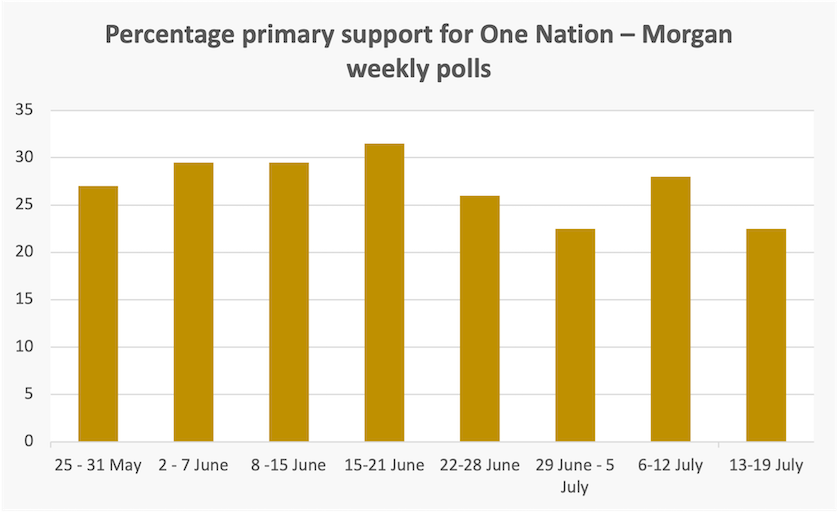
One Nation’s support is down 9 percentage points from its peak.
There is a plethora of opinion polls, but one worth following because of its regularity is the weekly Morgan poll, tracking parties’ primary support. The graphic below picks up its main message.