Education
How education relates to support for One Nation
It’s more complex, and more challenging, than you may think.
Most public discussions on education policy are about specific issues such as school curriculums, the interpretation of NAPLAN results, and funding formulae.
These are productive discussions, but it’s easy to overlook the broader context. That is the role education plays in our individual and collective lives, a role shaped by public policy – not only policy categorized as “education”, but by the whole relationship between citizens and the government they elect.
This broader approach is taken by Susan Close, former Deputy Premier of South Australia, delivering the 2026 Hugh Stretton Oration – Is education policy damaging our democracy? – recorded on the ABC’s Big Ideas program.
Her starting point is the observation that more than 260 000 South Australians, a quarter of the electorate, voted for One Nation in the state election earlier this year.
We might have expected her to go on to explain the inverse relationship between education and support for One Nation – a statistically robust correlation covered in these roundups. There’s a temptingly predictable explanation for that relationship, but she didn’t go there.
Instead, her oration is about a much wider idea of public policy, to do with the way our political systems create or work against social inclusion. Echoing the Nobel Prize-winning work of Thomas Schelling, she speaks about the tension between our individual and collective choices and the consequences of those decisions, particularly as they may result in social segregation.
A set of financial incentives, reinforced by a slow “tipping” process, has encouraged those with means to send their children to private schools, even if they have to scrape to put those means together.
This goes back many years – more than half a century in fact. Because it has developed slowly we haven’t noticed that it has given us almost the most economically segregated education system of the entire “developed world”. Most people would surely be shocked by the data she cites on school segregation, contrasting Australia with the USA, UK, France and other countries with which we often compare ourselves. Only 10 percent of American children go to private schools, and in class-ridden Britain the figure is even lower – 7 percent. We’re at 40 percent and rising.
She mentions the well-researched consequences of such segregation: children from disadvantaged backgrounds do far better in desegregated schools than in schools where they associate only with other children from similar disadvantaged backgrounds.
The consequences go beyond differences in NAPLAN tests and indicators such as progression to Year 12 – serious as these may be. She reminds us that education segregation, manifest in clearly visible ways (even the quality of the buildings), has contributed to a large number of people feeling excluded, aggrieved, and resentful at the poor deal they have been given. She asks:
Can a vote for One Nation be read narrowly as anger at the education system? No of course not. But I think it must be read in part as exhaustion with a failed promise of the neoliberal approach to residualizing public services to be not quite good enough for those who cannot afford private, whether that be education, health, aged care or retirement incomes.
She understands the individual choices people make – people make tremendous sacrifices for their children – but she warns about the consequences if we continue on the path we have taken, and asks:
Do we have the courage to recognize that a radical reset is required before something more radical and darker is forced on us?
She asks the audience at the University of Adelaide, and the audience tuning into ABC podcasts:
Are you prepared to give government the instructions and the permission to make drastic and possibly expensive changes? Permission does not mean abstract approval. It means tolerating redistribution that does not benefit your household directly. It means resisting the instinct to seek individual escape where collective repair is required and it means voting not only for fairness in theory, but for the budgets, compromises. and discomfort that fairness demands.
Her oration is non-partisan. Both of the traditional parties have done their part in shaping our extremely segregated education system. (See the following post “Rich kid, poor kid” for a policy history.)
Perhaps time is on her side, and on Australia’s side. These roundups have drawn attention to shifting public opinion, suggesting that Australians, particularly younger Australians, are becoming more in favour of greater government involvement in crucial areas such as health and education. Not a socialist revolution, but a conservative reversion to a society that was more prepared to contribute to the public good.
Just this week the Australia Institute has published the results of a survey confirming that most Australians believe public schools are underfunded (and that private schools are overfunded): Chronic underfunding is driving the exodus to private schools.
As part of the survey parents with children in private schools were asked if they would have enrolled their children in the public system if their local public school were better funded. In response 38 percent said they would, and 21 percent weren’t sure. In view of the high and rising fees charged at private schools, paid by young families during their financially toughest years, it’s a reasonable assumption that most of these people should be comfortable paying higher taxes to fund public schools.
At the same time, however, there is a widespread political assumption that no-one is prepared to pay more taxes, and one party at least, a party with little understanding of the social wage, is promising smaller government and lower taxes, indifferent to the dangers of continuing on the neoliberal path.
Rich kid, poor kid
Our socially segregated school system results from decades of poor policy decisions by Labor and Coalition governments.
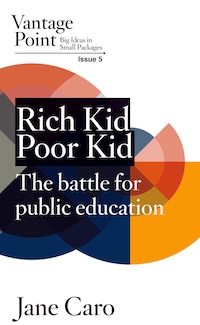
That’s the title of a book by Jane Caro – Rich kid, poor kid: the battle for public education”, described in a review by the Guardian’s Caitlin Cassidy as
… a scathing critique of Australia’s longstanding support for private education and the notion of choice to the detriment of our public schools, where enrolments are at record lows.
In a Conversation contribution – Australia’s frighteningly unequal funding system favours private schools, argues Jane Caro. How can we fix it? – Elisa Di Gregorio of Adelaide University provides hard figures on the inequities of school funding, and summarizes Caro’s work.
We got to this point of extreme segregation in a series of decisions going back to the 1960s – decisions made by Coalition and Labor governments. Prior to the 1960s, school education was purely a state matter, bound by the understanding that school education should be uniform, compulsory, secular and free.
Your taxes at work
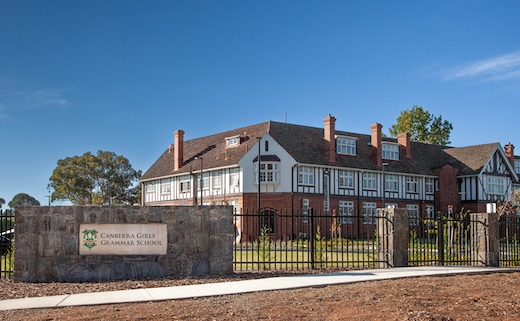
Di Gregorio reminds us that as a result of public funding arrangements, “over half of Australia’s private schools now receive more combined government funding per student from both the federal and state governments, than similar public schools”.
We’re not the only country to subsidize private schools, but the conditions of that funding are extremely generous. For example in most countries governments prohibit or cap extra fees charged by private schools and subject private schools to other conditions, but our public funding is largely unconditional.
She mentions the promise of the 2011 Gonski Review, that recommended a fully needs-based approach to funding. But the Gillard government’s “no school will lose a dollar” promise thwarted its implementation. As the number of children in private schools has grown, Labor governments have become more fearful of reform.
Di Gregorio considers Caro’s suggestions for reform to be modest, constrained by what is politically possible. They involve “reconsidering private school tax exemptions and having all schools that receive public money subject to the same standards and compliance measures”.
That political restraint is illustrated in a Pearls and Irritations contribution by Trevor Cobbold, a long-time campaigner for public education. His article, The private school sweetheart deal should end in 2029 – is about a Commonwealth program known as the Choice and Affordability Fund, introduced by the Morrison government in 2018, described by a Liberal state education minister as a “slush fund” at the time. The program is due to expire in 2029 – it was only intended to be a transition support to help schools cope with minor changes in funding arrangements – and the private school lobby is campaigning before the Senate to have it extended.
The program itself is small, involving only around $140 million of the $21 billion the Commonwealth outlays for non-government schools each year. What is revealing in Cobbold’s article is the way the private school lobby and the Liberal Party consider its extension to be a right that needs no justification.
Morrison’s war on learning hasn’t ended
We’re all poorer when we penalize young people for choosing to study humanities.
Remember the Job-Ready Graduate scheme introduced by the Morrison government in 2011 to redirect students to courses with immediate economic returns and away from liberal studies?
Five years later, and four years into the term of a Labor government, once a strong supporter of tertiary education, the scheme is still with us, even though Education Minister Jason Clare admits the scheme has failed.
The ABC’s Evelyn Manfield reminds us that while the government has pursued difficult reforms to make housing more affordable to young people, there is still the burden of student debt for those who have paid, or are paying, more than $50 000 for degrees targeted by the Morrison government, particularly arts and social science degrees: “Failed” university scheme hurting home ownership prospects.
She reminds us that arts degrees don’t provide a path to a high income, and the burden of debt repayments goes against bankers’ assessments for eligibility for housing loans.
There has been much criticism of the Job-Ready scheme, most recently by Universities Australia, commenting on a private member’s bill (a bill that was too fiscally weak to go anywhere). Job-Ready has not succeeded in the Morrison government’s attempt to change students’ choices, but it has probably contributed to a recorded 20 percent reduction in students from low socio-economic backgrounds enrolling in the most expensive degrees, and more generally to a 3.5 percent fall in the number of domestic students commencing a bachelor’s degree. Australia is probably not on track to meet the government’s stated target of 80 percent tertiary attainment by 2050.
According to the ABC’s national education and parenting reporter Conor Duffy, it appears that the government does not intend to address the basic problems of university underfunding and the distortion of $50 000 arts degrees. But it is proposing to allocate $3.6 billion over 10 years (anything less would be a rounding error) to educate more students from low socio-economic status regions, including selected suburbs: The government is making major changes to universities. Here's what to expect.
Under the government’s proposals the most insidious aspects of Morrison’s war on learning remain.
It shouldn’t be necessary for anyone to argue the case for supporting people to take a degree in humanities or social sciences. For the individual there is little financial return to such studies, but there are significant returns to society as a whole. That is why such studies should be primarily publicly funded, certainly not penalized. That applies the basic economic principle of “beneficiary pays”, rather than the distorted and irrational concept of “user pays”.