Other economics
The economics of immigration
Research by the Parliamentary Budget Office confirms that severe cuts to immigration would be dumb, really dumb.
The politics of immigration gets frequent cover in these roundups, most recently on July 4 which included a presentation of the numbers and links to expert views. Just this week Emily Foley of the University of Canberra has a Conversationcontribution analysing the divergence of public opinion and the hard numbers: Migration is dropping, but public concern is climbing. Why?. There has been less work on the economics of immigration.
Those who have weaponized immigration for political purposes create the impression that migrants impose a load on society. But in fact, because we have a tough immigration policy, immigrants are the people most likely to make a significant net contribution to society.
The Sydney Morning Herald’s Natassia Chrysanthos writes about migrants’ fiscal contribution in an article Budget loses billions, nation in deeper debt: The cost of cutting migration. They come ready to pay taxes and are unlikely to be drawing on government services for some time. As she puts it:
The reason higher overseas migration improves federal coffers is that migrants are generally younger and arrive in Australia at working age, after most of their education costs have been covered, meaning they deliver more in personal income tax and economic activity than they cost in government spending over time.
She is drawing on a regular document that generally gets little attention, the Parliamentary Budget Office’s latest Medium Term Budget Outlook. This has a section on the long-term fiscal consequences of different immigration scenarios, ranging from a reduction of 80 000 to a rise of the same amount. Even a variation of +/- 40 000 migrants results in a +/- variation in the fiscal balance of $80 billion. Its most telling contribution is a chart on the age distribution of migrants compared with the age distribution of native Australians. Young migrants are paying for services for the aged, and for the education of the children of native Australians.
The PBO document covers much more than immigration. Its medium-term projections on fiscal outcomes are generally positive, and it isn’t alarmist about debt: “Australia’s share of debt to GDP remains low relative to comparable economies”. But it notes that state debt is growing while Commonwealth debt is stable.
On the long-term it writes “Based on current projection scenarios, the Commonwealth’s fiscal position remains sustainable over the long-term to 2069-70”. Although it isn’t explicitly spelled out, that is probably based on the assumption that we don’t do anything economically destructive, such as electing a government with the Coalition’s current set of economic policies.
The (enforced) joy of shopping
Ideological zealots who designed the National Electricity Market have forced us to waste our time shopping around, just for the sake of “competition”.
If competition is to do its work in delivering lower prices for all, it should be most effective in markets for simple commodities like gasoline and electricity. In these markets we know what we want and there is no variation between suppliers: in fact for electricity there is only one company that owns the wire to your house and actually delivers it.
But as explained in a session of The Economy Stupid, the textbook model of one low competitive price does not emerge in these markets. There is significant price dispersion. In their program – The tricks they use to stop us getting cheap petrol – Peter Martin’s guests, David P Byrne of the University of Melbourne and Megan Flamer of RMIT University, explain how gasoline and electricity markets work to the relative benefit of some consumers – those who shop around – and therefore to the cost of others.
They describe the way gasoline prices were set in one city. Every Wednesday one firm, a price leader, would raise its prices, and all others would follow. Over the next six days prices would slowly fall back. No competition law was broken, because there was no specific collusion.
It’s a clever form of price discrimination. Those who don’t even look at the pump price would fill up regardless of the day, while others, more conscious of price, would deliberately wait until Monday or Tuesday.
Electricity is somewhat different, in that there are many comparison websites, and there are complications of time-of-day charges and fixed daily charges. But the researchers found that shopping around pays off: in fact David Byrne shows almost a missionary zeal for shopping around.
It’s a pity the program lasts only 30 minutes because they only scratch the surface in consumer behaviour and competition policy.
For example, gasoline provides an example of what economists would call “informed irrational behaviour”. Some consumers consciously incur extra travel costs to avoid dealing with a garage they believe to be price gouging, even though those costs exceed the cost of dealing with the price gouging supplier. Dumb for one, beneficial for all, and confirmation that some consumers at least value the legitimacy of a transaction at least as much as the price. It breaks the individual self-interest assumption of the competitive model.
Electricity provided the example for work done for the OECD in 2008. Consumers can be divided two ways. First is between the time-poor and the time-rich. As Byrne says, many people are just too busy to shop around for cheaper electricity. Second is between those who find the task too hard because of the arithmetical complexity. If you can’t work with Excel you’re going to find it hard to shop around.
These classifications can be presented as a 2X2 matrix, shown below.
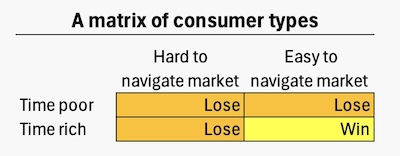
Those in the bottom right corner – nerdish retired engineers are the stereotype – benefit from markets that rely on shopping around, while others incur a “loyalty tax”.
Such a market structure does not align with our ideas of distributive justice. And in the case of electricity it has to be sustained by the cost of a sustaining a number of competing “retailers”, doing what the old state-owned utilities did at much lower cost, without having to absorb the cost of fussy customers opening and closing accounts every three months. The ideological zealots who designed our National Electricity Market forgot that competition has costs, and that in some markets those costs outweigh the benefits.
For many shopping around is one of the joys of capitalism – for clothes, holidays, cars, restaurants and other products with differentiation. But electricity – a commodity we don’t even see? As I listened to the program I was hoping one of Peter’s guests would mention the possibility or re-nationalizing electricity distribution, but time ran out.