Other politics
Abbott’s return
In electing Tony Abbott as president the Liberal Party seems to be defining itself as the natural party of opposition.
As if it has learned nothing from its long-term loss of support, its catastrophic electoral defeat last year, or opinion polls that now put the Coalition’s primary vote just a couple of points ahead of the Greens, the Liberal Party last month elected Tony Abbott unopposed as party president.
Many organizations use the presidency as recognition of past services. It’s often a role for elders whose ideas and contributions belong to another era. Abbott turns 70 next year, and it’s now 32 years since he was elected to Parliament. Australia has moved on, and so too should the Liberal Party have moved on.
But as Jason Koutsoukis writes in the Saturday Paper – “The operating wing of Sky after dark”: Inside Tony Abbott’s Liberal Party – Abbott has every intention of remaining active in shaping Liberal Party policy and strategies, and he seems to have resumed his close association with his policy minder Peta Credlin.
Koutsoukis recognizes Abbott’s strength: he has shown himself to be an effective fighter from the opposition benches. He’s a master of the three-word-slogan – “dump net zero”, “stop the boats” and so on, and at portraying a Labor government as weak, indecisive, or even treacherous.
That may be why he is welcome in a party that defines its political goal as removing Labor from office. Australia “simply has to get rid of this rotten Prime Minister and this rotten Government”, to quote Angus Taylor. Lacking its own policy platform the Liberal Party can even seriously entertain the idea of developing some form of alliance with a far-right populist movement crafting its local version of Trump’s MAGA. Any path that gets rid of Labor will do.
It could be a successful strategy if the Albanese government were truly on the nose. But it isn’t. In fact Albanese has been carefully positioning Labor as the natural party of government, a role held by the Liberal Party from 1949 until it started to fall apart this century.
People may not be very enthused about the Albanese government, but at least it seems to be trying. That’s about the best any government can achieve in a democracy like Australia. In terms of policy all the Liberals are offering are lower taxes and higher defence spending, sending the obvious message that they envisage savage cuts to health care, school education, roads, and other public services. Not an election-winning message.
Instead of attending to their policy weaknesses, the Liberals have elected a pugilist to carry on a fight. Koutsoukis quotes a former Liberal minister:
The Abbott roadshow is like some grotesque carnival of the worst elements of Australian political populism, turning the once great Liberal Party into the operating wing of Sky after dark, where no minority is safe from a dog whistle, no bias or bigotry unwelcome, and decency is banished to a back cupboard to join the one or two remaining Liberal moderates shaking nervously in the dark.
Some may dismiss such statements as grizzles from people who have had their own run-ins with Abbott, but Abbott himself is reinforcing this impression. On Thursday last week he gave a speech in London, UK, to a right-wing body known as the Alliance for Responsible Citizenship. Quadrant magazine has a transcript of that speech – We have a right to our culture – on its website.
It’s clear from that speech that Abbott has entered the culture wars – which must surely dismay those few surviving grown-ups in the Liberal Party who want to see it address economic issues. It is hard to make much sense of the speech – it seems that on this occasion he didn’t have Credlin restraining him from making the wildest and most bigoted statements, and from his selective re-writing of Australian history.
Maybe he’s making a pitch to One Nation voters. Supporting his assertion that there is a left-wing movement designed to displace Western culture, Abbott says:
In this regard, migrants from Islamic countries are especially useful, because belief in a global caliphate, and the conviction that it’s the Koran rather than the legislature that validates law, starts to make pluralist democracy unworkable. To green-left, cultural-Marxist governments, mass migration from the “global south” is not a problem; it’s the plan. It’s the way for supposedly unjustly rich countries to atone for their white privilege and to apologise to poorer ones by becoming more like them.
Who other than a hard core of One Nation supporters, could relate to such drivel?
Or maybe it’s an undisciplined stream of consciousness from someone who’s losing control of his own thinking. The speech presents a repeated theme about some left-wing conspiracy plotting evil deeds. It has the same credibility as the assertion that there is an underground paedophile ring operating out of a Washington pizza restaurant. We should pity the poor fellow who was once able to engage in some form of rational discourse.
Or maybe it’s a statement about his religious and social beliefs. Amplifying his displacement theory, which he sees in terms of an imagined “left’s” enthusiasm for mass migration, he writes:
This is done in order to dilute and eventually to extinguish the Anglo-Celtic core culture and the Judaeo-Christian foundational ethos (which is actually what attracts migrants to the Anglosphere) that today’s left-establishment finds so suffocating and judgmental.
He must have missed something in religious studies in his time at St Patrick’s Seminary, because there is no such thing as some “Anglo-Celtic core culture” or a “Judaeo-Christian foundational ethos”. The various Christian sects have been fighting wars, many of them deadly, ever since the Council of Nicea in 328. Nor does the history of Christian-Jewish relationships paint a picture of harmony.
Religious conflicts, antisemitism, and discrimination against Irish Catholics, are part of Australia’s history, and as in other countries various Christian churches have been splintering and re-aligning; in fact settler countries like Australia were magnets for dissenting religious movements. Even within Catholicism there are several sects, with radically different views on social justice, the separation or otherwise of church and state, and the reach of religious law. (Abbott, Turnbull and Albanese are all Catholics, with different views on social justice.)
Abbott’s Catholicism seem to be a long distance from the social teachings of the current Pope, Leo XIV, and his predecessor, Bendict XVI. His faith seems to be close to a stream of socially conservative English Catholicism that valorises the pre-Reformation feudal order. That’s a long way from the religious belief of Australians: only 44 percent of Australians claim to have Christian affiliation, and 39 percent have no religious affiliation, according to 2021 Census data.
But then Abbott never seems to have been wholly Australian. He has always seen the UK as the centre of the civilized world, and Koutsoukis quotes one senior Victorian Liberal who observes that Abbott “actually loves Britian more, or at least as much, as Australia”. We should remember that between 2020 to 2024 Abbott served as adviser to the UK Board of Trade: that is, he was serving a foreign government in a policy area where its and Australia’s interests are in direct conflict. And we should never forget the way he used his position as Prime Minister to thwart the move for us to have our own head of state. He makes no secret of his firm attachment to the British monarchy and to the “Australian” flag, foisted on us by our colonial masters.
Koutsoukis suggests Abbott may be making a pitch to make a comeback as Prime Minister. But when he filed his story he wouldn’t have come across that speech to the Alliance for Responsible Citizenship. It seems to put him right out of contention for any serious elected position in Australia, but it confirms his role as a culture warrior who has no affection for or attachment to Australia.
Immigration – some basic figures
Our rates of immigration and population growth are about the same as in the pre-Covid period, and somewhat lower than they were in the 1945-1970 years.
The resurgence of One Nation, and publicity given to the politics of immigration in European countries, have given an opportunity for populists to throw around claims about excess immigration.
Racist dog-whistlers, white supremacists, and those who hold conspiracy theories about a deliberate “replacement” policy, will go on scaremongering. But there are also those who see immigration as putting pressure on the housing market, and on urban infrastructure, who are trying to grapple with conflicting assertions and loosely-quoted numbers.
Writing in The Conversation – Hanson has tapped into angst about immigration, but it remains central to the Australian story – Frank Bongiorno takes us through a history about our attitudes to immigration. Our attitudes to immigration tend to fluctuate according to the state of the economy – or at least our general impression of the state of the economy. The better the economy is seen to be doing, the more open we feel towards immigrants. (In this regard the repeated talk about a “cost-of-living crisis” may be at least partially responsible for hardening attitudes to immigration.)
Drawing on the latest release of ABS population statistics, the government points out that net overseas migration is falling. The ABC’s Holly Trengenza, drawing on the same data, points out that while net overseas migration has fallen a little, it is still above the government’s long-term forecasts: Coalition claims high migration has become new normal as Australia records 300,000 new arrivals.
Those who are concerned about the way immigration exerts pressure on housing and infrastructure would do well to look at the slightly bigger picture – population growth. Although the timing of their effects may be different, native Australians having babies and new immigrants put the same pressures on housing and infrastructure.
The graph below, based on the ABS population estimates linked above, looks at the rates of natural increase and immigration over the last 20 years. That is, it looks at immigration in relation to population.
There is the obvious disruption of Covid, but it looks like we are back to a 1.5 percent population growth rate, as we were in the pre-Covid period. The gap between natural increase and immigration has closed a little, reflecting our falling birth rate.
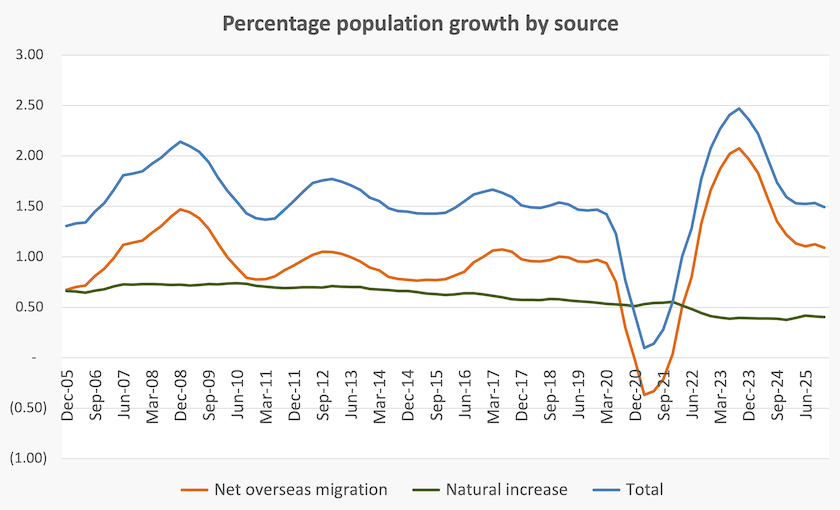
It’s hard to make long-term comparisons about immigration, but in historical terms we have probably had long periods of higher rates of population growth and immigration. We sustained a very high immigration rate in the 1945 to 1971 period. Our population growth rate over that period was about 2.0 percent (0.5 percent higher than today), and our rate of “settler arrivals” (as close as we can get to today’s equivalent of net migration) was about 1.2 percent, compared with about 1.0 percent over this century.
These clarifications and figures are not meant to imply that there is any historical “right” level of immigration or population growth, but they should put some clarity around absurdly misleading claims about immigration. So long as One Nation and Coalition politicians treat immigration as an excuse for a culture war, we are unlikely to be able to have a sensible national conversation about population, immigration or settlement policies.