Public ideas
Viktor Shvets on a world on fire
A look at the trajectory of the world economy, and at reasons younger people are turning away from established politics.
In August last year I ran a short review of Viktor Shvets’ book The twilight before the storm: how to avoid a world on fire. Last month Peter Martin interviewed Shvets on The economy stupid, drawing on the title of his book – how to avoid a world on fire.
To draw from that earlier review, Shvets, like Marx, sees the contradictions in capitalism. Capitalism’s tremendous productive capacity coexists with forces that make it economically and politically unstable. Shvets is no starry-eyed revolutionary, however: he’s a former managing director at Macquarie Capital.
In this interview he likens the present world situation to an earlier period of multiple and intersecting disruptions, namely the 1930s. This was a period when people experienced intense technological change, the growth of financialization and associated financial crises, and rapidly worsening inequality. In response people became resentful and distrusting of the economic and political system, and tended to turn away from political parties, choosing to follow strongmen who could promise to do things to achieve change – even if that involved the populist promise of offering simple solutions to difficult problems.
Shvets and Martin acknowledge the impact of the terrible wars between 1933 and 1945, and the rise of fascism and communism, but most of their discussion is about the postwar order in the western countries, and why it succeeded – more by luck rather than by consensus design.
A key element was the strengthening of state capacity, as illustrated in the New Deal in the USA and the work of postwar reconstruction in Australia. But the generation that came after, the baby boomers, did not follow through with the program. Their instincts were libertarian, and anti-government. That’s an important point, because we often see the protest movements of the 1960s as “left”, when in fact they were more about freedom from the shackles of convention and government control. That’s why many of the rebels at Woodstock so easily found their way into investment banking and other powerful institutions.
The baby boomers looked after themselves well, but they handed the next generations a lousy deal, particularly in the form of ineffective and weakened governments. That’s why those following generations are once again turning against established political and economic systems.
In this regard Shvets and Martin are joined in the studio by Gareth Hutchens – not only in his usual role as an experienced economic journalist, but also as a representative of those following generations. (Hutchens would be classified as a “Millennial”, while Martin would definitely qualify as a “baby boomer”.) Emerging from this discussion are significant differences in Martin’s and Hutchens’ world views. Both are well-educated, liberal, open-minded and highly competent economic journalists, respectful of each other’s views, but their impressions about the world in which they grew up and in which they now live are very different, confirming Shvets’ general observations. Simple terms like “pessimism” vs “optimism” don’t do full justice to their differences: it’s worth spending 30 minutes to hear the discussion. It’s also worth listening to Shvets’ prediction of the world’s coming economic threats. Spoiler: it isn’t inflation.
Mariana Mazzucato: making economics work for the common good
Governments should have a stronger role than as backups when the private sector fails: they should be working with the private sector as engines of innovation and growth.
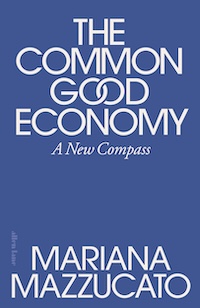
Like Viktor Shvets (see the above post), Mariana Mazzucato looks at economies in terms of major structural and technological changes, and is not bound by any economic philosophy other than a belief that economics should work for the common good.
Over many years she has had a consistent message about the important economic role government can and should play in national economies. This is in contrast to the view we repeatedly hear from the neoliberal right, that government is simply an unproductive overhead, a burden on the productive and innovative private sector.
There have been many links to her work in these roundups. Her most recent Australian appearance has been on Late Night Live, where David Marr interviews her about the opportunities presented when governments and the private sector work together to add value. Governments have generally left the economy to the private sector, intervening only when there is some form of market failure, such as monopolization. This is the orthodox theory of public expenditure, taught in schools of economics and public policy.
Mazzucato has consistently asserted that governments should take a much stronger role in the economy than simply correcting market failures. They should seek out and exploit opportunities to work with the private sector to advance the common good. She points out that governments can, and do, develop capabilities, particularly in innovation, that are not present in the private sector.
She is author of several books on economics, the latest being her work The common good economy: a new compass.
The United States’ 250th birthday – a celebration of ideas

Look past the hoopla of July 4 and Trump’s vulgarity. July 4 is actually a celebration of public ideas.
Today, 4 July, marks the 250th anniversary of the day the Second Continental Congress adopted the Declaration of Independence, in 1776, formally declaring separation of the 13 colonies – the ”united states” – from Great Britain.
We need to get our timelines straight. Although the colonists’ grievances against their British masters steadily escalated during the middle years of the 18th century, Americans tend to mark certain events, such as the Boston Tea party in 1773 (actually a minor incident), and the battles of Concord and Lexington (Paul Revere’s ride) in 1775, as the start of the War of Independence. In 1776 when the Declaration of Independence was signed the war was raging and was not going the colonists’ way. Cornwallis’s surrender at Yorktown came much later in 1781, and the United States Constitution was not ratified until 1788 – the same year as another colonial expansion was formally proclaimed 16 000 km away.
That’s a 120-word summary of events about which millions of pages have been written. For those who want to learn about the War of Independence in 12 hours there is Ken Burns’ The American Revolution available on SBS.
But July 4 is about the Declaration of Independence, the document that was to find practical realization in the Constitution 12 years later. It’s an important date because it celebrates the adoption of a set of ideas – ideas that were radical in their time. These are captured in memorable words, reflecting the strong influence of Jefferson:
We hold these truths to be self-evident, that all men are created equal, that they are endowed by their Creator with certain unalienable Rights, that among these are Life, Liberty and the pursuit of Happiness. That to secure these rights, Governments are instituted among Men, deriving their just powers from the consent of the governed. That whenever any Form of Government becomes destructive of these ends, it is the Right of the People to alter or to abolish it, and to institute new Government, laying its foundation on such principles and organizing its powers in such form, as to them shall seem most likely to effect their Safety and Happiness.
The sceptic will note these ideals were not to be realized for 189 years with the passing of the Civil Rights Act and the Voting Rights Act in the 1960s, and that the country is classified by the Economist Democracy Index as a “flawed democracy”, but the ideas have been influential, not only in the United States, but in all democracies. Within the United States there are still bitter conflicts about interpretation of the idea that all are created equal, particular as they apply to those whose ancestors were transported to the southern colonies as slaves.
These ideas are the subject of a 6-part series on the ABC, hosted by Nick Bryant, under the heading “America at 250”. (More rightly it’s about the USA at 250, because North America has been settled for about 20 000 years.)
These programs reveal and explain some strange aspects of the USA that were influenced by those ideas. For example the Constitution that gave realization to the ideas in the Declaration actually gave the president and the executive government more discretionary power than George III enjoyed, and the college system, which has led to distorted election outcomes, was designed as a protection against populism. In fact many of the leading revolutionaries had more attachment to the King than they did to the British Parliament. Many see the Declaration as an assertion of democracy, and indeed the Constitution it was to shape did lay down many democratic principles, but above all it was a Declaration of Independence, and of personal liberty. Democracy is effectively a supporting condition.
It is clear that the experience of the British in losing the American colonies was to have an effect on the way they handled other colonies, particularly. Australia.
Two sessions pay particular attention to the situation of aboriginal Americans (”Indians”) in this process. For many, perhaps most, revolutionaries, freedom from Britain meant freedom to cross the Appalachians and to take land from the original owners. Note that the gathering who endorsed the Declaration of Independence called themselves the ContinentalCongress.
The final session is due to be broadcast and mounted today. The five sessions so far are:
The beginnings of “We the people”, with Harvard historian Jill Lapore.
How royalists became revolutionaries, with political scientist Adam Smith of Oxford University,
The “violent birth of the US”, with Ken Burns.
The native American perspective, with Dina Gilo-Whitaker of California State University.
The “radical disunion” of America with Shelby Steele of the Hoover Institution at Stanford University.