Public ideas
Geraldine Doogue on the future of journalism
Quality journalism has a future, provided it meets people’s demands without compromising its principles.
Because it is so rich in ideas, carefully crafted in a disciplined narrative, I won’t try to summarize Geraldine Doogue’s Andrew Olle Lecture, other than to note that WB Yeats’ The second coming runs as a leitmotif through her presentation. She quotes from Yeats – “The best lack all conviction, while the worst are full of passionate intensity” – complementing it with a quote from Cambridge historian Christopher Clark: “It has never been so difficult to think calmly” – “yet so necessary” she adds.
She titles her presentation “Not drowning, waving” – the name adopted from a popular band in the 1980s. It’s a meaningful title, because the band’s name, and its lively music, negate the gloomy message in the 1957 poem “Not waving but drowning”.
Quality journalism isn’t drowning, but it has to adapt in a world where people are turning to media “harnessing community rage and anger”. She goes on to suggest what quality media could look like in this changed world. Some of her ideas are surprising. A hint of the tone of those ideas is in her statement claiming that we may have “reached peak individualism”.
ABC Chair Ken Williams, in his short response after the lecture notes that she has presented “stern and confronting material” about journalism.
There is a transcript of her lecture on the ABC site, but I recommend taking 50 minutes to enjoy and be stimulated by impassioned journalism by watching her presentation on ABC iVview, linked above.
The twilight before the storm, or what follows capitalism
We have a productivity problem, but it’s not the problem you probably have in mind.
Imagine someone who has had, and still has, a successful career in finance and who writes:
In economics today, the finance industry is deemed to create value, but most of the government’s activities cannot be measured and hence, are regarded as either worthless or at least something that cannot be counted.
That’s a quote from Viktor Shvets’ book The twilight before the storm: from the fractured 1930s to today’s crisis culture, how to avoid a world on fire. The financialization of advanced economies is one of the problems he identifies as facing capitalism.
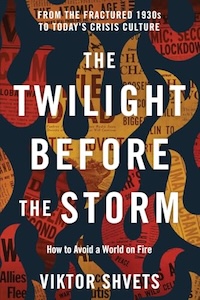
Like Marx he sees the contradictions in capitalism – its tremendous productive capacity that coexists with the forces that make it economically and politically unstable. Those forces are coming together to disrupt not only national economics, but the whole economic order.
His book was published in August last year, before Trump’s election. Although Trump gets a few mentions in the book, Shvets is writing about the movements at play, rather than any individuals or political parties.
At one level it’s about productivity – but not the way we’ve been thinking of it in our current debates. In fact just the opposite. In advanced economics, including China, the private sector is able to turn out an abundance of products at low cost, and at the same time there are unfulfilled needs for labour-intensive services, particularly in the care economy (although he beieves that many of these services will be taken over by artificial intelligence). It’s about market failure on a grand scale, resulting in a growing gap that has to be filled by government.
He believes that people in “advanced” economics are increasing ready for government to take a srtronger role in their lives. GenZ – people now aged between 12 and 28 – are expressing more collectivist values than did pervious generations when they were in that age bracket. More left in the traditional sense but not necessarily more liberal.
It's a long work, but his prologue gives a clear summary. Alan Kohler gave him a run on Intelligent Investor last year, where you will find a 50-minute podcast and a transcript, and on his own website you will find links to the five themes in his work.