Politics
Parties and their supporters
Labor and the Coalition move further apart, while polls reveal big differences in the beliefs and values of Labor, One Nation and Coalition supporters.
The parties – starting to open up an ideological space
At least one reason people are abandoning the Labor and Coalition parties, confirmed by growing support for independents and the recent surge in support for One Nation, is that people believe the two old parties operate as a cosy duopoly, and that there is nothing much to distinguish them.
That idea of similarity is disputable, but the perception is real enough. Over this year so far, however, both those old parties have been making moves that provide some separation on the ideological spectrum.
Writing in the Saturday Paper – Abbott’s plot to return to parliament – Jason Koutsoukis describes the growing influence of a tight circle on the hard right – Tony Abbott, Peta Credlin and Angus Taylor. Theirs is an ideology with some elements of neoliberalism (a belief in “small government”), some elements of fascism (authoritarianism, faux nationalism, contempt for liberalism, science and enlightenment values), and large doses of MAGA populism.
Enough of this ideological space is shared with One Nation to allow Taylor to keep the door open to tight cooperation or even a partnership with One Nation.
Economically, in its response to the budget, Taylor and the Coalition’s Treasury spokesperson Wilson have made it clear that they will defend the interests of those living off inherited wealth and the benefits of tax concessions favouring the rich. Widening inequality of opportunity, a principle normally expressed by parties on the centre-right, seems to be of no concern to the Liberal Party.
Labor, by contrast, has made much of its budget to define itself as the party of the worker, and is probably quietly revelling in the squeals of the privileged one percent objecting to their modest moves in that direction. This is not a radical shift: the Albanese government has been moving slowly in that direction since it came to office, but it is now making more noise about it.
Notably neither party has expressed much of a commitment to the unemployed.
One difference that stands out between Labor and the Coalition is the way they frame their main objectives. Taylor repeats a traditional Coalition objective of removing Labor from office (or if in government, keeping Labor out of office), as if it’s a self-evident truth that Labor is corrupt and incompetent. We don’t hear that same obsession from Labor. The Coalition, particularly the Liberal Party, presents itself as the natural party of government, in a way that Labor doesn’t.
Their voters – clearly differentiated
In last week’s roundup I drew attention to a Roy Morgan poll taken straight after the budget, which, on first reading, suggested there is a 50:50 possibility Pauline Hanson becoming our next prime minister.
Roy Morgan surveyed people not only on their voting preferences, but also asked those who supported Labor, One Nation and the Coalition why they would vote for their chosen parties. At the cost of some simplification, I summarize those distinctions below.
Labor supporters believe that “Labor is the most competent and moderate governing option”. They believe that “Labor governs for ordinary people rather than wealthy elites”. At the top of their reasons for supporting Labor they note how Labor aligns with their own values around fairness, equality, inclusion, multiculturalism and workers’ rights.
One Nation supporters are deeply dissatisfied with the major parties. They are concerned about “immigration and national identity”, and believe “Australia is in economic and cultural decline”. In fact immigration stands out as their almost overwhelmingly dominant concern, which they link to housing shortages. Many see Pauline Hanson “as an authentic and honest political figure”. She “says what others won’t”.
Coalition supporters’ dominant theme is a belief that “the Coalition manages the economy, inflation, debt and budgets better than Labor”. “Many respondents expressed strong anger toward Labor, particularly over broken promises, spending, debt, inflation and leadership”. They see the Coalition as the party that supports small business. In common with One Nation supporters, they are critical of the government’s policies on renewable energy.
Notably 28 percent of One Nation supporters and 18 percent of Coalition supporters nominate the cost of living as a “key theme”, but it isn’t a key theme among Labor supporters.
Housing affordability is a key theme among Labor supporters (nominated by 22 percent) and One Nation supporters (nominated by 28 percent), but it hardly gets a mention by Coalition voters.
Support for small business is a key theme among One Nation and Coalition supporters.
These are only short extracts from the poll’s comprehensive survey – if printed it would come to 30 pages of detailed observations. It’s well worth a look for anyone who would like to check out their assumptions about voter behaviour, and by anyone drawn to a belief that there is a homogeneous “right” in Australia.
Post-budget polls
People don’t like the budget, but they don’t see anything wrong with its specific measures.
The last federal election was a year ago, and the next one is probably two years off, but there has been a flurry of polls ever since the One Nation/Liberal upset in South Australia.
The general pattern of these polls, reported on William Bowe’s Poll Bludger, is that Labor has been losing a few points in primary vote – a trend that started before the budget and has continued since – but its TPP outcome is less affected, having sat around 53:47 against the Coalition since the start of this year.
The bigger story is the Coalition’s loss to One Nation, and some polling suggests that Labor would have a tougher contest if it were against One Nation than if it were against the Coalition.
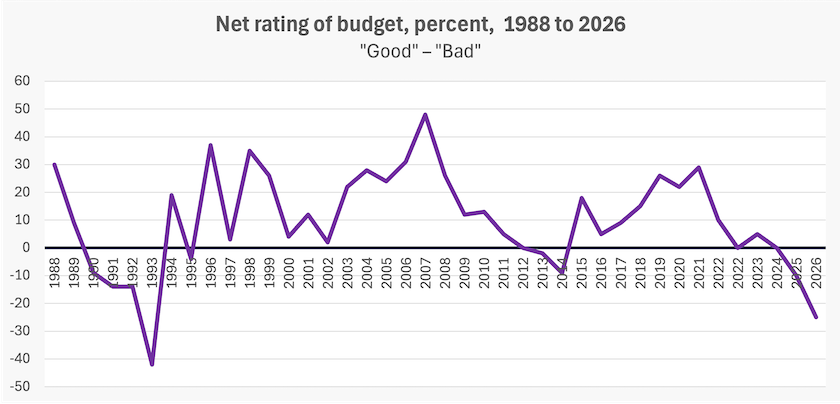
Perhaps the most striking poll, reported by William Bowe, is a Newspoll that has been running after every budget since 1988, asking people how they rate the budget in terms of its outcomes for the economy. On that score this budget rates at only 22 percent good, 47 percent bad, resulting in a net rating of minus 25 percent, the worst since 1983. But voters don’t think the opposition could do better.
The Newspoll time series of people’s assessment of budgets is shown on the graph below.
Disappointingly for the government, and for youbg people, even people aged 18 to 34 give it a negative rating (minus 2 percent) – but they certainly don’t think the opposition could do better.
Unsurprisingly those who own an “investment” property believe the opposition could do better, suggesting that the survey is picking up responses from those who confuse their personal self-interest with the health of the economy. In fact 52 percent of respondents believe they will be worse off financially as a result of the budget, compared with only 1 percent who believe they will be better off.
The more education respondents have the more likely they are to believe the budget is good for the economy, and the less likely they are to believe the opposition could do better. This, combined with the poor response from young people, suggests that the government has done a poor job in explaining its policies. Those with a good education may be able to see through the lies, bullshit, misrepresentations, sophistry, and selected data served by the opposition and its supporters among the privileged one percent, but others need more explanation about the budget measures.
The greatest anomaly in the post-budget response polls is in a Resolve Strategic poll, reported by James Massola in the Sydney Morning Herald: Labor’s primary vote slumps after broken promise budget. It surveys voters on 11 budget measures, and finds that people give a positive assessment on 10 of them, and a net zero on the other. This is shown in the graph below. (Note that on capital gains tax it mentions only the 50 percent, not indexation.)
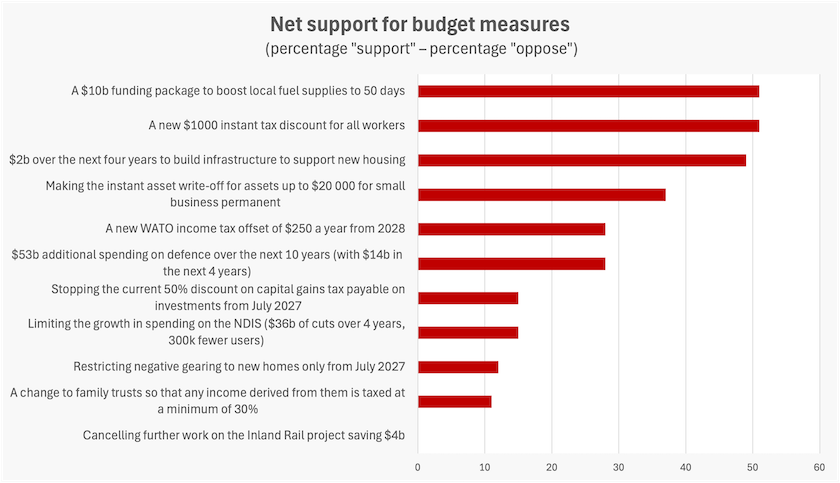
Although the instant asset write off provision, changes in capital gains tax, changes to family trusts, and changes to negative gearing, all enjoy net support, at least 42 percent report that they are undecided or neutral on these measures – again suggesting that a lot more explanation is needed, and providing a clear opportunity for scaremongers to mount their campaigns – as they have done.
It is notable that the cancellation of inland rail has not gone down well. The “small government” movement is forever talking about the need to cut spending and eliminate waste. A script writer for Utopia couldn’t have dreamed up such a poorly-planned, mismanaged and wasteful project. And how many people have any interest in a freight line from Parkes to Brisbane? Why do we worry about a railroad in the bush but are happy to endorse cuts to the NDIS.
Maybe this disappointment has something to do with people’s perception that the government, particularly the Commonwealth Government, does nothing. It spends taxpayers’ money on consultants’ studies, and makes grand announcements, but is never seen to be doing anything. The old signage that used to appear on construction projects, “your taxes at work”, may have yielded political dividends. Transport and Infrastructure Minister King would be well advised to ensure that projects are beyond “shovel ready” and can display that stuff is actually happening.
The main anomaly in these opinion polls lies in the comparison with support for the budget’s specific economic measures, and the strongly negative assessment of its benefit for the economy. You can hear SBS Political Correspondent Anna Henderson discussing this with David Marr on Late Night Live, offering possible explanations for the difference.
The polls, and the recent elections, seem to be revealing a general but undefinable malaise. People don’t like the budget, but they don’t see anything wrong with its specific measures. People want to pay less tax, but they want more – much more – spent on public goods. People increasingly report that the country is on the wrong track, but they don’t provide any idea about what the right tracks should be. We’re in for a long winter of discontent.
Immigration
The Coalition’s hard line on immigration has distanced itself from everyone except for One Nation supporters.
It’s now clear that Angus Taylor made what’s known as a “captain’s call” in his statements on immigration. That leaves Coalition politicians feeling and looking awkward when journalists ask them to describe the party’s migration policy, to explain how it differs from One Nation’s policy, and to confirm that it was made by the Coalition’s caucus.
Liberal Senator Andrew McLachlan has publicly distanced himself from Taylor’s idea of denying certain welfare benefits to taxpaying permanent residents, who are still to become citizens.
Business groups have objected to Taylor’s ideas, stressing our need for skilled labour.
Taylor’s suggestion that migrants impose a burden on the economy – that they are a “net drain” on society – is not only offensive to millions of Australians; it is also wrong. Migrants contribute far more in taxation revenue and call on government transfers much less than native Australians.
Taylor’s – and One Nation’s – idea that migration is responsible for housing shortages does not stand up to scrutiny: it is only a very minor factor adding to housing demand.
Taylor’s talk about “bad people coming from bad countries” is so blatant that it is an understatement to call it a racist dog whistle. And what does it say to those Jews in Australia who have migrated from the Soviet Union?
On housing Alan Kohler draws attention to a bottleneck that is delaying the construction of about 750 000 houses. And in any case the budget reveals that migration is on track to fall. If Taylor and Hanson are hell-bent on weaponizing migration, the government has the data which can counter their campaign.
Malcolm Turnbull, writing in The Guardian, warns that by echoing the hateful policies of One Nation, the Liberal party risks becoming a recruiting agent for extremist groups. For the most part those who turn up at anti-migration rallies are relatively harmless people, who have never quite become used to the multicultural Australia that has flourished since the Fraser government kicked away the last rotten pillars of White Australia a half-century ago. Demography will see their ranks thin.
But as Turnbull warns, there are more serious hard-line younger people, mainly men, who also turn up to those rallies. Their attachment to “White Australia” is not just a sentimental one: it’s a local manifestation of the white supremacy movement.
In response to this rising threat the government has taken the decisive step of banning the movement that now formally calls itself “White Australia” as a prohibited hate group, under laws enacted in the wake of the Bondi massacre.
While security services and the government recognize the threat from the far right, the opposition, or at least the inner circle of the opposition making overtures to One Nation, seem to have trouble understanding the links between movements on the right. They turn a blind eye to attacks on aboriginal and Muslim Australians, and to a vile antisemitic statement by a One Nation Senator. They try to blame antisemitism on the left, deliberately failing to acknowledge that Hamas, Islamic State and Hezbollah – authoritarian, intolerant of liberalism, misogynistic – are the most extreme manifestations of the global right, the ideological brothers of those who would stop immigration from “bad countries”.
A terrorist attack on an aboriginal gathering in Perth on January 26 – an attack that would have killed many people had the bombmaker been more competent – seems to have passed unnoticed. Islamophobia special envoy Aftab Malik points out that the government has been sitting on his report on anti-Muslim hate and vilification since last September.
A less-reported by-election
Stafford by-election – bad for Labor, but no gain for Coalition.
Normally a state by-election receives little attention, but such is the sensitivity around the Coalition’s troubles, and the wonderment at One Nation’s resurgence, that every opinion poll and election is being closely scrutinized.
Stafford is a state electorate in Brisbane’s inner-northern suburbs, until recently considered to be a Labor stronghold. Jimmy Sullivan won it for the Labor Party in 2024, but that was after a 6.8 percent swing against Labor. He was expelled from the party last year and died last month, precipitating the by-election.
Because One Nation did not nominate a candidate it was bound to result in a Labor-LNP contest. Even though Labor still enjoyed a 5.3 percent TPP margin, pollsters were tipping that it could fall to the LNP.
Labor held on to the seat – just – in a 51.3:48.7 TPP outcome. That was a four percent swing.
There was an 8.0 percent primary vote swing against Labor, and a 3.4 percent swing against the Greens, but only a 2.2 percent swing to the LNP. The discrepancy is explained by a Melbourne Cup field of small parties and independents who all enjoyed strong support – collectively 12.2 percent. None apart from Family First had contested the 2024 election. Full results are on Antony Green’s Election Blog.
Labor was saved by an 86 percent preference flow from the Greens, even though they had an open ticket. From the other candidates Labot enjoyed only a 34 percent preference flow.
Trends in crime
Promising data on crime victimisation rates.
Publicity around the death of Kumanjayi Little Baby and a murder involving the death of a woman and two children, has brought the issue of domestic violence to the fore.
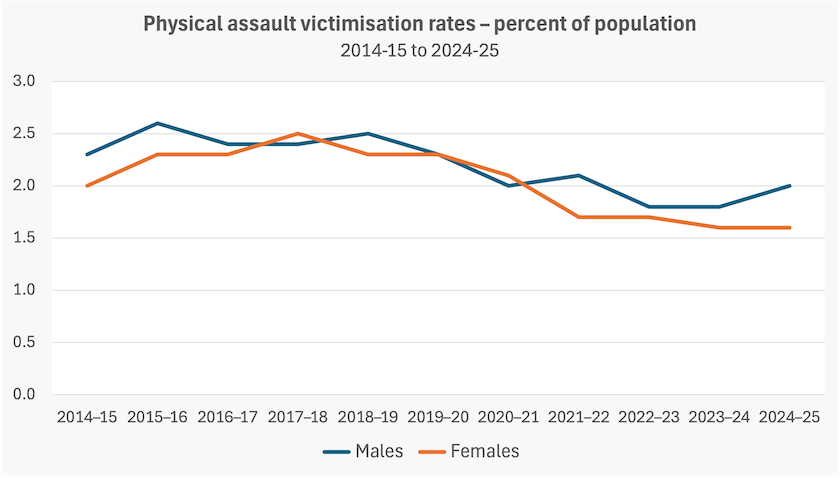
The ABS has recently released crime victimisation data for 2024-25. As with previous publications on crime, it confirms a well-established trend of falling rates of victimisation in most categories of crime. It is understandable however, that there is a focus of attention on certain crime hotspots, distracting us from this national success.
The graph below shows that for physical assault against women, victimisation rates are falling.
There are two qualifications around such data.
One is that it is generated by reports: unreported crime is not recorded. But over time moves have developed to make reporting less stressful, and even if there were an under-reporting bias it wouldn’t account for a falling trend.
The other is that this data refers only to physical assault. It does not cover other forms of violence, including coercive control through GPS tracking and financial control.