Economics
That interest rate rise
The Reserve Bank itself is raising inflationary expectations. That is irresponsible.
It’s not possible to describe the reasoning behind the Reserve Bank’s decision to lift the cash rate target, because it has no logical flow. Its press release describes an economy that’s coping reasonably well, and is experiencing some easing of demand-side pressure. Its assessment of the economy’s performance in the last half year reads:
Business investment was above expectations and consumption was below expectations. Meanwhile, growth in unit labour costs declined. More recently, the unemployment rate has been a little lower than expected and measures of labour underutilisation remain at low rates. Activity and prices in the housing market grew strongly over the past year, although housing price growth moderated somewhat at the start of 2026.
The next sentence should read something along the lines “So the Board decided to leave interest rates on hold.” And apparently four of the Bank’s nine board members were of a similar opinion.
It might have reinforced the reason for such caution by reference to the likely economic disruption caused by oil price rises, and the fall in the ANZ-Roy Morgan Consumer Confidence Index (the second-lowest level of all time). The indicators are of an economy with easing, not growing, demand-side pressure.
But that’s not the way five of those board members were thinking. Their obsession is with “inflation”, as indicated by a single number indicator. That number, known as the CPI, is of movements in the cost of a standardized basket of goods in a representative household, and that number has to be brought back to an arbitrarily-defined range between 2.0 and 3.0 percent, regardless of the way that number is generated.
The absurdity of monetary policy being determined by a simple mathematical formula is covered in the roundup of 7 February: Interest rates – the RBA is hostage to an arbitrary formula. That explanation suggests that although the RBA board and staff know the mechanism is absurd (they’re some of Australia’s top economists), they feel they are trapped in it by the Bank’s externally-imposed mandate, which treats “inflation” as if it is a well-defined condition subject to precise and objective measurement.
The short explanation for this entrapment is that although the CPI is a poor indicator of inflation, its prominence in the media and among the commentariat means that it sets inflationary expectations. In his post The RBA rate hike that will do nothing to curb inflation (written in anticipation of the Bank’s decision), Ian Verrender draws on history and on behavioural economics to describe the influence of expectations, sentiment and herd behaviour, rather than physical economic “speed limits”, as the driver of price rises.
The RBA staff would know the limitation of the CPI as an inflation indicator, but in the Bank’s press release is the worrying implication that the RBA itself endorses the idea that any rise in the CPI, however it is caused, is “inflation”, and must be tackled at almost any cost, where it says “the conflict in the Middle East has resulted in sharply higher fuel prices, which, if sustained, will add to inflation”.
Broadly similar articles by John Hawkins in The Conversation – RBA narrowly votes to lift interest rates. The Middle East war may determine if there’s more to come – and by the ABC’s Gareth Hutchens – RBA lifts interest rates by 0.25 pc for second time this year – explain that while the Bank’s decision has not been directly influenced by the present oil supply problems, they base their beliefs about the future trajectory of interest rates on the likely effect of oil prices on the CPI.
Announcing this is surely irresponsible behaviour by the Bank, to be contributing to elevated inflationary explanations, particularly when price rises resulting from higher oil prices are about economic structural adjustment rather than a damaging outbreak of inflation.
To come back to basics, an across-the-board rise in prices, which feeds into higher wages and other factor costs, and which in turn results in higher prices in a self-sustaining or even accelerating feedback loop of price rises, is a serious problem, and must be addressed with appropriate monetary or fiscal policy responses. Protecting against such an outcome is the task of monetary policy.
But that’s not what’s happening in Australia. Some prices, such as health care, have risen as a result of government decisions. Housing prices are up. Some other prices, such as communication, have hardly moved.
Differential price rises are the means by which market economies prompt a re-allocation of resources. The rise in oil prices, which is likely to affect the CPI, should prompt some degree of more efficient resource allocation, away from dependence on fossil fuels. Higher transport costs will affect food prices, but those higher prices should encourage more local production. Consumers will find electric vehicles more attractive; investors will put their money into renewable energy (provided the RBA doesn’t cause a capital strike by increasing interest rates). And so on in a set of adjustments throughout the economy, as we face the hard reality that the days of cheap fossil fuel are behind us. It’s a hard lesson that we should have learned many years ago.[1]
The RBA does not have a mandate to thwart productivity-improving structural change.
1. This should not be confused with what economists call the “substitution effect”, which tends to bias CPI figures towards overestimation of the pain of price rises on households. The substitution effect refers to short-term relative price movements in broadly similar – i.e. “substitutable” – goods, such as mutton and beef.↩
A Spender on tax reform
Allegra Spender presents carefully-considered proposals for income tax reform, to achieve intergenerational equity.
Having covered tax reform issues in a 2024 Green Paper, Allegra Spender has now released her White Paper on tax reform, building on the feedback generated in response to that Green Paper.
Although she presents her proposals for personal tax reform as a detailed package, she stresses that it “is just one possible version of tax reform”. What’s important is the set of principles behind her proposals, which are about intergenerational equity and movement to more neutrality between taxes earned through personal effort – specifically income tax – and taxes on income arising from returns on investment. In all they are budget neutral.
Those reforms would be achieved by small cuts in marginal income tax rates – by 3.0 percent in the $18201 - $45000 bracket, and by 2.5 percent in all other brackets – but these rates would apply only to labour income. Income from other sources would be taxed at a minimum rate of 27.5 percent, without any tax-free allowance.
Her proposals include reform of taxes on capital gains, income from superannuation (both pre- and post-retirement), and on family trusts. Her white paper goes into much more detail than various submissions floating around, reflecting the benefits of careful consideration of practicalities and of a long consultation period.
One strong point of her analysis is that our present income tax system does a pretty good job in achieving what economists call “horizontal equity” – the principle that two taxpayers with the same income should pay the same tax – but it does so only up to an income of around $100000. For those with higher incomes, particularly incomes above $250000, many people are able to take advantage of tax breaks that reduce their tax dramatically. These tax breaks are enjoyed disproportionately by older people, and capital gains deductions are a major contributor to this inequity.
She anticipates, and rebuts, arguments that her proposals would constitute an attack on wealth. The combined effect of her measures, particularly in their intergenerational benefits and their discouragement of housing speculation, should give younger people more opportunity to accumulate wealth, particularly home ownership, over their lifetime. They should also encourage people to direct their personal investments to more productive investments than housing speculation, which for the most part is simply turnover of existing assets rather than the creation of new assets. They’re actually about ensuring our savings go to real wealth creation, rather than the illusory “wealth” of asset price inflation.
Some may see her proposals as politically risky. A net shift in personal tax from older people enjoying income from accumulated wealth to younger asset-poor workers would have consequences for people living in her Wentworth electorate – estimated by Roy Morgan to be Australia’s wealthiest electorate. (It lies between the Sydney CBD and the Pacific coast, including world-renowned suburbs such as Vaucluse and Watsons Bay.) Drawing on some rough calculations, the ABC’s Tom Crowley points out that the average taxpayer in Wentworth presently enjoys about $13000 in benefits from the capital gains tax discount – MP whose electorate gets largest capital gains tax discount wants to rein it in. He quotes Spender on this observation:
People are concerned about their own financial situation but they're also concerned about the financial situation of their children and grandchildren, and a country where the idea that if you work hard, you get ahead, is no longer working.
Two perspectives on innovation
The government has brought down yet another plan for increasing research, development and innovation in Australia, while Andrew leigh focuses on the conditions that foster innovation.
The government’s Ambitious Australia report
The government has released its Ambitious Australia report on research, development and innovation, calling for a boost to RD&I activity. To quote from the Industry Department’s dot point summary, it makes recommendations across six key areas:
- making RD&I efforts more focused and effective
- supporting basic research that builds new knowledge
- providing better RD&I incentives for businesses
- improving investment and access to capital
- building workforce skills
- showing leadership through government practice.
It has many sound recommendations, such as improving the research grant applications process so that academics can spend their time actually researching rather than writing endless applications. It has recommendations on institutional reforms to ensure that RD&I conducted in different agencies under different programs become more coordinated.
But it also shows signs of a lack of rigour. For example it recommends consolidating national RD&I efforts into six national innovation “pillars” – health and medical; agriculture and food; defence; energy and environment; resources; technology. What is a “pillar”? How did this messy categorization come about? What does that word “resources” cover that is not covered in the other pillars? Why is “technology” out on its own, when it surely apply to all pillars? This sloppy categorization hints of a process that was more focussed on producing a document than doing the hard work of developing new policy directions.
Those who have been around industry policy over the years will probably have a déjà vu reaction to this report. We have been here before, several times, but our economy is still light on innovation and on R&D. Our economy still relies on the export of minimally-processed mining and agricultural commodities – activities we do well, and which provide easy profits for business and public revenue for governments. The incentives built onto our economic structure provide more rewards for property speculation and rent capture than for wealth-creating investment. So why bother with innovation and R&D, particularly when our exchange rate is kept high by global demand for our commodities? It’s a cynical view that’s hard to counter.
In fact we find some of that frustration in a Radio National interview with Ian Chubb, who was one of the four members on the panel of experts advising the inquiry. He puts the case for boosting our R&D effort, outlines some of the report’s main recommendations, and notes that it has gone down well with businesses and the research community, but he also touches on what the published report doesn’t cover: our investors have been too “myopic, selfish and complacent”.
The curse of the “lucky country” – “a country run mainly by second rate people who share its luck” – will not be dispelled by a well-meaning government paper.
Andrew Leigh’s focus on innovation
A less bureaucratic approach on the specific subject of innovation is in Andrew Leigh’s book The shortest history of innovation.
In a speech to the Tech Council he dismisses the stereotype of the innovater as “a lone genius in a garret or garage”. Rather he says:
The reality is that innovation operates more like a team sport. A founder depends on engineers, designers, investors and early customers. Researchers exchange ideas with industry partners. Infrastructure providers support the digital backbone. Regulators set the boundaries of fair play.
Marie-Louise Verreynne, in a Conversation post, summarizes Leigh’s book, starting with his definition of innovation: “Innovation is not invention per se, but the introduction of new products, processes or organisational methods that create value”.
Leigh stresses the importance of enabling conditions that allow innovation to flourish. That’s about a complex ecology of institutions, conventions, practices, and social attitudes – the conditions that exist in Palo Alto, for example, that do not necessarily exist in other cities of similar size. Public policy can help develop these conditions, but not by simple measures such as establishment of business parks with targeted tax breaks. Rather those conditions develop in organic ways, through the complementary and mutually-reinforcing activities of private and public actors. Universities and research institutions are almost always part of that ecology, but many other enterprises are needed to provide the necessary environment to thrive.
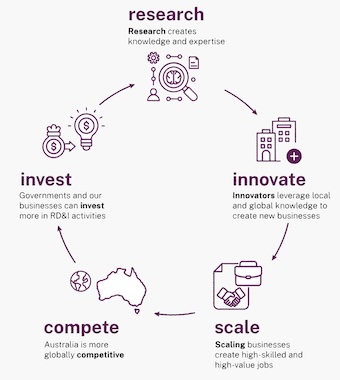
The government paper, referred to above, tends to separate out the different aspects of what it calls the RD&I flywheel, pictured alongside. Leigh’s emphasis on enabling conditions implies a more complex, less linear, place of innovation as an input to wealth creation.
Leigh also appears as one of five panellists on a Radio National program on Innovation – from the spinning jenny to AI. It’s a half-hour story about the conditions that support innovation, and how it tends to come in waves: the panel identifies six distinct waves of innovation, each of which results in productivity improvements that go on to drive social transformation – often in unpredictable ways.
Leigh’s description of innovation waves is broadly similar to that of the Russian economist Nikolai Kondratiev. Each wave has two phases. In the first phase the technological breakthrough improves what we have already been doing. That is, to bring about a significant productivity improvement. As Per Espen Stoknes explains on that program the spinning jenny resulted in a massive rise in labour productivity in the weaving industry. The second phase, consequent on the first, results in social structural change. Per Espen Stoknes explains how those productivity changes in the weaving industry contributed to a collapse of the feudal system in England, and its replacement with capitalism. We can speculate about those second-round effects, as we are doing with AI, but it’s close to impossible to predict how they will play out.
Progress on the gender pay gap
The gender pay gap is slowly closing, but it’s still wide in the finance sector.
The gender pay gap is slowly closing. Between 2023-24 and 2024-25 the median pay gap between men and women fell from 12.1 percent to 11.2 percent, according to the 2026 Employer Gender Pay Gaps Report published by the Commonwealth Workplace Gender Equality Agency. This regular survey, instituted by the Albanese government, looks at firms and industries in terms of differences in men’s and women’s pay, regardless of their positions or occupations. It is quite different from surveys about equal pay for equal work.
It remains high (>15 percent) in certain sectors – construction; finance and insurance; real estate services; mining; electricity, gas and water supply; and professional, scientific and technical services. These are all well-paid industries. No doubt this high pay gap is partly attributable to low female enrolment in higher education courses with skills relevant to these sectors.
From the agency’s site you can download information for all 8617 enterprises surveyed. More digestible is a short Conversation summary by Leonora Risse of the Queensland University of Technology: Australia’s gender pay gap is narrowing – and the public spotlight seems to be helping. She includes a chart for the top 10 ASX-listed companies, which includes our largest banks.[2] It’s notable that our big banks have a wider gender pay gap than our big mining companies.
She draws our attention to discretionary payments – such as bonuses, overtime, penalty rates, shift and leave loadings. The gender pay gap in total remuneration, which includes these payments, is significantly larger than the gap in base salaries.
2. Not on her list are two banks that aren’t in the top ten companies. Westpac comes in at 21.6 percent, and the Bendigo and Adelaide Bank comes in at 25.2 percent. The whole banking sector is dominated by overpaid men. ↩
Marvellous Melbourne
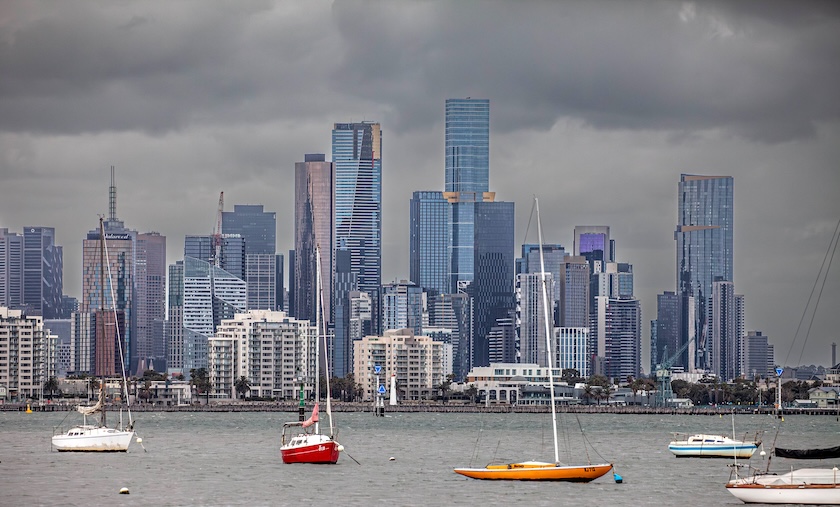
Another survey ranks Australia’s big cities among the world’s top 50.
Last Saturday on Saturday Extra Nick Bryant reminded us that the magazine Time Out has ranked Melbourne in top place among the world’s 50 best cities. He interviews urban designer Craig Allchin and Alison Holloway, a principal at SGS Economics and Planning, about this assessment. They go along with it, with a few reservations.
In such rankings there are somewhat arbitrary subjective assessments at play, and there is no process of peer review. For whom is a city good or bad – residents, tourists, businesspeople? But various bodies using different criteria tend to give our capital cities strong rankings: we must be doing something right. In spite of its meaningless obsession with football, the disruption of the F1 Grand Prix, and some unique road rules designed to confuse visitors, Melbourne always scores well.
It’s notable that in this Time Out assessment, while Melbourne comes in at #1, Sydney comes in at #21, and Adelaide at #29 (right next to Berlin). On that basis one could claim that just on half of Australians live in one of the world’s fifty best cities.
Obviously housing affordability comes up as a negative point. To an extent that’s a question of demand – one does not need a degree in economics to realize that housing is expensive in places where people want to live.
Craig Allchin reminds us that Melbourne is having some success in making housing more affordable for home buyers, particularly since the state government pushed up land taxes on “investment” properties. (Cotality data shows that Melbourne dwelling prices are just keeping up with inflation, and that unit prices are actually falling in real terms.)
Perhaps if we could have Berlin’s winter weather, Detroit’s crime rate, Delhi’s air pollution, Istanbul’s lack of public space, and Mexico City’s traffic congestion, Melbourne’s housing would become much more affordable. That’s essentially the policy approach advocated by those who criticize the Victorian government for spending so much to make Melbourne a liveable city.