Economics
Capital gains tax and negative gearing reform
There are many well-intentioned but poorly-developed arguments for reform of capital gains taxes: e61brings to our attention the design features that should guide CGT and negative gearing tax reform.
A basic principle of taxation is that if income is to be taxed, it should be treated in the same way regardless of the way that income is earned.In 1966 when the Hawke-Keating government introduced a capital gains tax it strived to meet that design principle. As has often been explained in these roundups, in 1999 the Howard government, under pressure from the finance sector, changed the CGT rules so as to favour fast asset turnover over long-term investment.
Notwithstanding the howls from the mob calling themselves “the opposition”, there now seems to be both expert and popular opinion favouring reform of CGT, and there is emerging similar support for reform of negative gearing allowances.
If one were to design a CGT according to the textbooks, it would be assessed every year on the basis of the growth in value of the asset. If the value of your BHP shares rose from $50 000 to $60 000 over the year, that $10 000 gain would be part of your taxable income. That is, gains would be taxed whether they are realized or not.
A refinement is to tax only the post-inflation gain in the asset’s value – the real gain – allowing a deduction for the inflationary component of that gain. So in the example above, if inflation were 4 percent, $2 000 (=4 percent of 50 000) would be deducted from the capital base and CGT would be applied only to the $8 000 real gain.
That all works well for easily-valued assets like ASX-listed shares, but when it comes to other assets – real estate, equity in private companies, art bought as an investment – annual valuation becomes cumbersome and expensive. Also, accrued profits are book profits only: they do not provide the funds to pay any tax liability. So the Hawke-Keating government decided that capital gains would be taxed only on realization, with an allowance for inflation over the period between purchase and sale.
That brought its own problems. Few assets have a single date of purchase and a single date of sale: companies issue new shares; landlords do renovations on buildings. And sale of some indivisible assets, such as real-estate or a business, can suddenly land a taxpayer with a massive one-year income, pushing him or her into a high income-tax bracket. But these problems do not justify the terrible vandalism the Howard government did to our tax system.
The principle of deducting inflation as a component in assessing capital gains can also hold for interest. If your $10 000 bank deposit earns $500 interest, and inflation is 4 percent, only $100 of that is real income. The other $400 is just a catch-up with inflation. Therefore you should pay tax only on $100.
The same logic holds for borrowers, who should be permitted to claim a tax deduction only on the real interest expense. The present system of allowing full deductibility of interest on loans for business expenses, including loans for “investor” housing, biases investors to borrow more heavily than they would otherwise, meaning their portfolios become more leveraged.
A team of researchers at e61 have looked at ways of putting best practice principles into taxing real-estate: What are we discounting for? Thinking through CGT reform options utilising property data. They model four possibilities, starting with the present 50 percent deduction without inflation adjustment, moving through proposals for specific percentage deductions. The model that comes closest to the ideal is what they call the ILT-neutral system, which makes the system neutral with respect to inflation, leverage and timing (ILT). They model capital gains on assets held up to ten years, but by extension of their logic, particularly their allowance for inflation-adjustment, their proposals would also apply more neutrality to investments held for a long time.
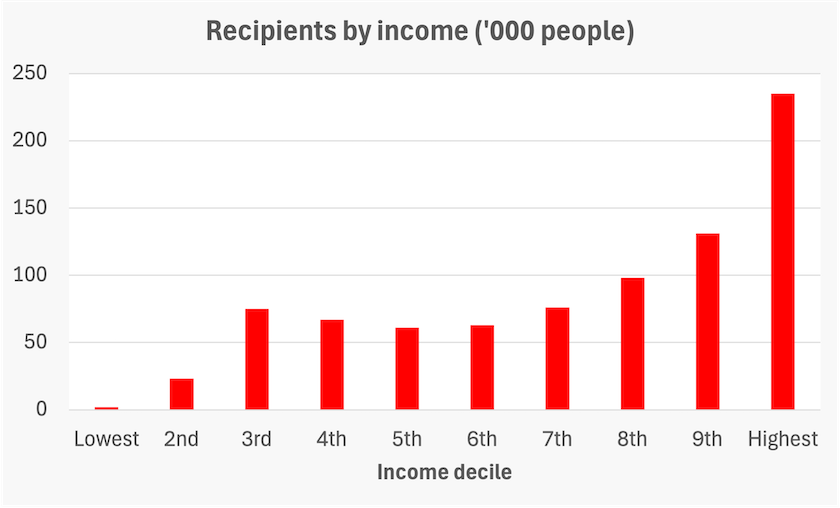
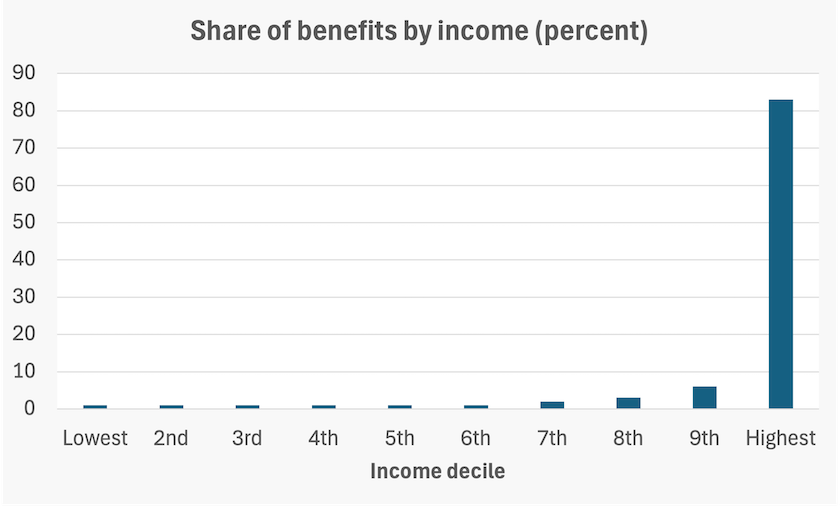
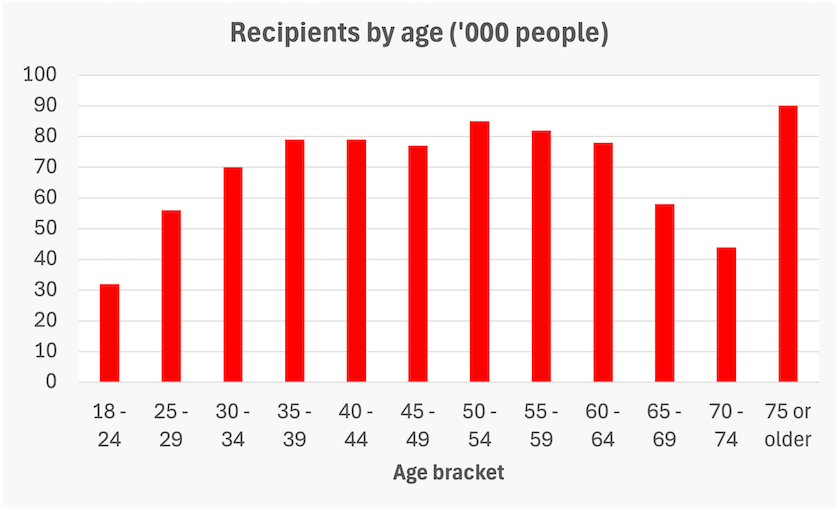
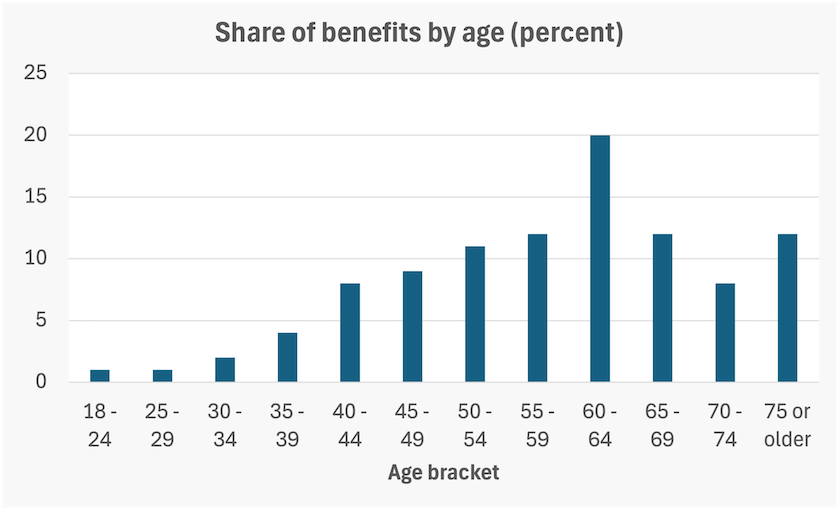
A less fully modelled proposal for CGT and negative gearing reform is in a Conversation contribution by Jago Dodson and Liam Davis of RMIT University. How cutting the capital gains tax discount could help rebalance the housing market, which focuses on the distribution of benefits from the present tax treatment of capital gains. They fail to acknowledge the distortionary effect of reducing the discount while doing nothing to adjust for inflation, but their analysis of the inequities of the current system is thorough. The benefits are disproportionately enjoyed by older people and people in the highest income decile.
Charts of their findings, by income and by age, are below. I have presented them all, because the editors of their Conversation article have rendered them unintelligible. Their good research should be accompanied by clearer presentation.
The consequences of war in the Gulf
In our insular way our main concern seems to be about gasoline prices and the CPI. Wars have more far-reaching consequences.
When oil last stopped coming through the Straits of Hormuz – the narrow waterway separating Iran from the Arab nations – the world price of oil quadrupled and the entire world economic order was upset.
That was a half-century ago, during the 1973-74 oil embargo. Before the embargo the price of oil had been absurdly low ($US3 a barrel). As the embargo was called off the price of oil quadrupled. Since then most “developed” countries have become less dependent on fossil fuels, and others have diversified their sources. Also the embargo was associated with the collapse of the postwar Bretton Woods order. That was a sudden and dramatic collapse of the world order; the present collapse, orchestrated by Trump and his cronies, has been more incremental. But the consequences will still be far-reaching.
There is obvious concern about the effects on the global economy of higher oil and gas prices resulting from conflict in the Gulf region. In some ways the situation now is more complex than it was in the 1970s, because then it was only about oil, and the Arab nations are more fully integrated in the world economy. (Qatar in 1973 was an isolated backwater.) With the bombing of Qatar’s gas plant concern is now also about gas. Qatar is one of the world’s major exporters of LNG – and Australia is another.[1]
The wider effects on the world economy are hard to guess. There could be significant political re-alignments: in fact Canadian Prime Minister Mark Carney is in Australia talking about the opportunity for a gathering of middle-order powers as a balance against US and China hegemons. The idea was hatched before the war, and it probably now has more relevance. (Can we resurrect that French submarine deal and abandon AUKUS?) There is also a new arms race in many countries: this means new demands on already stretched public budgets.
Concerns in Australia

Some left over from the Korean War
Apart from the problems of stranded airline passengers, the main concern in Australia seems to be about gasoline prices, their effect on the CPI, and any consequent decision by the Reserve Bank on interest rates.
If we can get those matters settled we can blame the government for any disruption, and go on with life as usual, filling up our cars and grizzling about electricity bills. Coalition treasury spokesperson Tim Wilson, finding it difficult to blame Labor for starting the war, suggests that the government cut fuel excise: his hatred of government spending extends to a belief that we should cut a source of funding for roads.
In an exquisite convergence of views, the Maritime Union of Australia, and shock jocks on Sky News, are warning that Australia has no domestically-located fuel reserve. (You can check fuel reserve figures on the Department of Climate Change and Energy’s website.)
We are unlikely to see anything as dramatic as the 1973-74 reaction when countries introduced gasoline rationing (odd numberplates odd days, even numberplates even days), and gasoline station queues became longer than bread queues in the Soviet Union, but there will inevitably be price rises. Stella Huangfu of the University of Sydney, describes the probable price effects in her Conversation contribution: Why surging oil prices are a shock for the global economy – but not yet a crisis. She reminds us of a rule-of-thumb that a price rise of $US10 a barrel translates into an Australian price rise at the pump of 10 cents a litre.
That means there will be some resulting rise in the CPI, and there is a reasoned chain of logic that runs as follows: because inflation, at 3.8 percent, is already higher than the Reserve Bank’s 2 to 3 percent comfort band, the RBA will inevitably raise the interest rate at its next meeting on March 16-17.
A post on the ABC website by Gareth Hutchens and Samuel Yang, quotes Reserve Bank Governor, Michelle Bullock, who questions that simple reasoning, Yes, there will be an effect on energy prices, “but at the same time, a prolonged impact on energy markets could have adverse effects on global economic activity and result in downward pressure on inflation. It is not obvious how this might play out” she says.
Even if the oil price pushes up the CPI, that should not result in a formula-driven rise in interest rates. If we accept the basic idea that self-sustaining inflation results from too much demand for a limited supply of goods and services, then the gasoline price rise could actually have the same effect as an interest rate rise in suppressing demand.
If the price rises by 40 cents a litre, when you fill up your car with 40 litres of gasoline, you will pay an extra $16, much of which goes out of the country to the foreign oil companies, and a little bit ($1.45) goes to the government as extra GST. Both have the effect of taking money out of the domestic economy and suppressing domestic demand, which is precisely what monetary policy tries to do to suppress inflation.
I doubt if many readers of this blog have a Ford Ranger, but if they do these amounts are doubled: an oil price rise is a much more progressive way to dampen consumer expenditure than higher interest rates, and it may even encourage people to drive less aggressively and to trade in the big ute for an electric vehicle.
Much depends on the extent to which the RBA reacts to the published CPI figures, which tend to drive inflationary expectations, and the extent to which it uses the economic expertise of its staff to assess whether there is any danger of accelerating or self-sustaining inflation. See the roundup of February 7: The RBA is hostage to an arbitrary formula.
The other consequence of the war is on gas prices. Our government has just secured a domestic gas reservation scheme, in order to keep domestic gas prices within reasonable limits because of their influence on electricity prices and on some energy-intensive industries. With Qatar disabled (we don’t know how long), there will be a strong rise in international prices, putting stress on our reservation policy.
Logically the disruptions in oil and gas supplies should supercharge our determination to re-structure our economy away from fossil fuels. The political situation, however, is that any short-term rise in electricity and domestic gas prices will probably result in a campaign of lies about the failure of renewable energy.
1. The big 5 LNG exporters, in rough order (the order often changes), are the USA, Russia, Qatar, Australia and Norway. Most western countries are switching away from Russia as a supplier. ↩
National accounts
The December quarter national accounts depict an economy slowly picking up speed.
Keating would have called the December quarter national accounts “a lovely set of numbers”. Over the last year GDP has risen by 2.6 percent, and over the last quarter it has risen by 0.8 percent: that would be an annual 3.2 percent if maintained.
Of course much of that is from population growth, but there is also some growth in GDP per capita, which is up by 0.9 percent over the year. That aligns with GDP per hour worked – a basic indicator of productivity – being up by 0.9 percent over the year. Similarly real household disposable income per capita – a rough indicator of our income after we’ve paid income tax – is up by 0.9 percent over the year.
Steve Bartos and John Hawkins of the University of Canberra, writing in The Conversation – Australian economy picks up speed, but managing inflation and rates is getting harder – remind us that in times past these growth rates would have been considered low: in the 1990s and 2000s rates of 3.0 and 3.5 percent were common, until the global financial crisis hit. Our economy is slowly picking up speed, but the job of managing inflation and interest rates is getting harder. They also point out that the Reserve Bank may consider even this modest 2.6 percent growth rate to be exceeding the speed limit. (The Reserve Bank has a dismal assessment of the economy’s productive capacity.)
Understanding inflation
Three articles on inflation – one basic, one stellar, and one that debunks the idea that it’s all due to government demand.
The basics
Luke Hartigan of the University of Sydney has a Conversation contribution: What exactly is inflation, and are interest rates the only option for dealing with it?
It’s essentially an Economics 1 introduction to monetary policy, with explanations about the way the CPI is measured, “cost-push” and “demand-pull” theories, and the way our Reserve Bank operates. The word “exactly” in the title is misleading: Hartigan explains some (but by no means all) of the ambiguities in understanding inflation.
Theory and practice – introducing NAIRU
Are central bankers guided by astrology? That’s the implication of a Conversation article also by Luke Hartigan: Why central bankers look to the “stars” when setting interest rates.
But his article is really about the difference between difficult-to-measure variables that are used in macroeconomics textbooks, and the more precise variables that are generated by economic data. The “stars” to which he refers are the asterisks that economists often apply to the former set.
The important variables are the economy’s potential output (y*), the non-accelerating rate of unemployment – NAIRU (u*), and the neutral interest rate (r*). They are all unobservable concepts, but they can be estimated from other data.
His article is about central bankers’ quest for an interest rate that can hold the economy in equilibrium, like an autopilot or a car’s cruise control. If only they can get NAIRU just right what a wonderful world it would be.
Perhaps there is no “equilibrium” in a system as interactively complex as a modern economy, with positive feedback loops, ill-informed judgements made by humans guided by emotion, and the exogenous variables of climate change and an erratic narcissist guiding the world’s second-largest economy.
A description of the real world in which monetary policy operates is in a speech by Assistant Governor Sarah Hunter: Recent refinements to the dual mandate and navigating back to target. It could be titled “NAIRU as we have interpreted it” and summarized as “We’ve kept interest rates lower than the rates central banks have applied in other countries, because we’re not so dogmatic about inflation and care more about keeping unemployment down”, but that would have been met with outrage from the Murdoch media and the Financial Review, and would probably have spooked financial markets.
One possible conclusion of her article is that we should stop grizzling about interest rates, because they are low by our historical standards and in comparison with the rest of the world.
Debunking the partisan idea that government demand drives inflation
There is an argument, in partisan tones, about whether inflation is driven by government demand (incontrovertibly bad according to the right) or by private demand (still bad, but better than profligate public spending).
Gianni La Cava of e61 has a highly informative post adding real-world economics to this misleadingly simple economic model titled Take a walk on the supply side: Inflation’s real driver isn’t public or private demand, it’s supply constraints. It’s a short article, well backed up with data, describing what is meant by private and public demand. When you have a medical consultation, drawing on Medicare, it’s your decision – your demand – driving that public expenditure. It’s government expenditure but not government demand, and the distinction is important in terms of public policy.
He also goes into what is known as the Baumol effect (often covered in these roundups), which shows that because the public sector provides many intrinsically labour-intensive services (health care, teaching, policing), its costs and therefore expenditure for its services are likely to grow faster than for goods and services provided in private markets where labour-productivity improvements bring down prices.
Demonstrating the Baumol effect in action, he shows that since 2000, while the price index for national government consumption has risen by about 80 percent, roughly in line with the CPI, the price index for state and local government consumption has risen by about 140 percent. The Baumol effect is playing out, but for state and local governments, rather than the Commonwealth. This has clear implications for federal funding agreements, including the rate and scope of the GST.
University life
It is hard to explain university life in the 1960s and 1970s to current day undergraduates. In those years a university education, once confined to a small privileged class, started to become part of the natural life journey for a greater proportion of young people, initially the “baby boomers”. And the campuses – only 8 in the whole country – were crowded.
If you didn’t arrive early for a lecture you would have to sit on the steps of the theatre, or perhaps sit in the corridor outside and watch the lecture on grainy closed-circuit television. Tutorials of 40 or 50 students were common. In many courses the first year failure rate was high – perhaps as high as 50 percent – because the standard of high school education was so patchy that universities took on the role of screening students suited for tertiary studies. In 2026 lecturers find themselves in a 200-seat theatre with just two or three students.
In spite of the crowding those who went to university in the 1960s and 1970s enjoyed the experience, particularly the extra-curricular life. There were the usual attractors of booze, experimentations with recreational drugs, gauche and cringeworthy sexual encounters. But there was also mixing, where forestry students socialized with philosophy students. Where Australian-born students socialized with Columbo-Plan students from south-east Asia – a welcome respite from White Australia. Where students could try out their political ideas – communist, libertarian, socialist – in a safe environment. Where students from privileged backgrounds could meet those with tougher upbringings, supported by generous means-tested Commonwealth scholarships and cadetships.
Students found the Menzies government rather stuffy. It was indeed patrician and sentimentally attached to the British monarchy. But in its early days at least it was in a nation-building mood, and that meant investment in tertiary education.
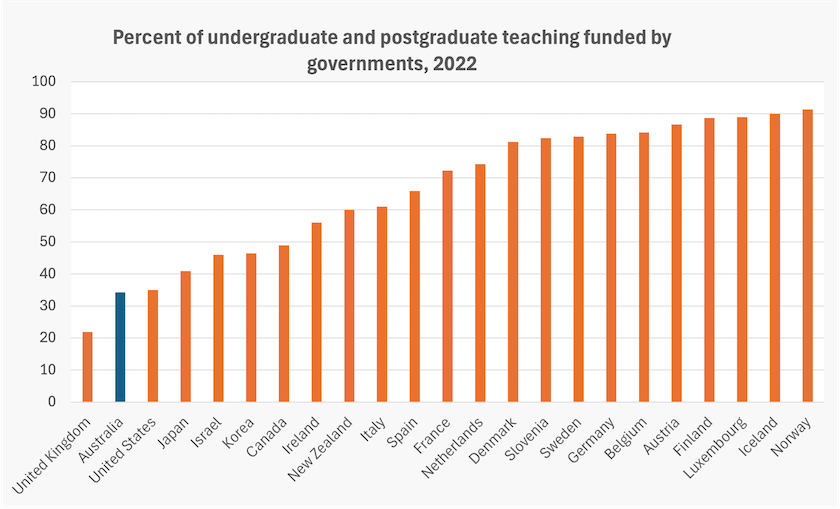
That has all changed, because university funding has changed, under both Coalition and Labor governments. According to OECD statistics, Australia stands out among high-income countries as having almost the poorest level of government funding for university courses.[2]
The ABC’s Scott Wallen and Ebony ten Broeke describe how “going to university” in 2022 can be a lonely online experience. They compare the experience of two students who went to the same university 30 years apart. By the more recent student’s description the current university experience seems to be effective in transferring basic knowledge, but about as intellectually inspiring and challenging as learning how to use the latest version of Excel.

Last undergraduate on campus
It’s not the same for all universities. Wallen and Broeke cite Tertiary Education Union surveys that find, in general, the undergraduate experience is more positive in old universities than in some of the newer non-metropolitan universities. (There are some notable exceptions.)
Online learning is the obvious suspect. Before Covid online learning was a supplement to the classroom, but Covid allowed it, de facto, to become a replacement for the classroom.
Another driver is financial. In past times there was less need for students to work during semester-time: paid employment was largely confined to the long summer vacation. Most students did their first degrees full-time: part-time study, mixed with work, was largely for postgraduate study. Housing, even though it was basic (shared refrigerators, conflicts over cleaning), was generally affordable.
And among some Coalition politicians there has been a hostility to education, particularly liberal education. The Howard government abolished compulsory student unionism, and the Morrison government was openly hostile to learning.
Those are the immediate drivers of this change. But the more basic driver is the commodification of tertiary education. Under the influence of neoliberal ideas education has changed from a collective investment in human capital, to an individual investment, with an emphasis on individual earning potential.
Hard-nosed economists may see this as a welcome development: by most productivity metrics it’s a great efficiency improvement. But that’s to ignore the benefit of student life, because it’s where young people develop curiosity, an openness to new ideas, excitement in learning and discovery, interest in multidisciplinary approaches to problems, and a healthy scepticism – all assets that will serve them and the community in their later life.
2. Direct comparisons don’t tell the whole story. Although our government expenditure is about the same as America’s, our student loan scheme is more generous. But we are among the stingiest with our public fundin. ↩
Price discrimination coming to you
Imagine if every supplier had a price, “just for you”. It could be highly exploitative.
When students are taught basic economics the assumption is that the market sets one price for all consumers. Indeed, some markets do work like that: you won’t find much dispersion around the price of milk and newspapers. Indeed, the presence of a uniform price across suppliers is an indicator that markets are working their magic.
But in most markets there is sustained price dispersion. Sellers try to segment the market by charging more for customers who are willing to pay more, for example. That’s why the convenience store in your neighbourhood can charge more than the big supermarket in the more distant shopping centre. In that case the local convenience store probably has higher unit costs than the supermarket, but in many cases firms charge different prices for the same, or virtually the same, product. Cinemas charge more on Friday and Saturday night, because that’s when demand is highest. The car with heated seats, leather trim and a larger screen is priced at $5000 more than the basic model.
We often find these cases of price discrimination (to use the economists’ terms) to be of personal benefit. First class and business-class passengers subsidize economy class passengers. (The difference in the airline’s costs is far less than the difference in prices charged.)
But it is not always to the customer’s benefit, when we find some need to travel at very short notice and find that the airfares are at extraordinarily high prices. We have names for such behaviour, such as price gouging. Economists from colder climates refer to the “snow shovel” practice, when hardware stores jack up the price of snow shovels after an unusually heavy snowfall.
The ideal form of price gouging would be for the supplier to bargain with each customer, to push them to their limit. What restrains them is what economists know as “menu costs”. The restaurant’s owners might be tempted to charge more for more affluent customers, but they are constrained by the fact that they have standard printed menus. (They compensate by using price discrimination in their wine offerings.)
But perhaps modern technology can do away with the burden of menu costs. ABC Technology reporter James Purtill has a post Digital price tags bring online-style “dynamic pricing” to supermarkets, which describes how paper price tags can be replaced with digital tags that can be adjusted at any time. Perhaps as the sales of Oreo cookies rise the price could be automatically raised to a sweet spot that maximises profits. Perhaps the customer who has just bought the expensive imported cheese could be offered higher prices for all other groceries. The possibilities, when real-time data gathering and artificial intelligence are combined, are endless.
Their post includes a picture of Allan Fels looking most concerned by this new venture into price discrimination.
The curse of the open office
Yet another study confirms that open-plan offices suppress productivity. But do managers care about productivity, or are they more concerned about status symbols?
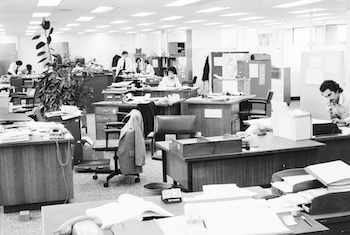
Libby Sender of Bond University, in a Conversation contribution, has added another study to research confirming that people are less productive when they work in open offices, than when they have their own office space.
An enduring dumb idea
Her article Why your brain has to work harder in an open‑plan office than private offices draws on the effect of distraction on our capacity to concentrate. The stress on people trying to work in open-plan offices can be detected and its effect on productivity can be measured. The open-plan office may save a little in rent, but that saving is usually more than lost in worsened productivity.
That aligns with previous research. But do corporations and government departments take any notice of it? Allocation of workplaces is an exercise in distributing symbols of hierarchical status, which to many insecure mid-level managers is far more important than productivity.
We see this concern most tangibly in opposition to working from home, which deprives the middle manager of the comforting confirmation that he or she has command over a number of submissive “subordinates”.