Public ideas
Australia’s slide into mediocrity
After a period of energetic reform during the Hawke-Keating era, the Howard government led the nation into a state of torpor, which is still stopping Australia from achieving its potential.
Martyn Goddard, on his Policy Post, has mounted an article Loss of vision: Australia’s leaders forgot how to lead.
It traces the national political and social trajectory over the last 80 or so years. In his words, it’s “the story of how imagination and purpose created a new and better nation, and how that sense of purpose became corrupted, turning in upon itself as ideas of bold and risky reform gave way to comfortable statis”.
That “new and better” nation was shaped between 1972 and 1976, starting with the election of the Whitlam government and it ended in 1996 with the election of the Howard government.
From a 2026 viewpoint, as we watch a timid Labor government struggling with the political effort of removing a few distortions from the tax system, it’s extraordinary to read about Whitlam’s “bewildering range of reforms” implemented in two and a half years. These reforms, mainly in social and foreign policy, were followed a few years later by the Hawke-Keating government’s similarly far-reaching economic reforms.
Goddard picks up the zeitgeist of the reform period: it was indeed a time of confidence and national pride. While the most impactful reforms were the establishment of Medicare and the end of tariff assistance, the most powerfully symbolic reform was the end of White Australia, a change in direction embraced by the Fraser Liberal government with the same enthusiasm as the Labor governments.
Then in 1996 it all stopped, with the election of the Howard government. Almost single-handedly, Howard knocked the energy out of Australia. The vision of a government working for the common good – the common wealth to use the traditional term – gave way to the dismal idea of “small government” stripped of its capability to serve citizens’ needs, and the idea that people should be relieved of their responsibility to pay taxes to contribute to the common good.
The proceeds of a mining boom, that could have been directed to the public purpose and the strengthening of our national resilience, were squandered on tax cuts and privileges for mates of the government.
Goddard traces this slump into mediocrity, mainly through the lens of attitudes to immigration. White Australia didn’t come back, but many of the racist and xenophobic attitudes of earlier times were once again given respectability. Keating’s understanding of Australia as a nation in and linked to the fortunes of the Asian region gave way to Howard’s fealty to a British monarch and his embrace of a colonial mentality.
As is always the case with Goddard’s posts, his description of Australia’s social and political path is well supported with data.
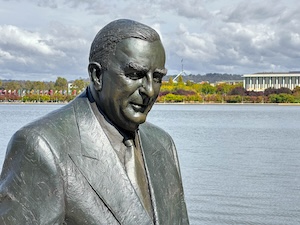
Ming also had a progressive side
Perhaps he is too dismissive of the way Australia navigated the postwar years. These were years of tremendous nation-building energy. Looking back on those years it all seems to be a bit cringeworthy, like a Barry Humphries movie, as our physical nation-building got far ahead of our social nation-building, but it was an exciting period. And we should not forget that while Menzies never came to grips with the reality that Australia was a separate country from Britain, and had an obsession with communism, he laid down the foundations on which future progressive governments would make the transitions that Goddard so clearly describes. Among these were the expansion of universities and the professionalisation of the public service.
Goddard, like many who have lived through that age of confidence, progress and optimism, regrets that “our leaders have forgotten how to lead”. But maybe he is looking for leadership in the wrong place – at our elected office holders. In democracies prime ministers, opposition “leaders”, and ministers live in a political world where their capacity to lead is severely constrained by the political environment. Think, for example, how difficult it is for any elected office-holder to remind us that we should pay more tax, or to tell us that spending on disability services has to be curtailed. Think how difficult it is for a state minister to warn coal miners that the industry has no future.
Leadership – the hard work of helping a community to make progress on difficult issues requiring adaptive change – is most easily exercised by those who have voice, but are not constrained by the demands that fall on those who occupy positions of authority. That’s why it’s better to look to people who are not in a position of authority – retired and respected senior politicians such as Keating, Hewson and Turnbull, or retired senior public servants, such as Ken Henry. Backbench politicians without aspirations to sit in the ministry (there are a few even within the big parties) can raise issues that others cannot. Officials in statutory agencies, such as the Productivity Commission, have a little more leeway than their political masters. Organizers who focus on a single issue, such as abortion law reform, can raise hard issues.
That is not to rule out the power of those with authority. They can block reforms, as those seeking restrictions on gambling know. But those with authority can also quietly support reformers, so that they can be seen to be responding to demands for reform. That was certainly an aspect of the Hawke and Keating strategy.
And the media have a responsibility to give voice to those who raise hard issues. Not to those who will appear on an interview with a set of prepared talking points: anyone even vaguely familiar with the way ministers and public servants work can predict almost every response a minister or party spokesperson will make in a media interview.
Our behaviour in the public sphere
Marcia Langton writes about long-standing dysfunctional norms of public behaviour that lie behind the aggressive ways Australians relate to one another in the political agora.
Much has been written following the assault on Helen Haines, calling for more civilized behaviour in the public sphere.
Marcia Langton, writing in the Saturday Paper, agrees. (It would be hard for anyone to disagree with such a call). Her piece, Violent rhetoric and the great Australian silence, goes further, into the ways we have been relating to one another ever since Federation – “a nation defined by exclusion” – and earlier:
The conventions that led to the federation of the colonies as the Commonwealth of Australia in 1901, at the end of a decade as violent, vicious and brutal as the previous century of frontier expansion, provide detailed documentation of discussions that differ little from today’s debates. Fear and difference are the defining refrains.
Today our talk of fear and difference has been turbocharged by so-called “social media”, attuned to stoking rage and stimulating fear and mistrust of the “other”.
Her strong message, highly relevant as we approach the first anniversary of the Bondi massacre, is a reminder that “Anti-Semitism, Islamophobia and anti-Aboriginal racism feed on the same reservoir, so a response that protects one community while treating another as suspect will fail them all.”
She suggests four ways we can improve our life in the public sphere.
First is about regulating the social media platforms. Just this week, in a deal between the government and the Greens, the path has been cleared for digital duty of care legislation to be enacted.
Second is about the language politicians use. This is a challenge to those who shelter behind the pretence that the political arena is some kind of theatre where the normal rules of discourse do not apply, where there is license to engage in dehumanising a group, or raising suspicion about “an enemy within”, all under the guise of “robust” discussion.
Third is about regulating our own anger and outrage.
And fourth is about rebuilding the physical public sphere –“the offline places where we meet people who are not like us”.
The same theme about the corrosive power of anger in politics is taken up by Andrew Leigh in on the ABC’s Religion and Ethics Report. Leigh notes that there has been a long-term trend for public life to become more civilized, but that trend has reversed in recent years: vitriol and hatred have made their way back into the political agora, and that return has correlated with the rise of “social media”. He reminds us of the gravity of that development:
The rise of anger is fundamentally challenging to the democratic ideal of a society in which we work through our differences, in which we have a respect for our political opponents that transcends our view about their policies.