Public ideas
Paul Keating on Australia’s history and geography
Keating and his biographer discuss the experiences that have shaped his ideas.
Historian James Curran, author of the recently-released book Grand ambition: Paul Keating’s global vision for Australia – is in a one-hour discussion with Keating at the Sydney Writers’ Festival.
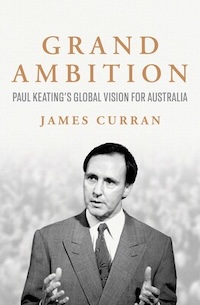
Keating explains how his world view, and therefore his idea of a strong, independent and sovereign Australia, was shaped by his understanding of history, particularly the history of the events leading up to the conflicts of the twentieth century. Through that understanding, and family experience in the Pacific War, he understands where Australia stands geographically, and that is in Asia.
It’s paradoxical that someone who last held office 30 years ago has a more realistic and up-to-date view of Australia’s place in the world than those in the present government who, through AUKUS, are ready to yield sovereignty to an unreliable and unpredictable US. He is also more realistic than those in the opposition who hang on to the remaining threads of Australia as a colonial outpost of the British Empire.
At one level the session could be seen as a discussion about foreign policy, and of Keating’s role in developing not only our own foreign policy, but also of Asia’s and America’s foreign policies, such as through APEC: Keating is not constrained by any sense of self-effacing modesty. But it is more than that, because it’s about the historical and geographical realities that have shaped ideas – realities that those on the right have not confronted.
He sees Australia as a country that has become afraid of change, that will not find its way once again on a path to prosperity until it engages with the hard task of structural reform, a quarter of a century having passed since the GST, our last significant move on structural reform. He praises the government for its moves on housing and tax reform, but would clearly like it to go much further and faster. And he wants us to shake off that ridiculous idea that our head of state should be the monarch of a distant foreign country that has problems of its own, a different geopolitical setting, a different culture, and no reason to have even the slightest interest in Australia’s welfare.