Economics
The Intergenerational Report
The intergenerational report has unsurprising projections on demography – we’re getting older. But it glosses over some deep-seated structural problems in the Australian economy.
Last week the government released the 2026 Intergenerational Report, the seventh since they were initiated by Treasurer Costello in 2002 and the second to be issued by the current government.
For those who don’t want to plod through its 326 pages, Treasury has provided a two-page at a glance document, but it is light on noteworthy content.
The two IGRs produced by the current government differ from those produced by Coalition governments, in that they emphasise the likely path of economic developments, while the Coalition’s IGRs were mainly about fiscal projections, with the implication that future governments would have no option other than privatizing and cutting services. Their concern was only with fiscal management, rather than the wider performance of the country’s economy.
This IGR starts with “five most consequential transformations” that will have implications for our society and our economy:
Artificial intelligence (AI) is developing rapidly, and will be a defining influence on the economy over the next 40 years.
Geopolitical fragmentation is increasing as conflict and competition have flared and broadened.
The energy transition is becoming more important and urgent.
The population is ageing more quickly, accelerated by falling fertility rates.
Australia’s industrial base is evolving further towards services, influenced by AI and the other major transitions.
In what appears to be an editorial revision, a sixth point about intergenerational equity is added:
At the same time, concerns about intergenerational equity have deepened, particularly regarding housing affordability for younger Australians.
AI didn’t appear in the 2023 IGR, and geopolitical risk did not command the same attention as this year’s IGR. On AI it is reasonably optimistic, stating in its summary:
Labour market impacts of AI are not yet fully evident but are expected to be uneven. While some tasks will be automated using AI, demand for labour is expected to increase in other areas – including tasks that can be performed to a higher standard by workers equipped with AI tools. Many jobs will be redesigned to realise these benefits, with the tasks that can be automated unbundled from other parts of roles that require human coordination, judgement and relationships.
That’s probably a reasonable forecast, in view of the way we have benefited from other technological changes that were usually preceded with dire forecasts of job losses. But it may be downplaying the speed and extent of structural change that will result from adoption of AI. The report includes a chart of AI’s progress in mastering human capabilities, reproduced below from its data.
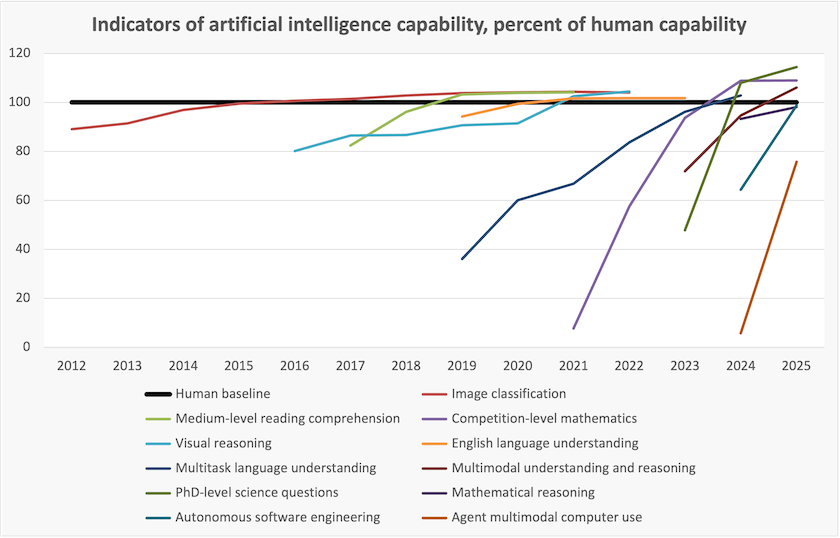
For example, AI exceeded human ability in “medium-level reading comprehension” around six years ago, shown on the pale green line, and has just broken through on “mathematical reasoning” shown on the purple line. AI may do to so-called “white collar” jobs at all levels – and not just at basic clerical levels – what mechanical automation has done to “blue collar jobs”. Its effects will have different regional manifestations however. AI is probably partly responsible for changes in our CBDs – and the political consequences may be significant, because those affected have much better access to policymakers than unionists in industrial trades ever had.
On geopolitical risk the IGR is based on an assumption that “economic openness will continue to deliver growth”, but that’s optimistic. Aaron Wong of e61 has a post The missing shocks in Australia’s Intergenerational Report. He lists three possible shocks: “a major geopolitical crisis that causes a substantial reversal in global cooperation and trade”; “a global bond market shock following a loss of confidence in the United States’ ability to service its debts”; and “a severe domestic recession”.
On that last point the IGR assumes that Australia will enjoy the benefit of an economically competent government, but we face what may be called a MAGA -style risk with the possible election of a populist far right government, particularly if the present chaos of our political right is not resolved and no economically-competent centre-right party emerges. And there is the less dramatic risk that we will elect an indolent and economically incompetent government, as we did between 1996 and 2007, allowing Australia to go down the slow path of decline that characterised South American countries last century.
The other development largely overlooked in the IGR is widening wealth inequality. It gets a mention in the context of housing, but not in its wider manifestation. A certain level of wealth and income inequality is an unavoidable aspect of capitalism – perhaps of any sustainable economic system. But when a society develops a class of oligarchs, whose financial wealth is self-perpetuating as Thomas Piketty describes, and who wield extraordinary political power, the whole fabric of society is at risk.
Ian Verrender has a post explaining the report’s demographic projection, summarised in its headline Intergenerational Report shows younger Australians face tough economic future. An ageing population results in a rising dependency ratio, which imposes a burden on young and middle-aged workers. The demographics of an ageing population have captured media attention in reporting on the IGR, but perhaps its most striking projection is that our population will go on growing until the 2060s, when countries such as Japan, Italy and even China already have stable or even falling populations.
Verrender also covers the problem of low productivity, which the IGR acknowledges with fine words about the government’s priorities but the IGR ducks the fundamental issues. Australian businesses have been able to enjoy growing profits in a growing population, without having to invest in improving productivity. That’s been good for corporate cash flow, but with no benefits in per-capita income.
Stephen Bartos and John Hawkins of the University of Canberra have a Conversation contribution, bringing attention to the IGR’s main points. They point out that its treatment of climate change seems to be too laid-back: it seems to be more about the marvellous things the government is doing in the energy transition rather than the urgency of the transition and the possible consequences of climate change shocks, particularly if temperatures exceed conservative projections.
They include the IGR’s fiscal projections, which were the main aspects of the Coalition’s IGRs, showing future likely fiscal changes. As a proportion of all government spending, outlays on health and aged care will rise strongly. But other income support, including aged care, will fall. That assumes that the populist right won’t be able to do irreparable damage to our superannuation system.
They also include the graph below, compiled from IGR data, contrasting our economic growth rates over the last 40 years with the IGR’s projections for the next 40 years.
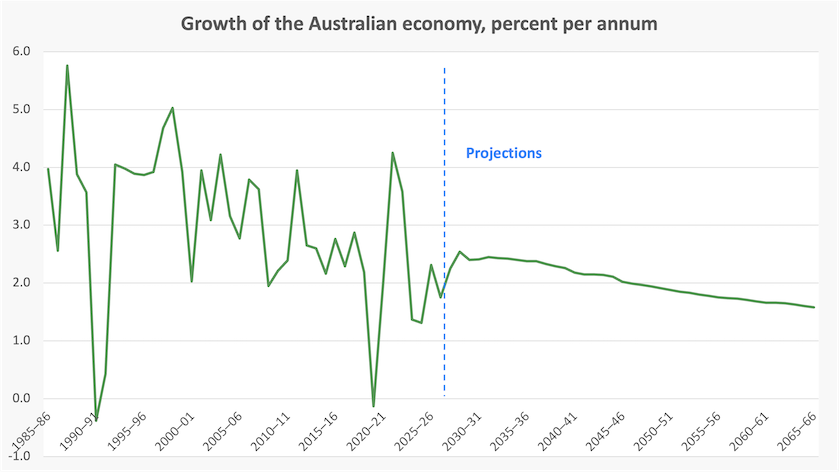
That is not to ridicule the IGR. It is simply to point out that it’s a projection, not a forecast. Experienced politicians and Treasury officials are wise enough to follow Yogi Berra’s advice “never make predictions, particularly about the future”.
The labour force
Will the Reserve Bank pay any attention to steadily rising unemployment?
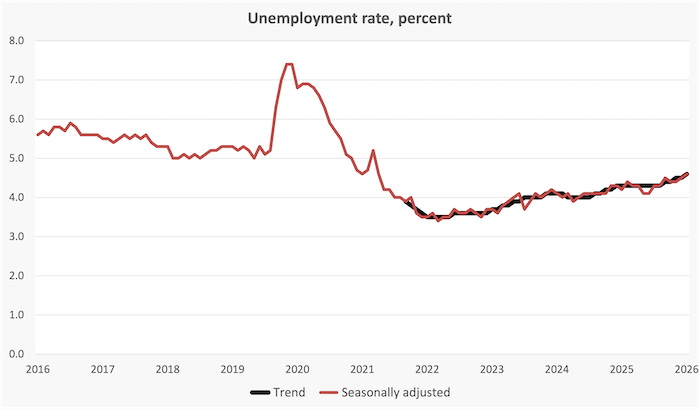
The ABS produced the August Labour force data on Thursday, with no surprises. Employment growth is tracking population growth, and the unemployment rate continues to creep up, as shown in the graph below.
The Reserve Bank board meets on Monday and Tuesday next week. Will they be satisfied that they have achieved enough misery in the labour market, or will they go on pushing up interest rates, in their monomaniacal obsession with the CPI, due to be released on Wednesday, the day after they meet.