Public ideas
On liberalism (and monsters)
Liberalism is about individual rights and freedoms. In liberal societies we constrain full expression of those rights and freedoms with an overlay of social morality, but that overlay can negate the enlightenment values underpining liberalism.
Populist movements are thriving. The old “left-right” divisions have lost their relevance to voters, and traditional centre-right parties are fragmenting. There seems to be no agreed set of values guiding the way we live our collective lives.
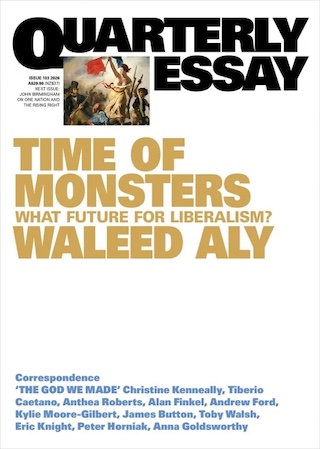
In his Quarterly Essay Time of Monsters: What Future for Liberalism? Waleed Aly makes sense out of this apparent confusion, finding that there actually is a basic organizing principle – liberalism. He writes:
Liberalism defines almost our entire social and political order in the West.
But surely that doesn’t align with our experience, as we observe assaults on democratic institutions, the abandonment of norms that guide civilized discourse, contempt for science and learning, and the rise of authoritarianism. There is disillusionment (some fabricated) at the failure of the liberal order to have lived up to its promise to go on making life better, because material progress seems to have stalled.
Aly explains that “the various modes of upheaval we’re seeing – conservative, progressive, victorious and vanquished – are all reactions to liberalism, often explicitly”. But the movements he describes as “post liberal” are still liberal at their base.
In his essay you will find a concise summary of the ideas and influence of liberal philosophers, starting with Hobbes (not usually seen as a liberal), moving through to Locke, Hume, Mill and Rawls.
As we delve into his explanation, a common theme emerges about a conflict between liberalism and our need for a shared set of values that can and should guide our collective life. Liberalism satisfies our desire for individual freedom and agency, but even liberalism’s strongest advocates have been uneasy because of its lack of concern for the common good, and the absence of an idea of virtue as a guide to one’s behaviour.
In a rebuttal of utilitarianism, and of the idea that the collective interest, through the “invisible hand”, is served by the sum of individual interests, he echoes, and at times quotes directly from, encyclicals of Pope Leo, particularly in relation to the risks posed by artificial intelligence.
He suggests that the best forms of government hold on to liberalism as a base, but they temper liberalism with an order of social morality. He fears that the US may be past the point where such an accommodation is possible, but he holds out hope for Australia, in part because we can observe the negative consequences of populist movements. He writes:
Australia is, by temperament and history, a more socially oriented place. It has tended to see government as an extension of its people and as an active agent in society, rather than a threat to freedom.
He mentions religious traditions as one source of such moral influences. In Australia’s case he suggests that our roots in Abrahamic religions are a strong influence. Some may disagree, considering the influence of indigenous Australians, the arrival of immigrants of Buddhist, Hindu and other persuasions, and survey data revealing a 39 percent “no religion” answer in our 2021 census. Anyone who has worked with such surveys knows that the responses to such questions are difficult to interpret, but the point in Aly’s classification is that he does not use the term “Judeo-Christian”, a term that specifically excludes the third part of the Abrahamic tradition. It’s laden with bigotry by exclusion, designed to conjure a negative image of Muslims.
You can hear Aly in a 19-minute summary of his essay, but without his historical summary on the ABC’s Saturday Extra: Waleed Aly on the crisis of liberalism. He and Nick Bryant discuss his essay in a slightly different frame, with more emphasis on the political effects of impermanence and precarity, resulting in grievance and the attraction of populist movements, and with less explanation of the underlying philosophy of liberalism. (19 minutes).