Politics
On the residualisation of public housing
Public housing was once housing for workers, but governments have allowed it to be re-defined as housing for the down and out. That’s bad for social cohesion and for housing supply.
Most people have the good fortune to be brought up with the idea that we should show polite respect for others, even if we strongly disagree with them, but such respect did not constrain Pauline Hanson from criticising Albanese’s mother for having lived in public housing when she might have had the means to find other housing.
More responsible media and a few politicians from mainstream parties who are still guided by a sense of decency have rightly criticised Hanson for her bad manners.
Her political judgment is also wanting, because she could have used the case of Albanese’s mother living in public housing as a strong criticism of the government, without at all implying any criticism of her behaviour.
Her criticism of Albanese’s mother is based on the idea that public housing is only for the down and out. Even a single mother in poor health is supposedly blocking someone with greater need.
That criterion has not always applied. In what are known as the “postwar years” after 1945 the Commonwealth and all Australians states signed on to a national housing agreement, based on the idea that “a dwelling of good standard and equipment is not only the need but the right of every citizen” to quote the late Patrick Troy of ANU in his 2011 work The rise and fall of public housing in Australia.
Governments built and owned public housing, which was of good quality by the standards of the time. They were solid constructions with two bedrooms and one bathroom, affordable for rent by a family with one breadwinner on the basic wage, often with an option to buy at a reasonably low interest rate. Standard designs made for scale economies, and public financing assured builders that they didn’t have to worry too much about property developers becoming insolvent.

Canberra guvvie
In fact in South Australia public housing was a major instrument in industry policy, because its low-cost housing provided workers with an effective higher disposable income than was available in other states. Canberra followed a similar pattern, building similar basic but reliable housing, still known affectionately as “guvvies”.
Singapore exemplifies the role of government housing as a benefit for all: 80 percent of Singaporeans live in government housing, generally in large apartment blocks with a large mixture of standards and sizes.
But the story in Australia has been one of re-defining public housing as “social housing”, as explained in the Australian Housing and Urban Research 2019 paper Understanding the “residualisation” of social housing.
Some may say that in those earlier times there was less stress on public finances. These days already heavily-indebted governments cannot afford to borrow to invest in housing. But if we took a sensible view of public accounts, as we do with corporate accounts, we would see such borrowing offset by assets on the other side of the balance sheet. Those who prattle on about gross government debt are making it hard for governments to practise sound economic management.
Another argument is that because there are shortages of skills and building materials, there’s not much point in governments expanding investment in public housing, because it would simply re-shuffle resources. But such re-shuffling may be just what is needed, because the resources that go into a five-bedroom, five-bathroom, one-indoor cinema, one-swimming pool house could probably build three or four more basic houses.
People like Albanese’s mother had every right to live in public housing. If there is to be criticism to be aimed at the government it is for not restoring that right.
But such criticism has to be framed in clear, unemotive language. That’s not One Nation’s style, because overturning norms of civilized behaviour is an essential aspect of its political strategy.
How is One Nation travelling?
An account of the political strategies adopted by other parties in response to One Nation’s provocations and policy proposals.
Although journalists are inclined to say that One Nation’s support is rising, such an assertion s not supported by opinion polls.
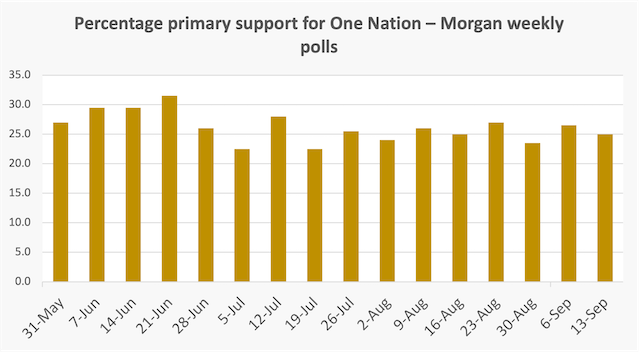
The Morgan weekly poll suggests that since its high point of about 30 percent in the middle of this year, One Nation’s support has fallen back to about 25 percent.
William Bowe’s Bludger Track, that averages all polls, suggests that its support grew rapidly over the 12 months to May this year, and since then has been slowly tapering off. It is now around 27 percent.
Some of that 25-27 percent are probably a loyal One Nation base, comprising the 8 percent who voted for One Nation (6 percent) or its populist rival Trumpet of Patriots (2 percent) in last year’s election. The others have come on board more recently.
The challenge for the established parties and independents is to bring those converts back into the fold. The trouble is that they are a heterogeneous lot, according to Kos Samaras as reported in Patricia Karvelas’ post The one piece of advice about Pauline Hanson that unites Labor and Liberal. Some, perhaps half, have a “parasocial relationship with her and her party”, while the rest are simply sick of the two-party system. The former tend to see any criticism of her policies as a personal insult – either against her or her voters – our version of the “deplorables” factor that worked against Hilary Clinton in 2016 – and are likely to harden their support in a defensive response. The latter are more open to persuasion on policy grounds. It’s hard to get through to both with one message.
The mainstream parties would therefore welcome support in the form of criticism that comes from outside the party system, such as the Australian Chamber of Commerce and Industry’s statement Australian business does not support economy damaging cuts to migration program. A detailed explanation of the economic cost of One Nation’s immigration policy is in a Conversation contribution by Ly Tran of Deakin University.
Hanson’s response to economic arguments, however, has been a “so what?”, a response that may have some traction with her supporters, because to many “the economy” is something to do with strange numbers that don’t have much to do with people’s lived experience.
Even though they are holding back on their criticism of Hanson, we should not be surprised that politicians have been constructing dirt files on her party: Labor and Coalition staff have been doing it forever, so it’s natural that they should dig up dirt on One Nation, hoping that journalists can use it, relieving politicians of the need to be seen initiating attacks that ridicule Pauline Hanson’s incoherent policies.
But sometimes a politician’s response is unavoidable. One of Hanson’s most stupid racist statements about Aboriginal Australians has provoked a strong and entirely justified response from the Liberals’ Jacinta Price. It is hard to imagine that she could have ignored Hanson’s statements, and that has given other Liberals of more moderate disposition authority to speak out.
That statement about Aboriginal Australians was in the past. Some political journalists suggest that Hanson, with help from Barnaby Joyce’s political experience and Gina Rinehart’s money, is becoming more politically savvy. James Massola in his article Regrets, Hanson’s got a few, but she’s also chalking up wins, writes that “the 2026 version of Pauline Hanson is far more practiced and polished than the original”. Parnell Palme McGuiness, who writes with authority on Germany’s right-wing populism, believes that Hanson’s tactics are working well in the Victorian election.
In Victoria One Nation candidates’ behaviour that would offend the genteel bourgeois classes could actually be seen as a matter of class comradeship for the party’s supporters. In her Age/Sydney Morning Herald article It’s the vibe: why Hanson’s candidate with a drug-taking past will win McGuiness writes about candidate Warren Pickering:
Chaotic home life is deeply familiar in lower-income electorates, such as the one Pickering is seeking to represent, where divorce, separation and de facto relationship rates are higher than in more advantaged areas. Pickering nailed the vibe that he is trustworthy – or at least can be trusted to represent his electorate – because he has lived a life much like theirs.
But at what stage does such an attraction to the marginalized become a liability? When Nazis are explicitly pledging their support for your party (Paul Sakkal: Neo-Nazis pledge to campaign to make Hanson prime minister) you’re surely going to lose votes.
Has Hanson really become more savvy, or are she and the people around her becoming overconfident? It doesn’t matter what country you’re in, you should tread very carefully around anything you say about war veterans. Kos Samaras, writing on Facebook (why doesn’t he choose a better medium?), believes that like Icarus, Hanson has made a bad error of judgement in attacking Hastie. “Icarus did not fall because he could not fly. He fell because he believed the rules did not apply to him”.
Rob Harris and Paul Sakkal of the Age/Sydney Morning Herald have an account of the wide political ramification of the Hanson-Hastie dispute. It’s partly about social class: in the army Hastie was a captain; Roberts-Smith was a corporal. It’s also about Gina Rinehart’s connections with the hard right in Australia, including those in Tony Abbott’s inner circle: Why Rinehart is pushing to make Hastie an outcast, and backing Hanson to bring him down.
Hastie’s strong response is putting pressure on members of the Liberal Party to state where they stand, not in terms of a Hastie-Taylor “leadership” contest as some journalists see it, but in terms of where they stand in relation to One Nation’s populist and divisive form of politics. (If you find the Harris-Sakkal piece to be firmly locked behind a paywall, The Guardian’s Henry Belot has an article covering the same ground, but in less detail: Andrew Hastie knew taking on Pauline Hanson would cost him. Liberals are divided over the price of following suit.)
Undoubtedly there is a degree of self-interest in Hastie’s stance, because his Canning federal electorate stands out as quite different from other urban electorates: its demographic is very much a One Nation demographic. (See the roundup of 10 October last year.) But that shouldn’t detract from his principled opposition to One Nation’s approach to politics.
Labor strategists are largely sitting back: when your rivals fight your interests aren’t helped by intervening. Labor’s numbers people would be well aware that One Nation support has mainly come from former Coalition, particularly National Party, voters, and would like to see One Nation’s support held in some sweet spot. A wipeout of One Nation would see the recovery of a strong “broad church” Coalition, and an overwhelming success for One Nation would see it in a position to form government with the Liberal Party as a junior partner. The ideal for Labor is somewhere in between, with a divided political right, and they are probably guessing, based on historical preference flows (consolidated on Antony Green’s election blog), that a proportion of preferences, particularly among younger converts to One Nation, flow to Labor.
But is Labor, itself, any more savvy then One Nation? Are its ministers sensitive to the accusation that it’s a party of elites living in another world, indifferent to and unfamiliar with the concerns of working-class Australians? If they were so aware, surely Transport Minister Catherine King would not have accepted lifetime membership of Qantas’ platinum frequent flyer rewards, providing free access to first and business class lounges across the globe, additional baggage allowance, priority check-in, boarding and baggage access – not just for her official travel, but for the rest of her life.
What a political gift to One Nation, and what an insult to her Labor colleagues in Victoria trying to fend off a Liberal-National-One Nation coalition!
Immigration – what’s all the fuss about?
Our rate of immigration is back to its long-term average, and our rate of population growth, which is more relevant in terms of housing and infrastructure pressure, has actually fallen in the post-Covid period.
There will be more on immigration in next week’s roundup, as people respond to Tony Burke’s announcements in his Press Club address on Thursday.
At first sight it’s hard to see why immigration has become an issue. The right’s politics makes no sense: immigration is contributing to higher housing prices, and that’s a bad thing; this terrible Labor government has changed income tax scales contributing to lower housing prices and that’s a bad thing.
Go figure.
Angus Taylor gets up on his pulpit, and asserts that we must reduce our net overseas migration, as if the case for reducing immigration is as self-evident as the case for reducing the rabbit population or keeping measles out of the country, but why?
While politicians were tying themselves in knots about immigration, on Thursday the ABS quietly released population statistics for the year to March. Some media have covered this release, but they report on the absolute numbers, rather than the rate of immigration, which makes more sense in a growing population.
The graph below shows the rates of immigration (net overseas immigration), natural increase, and total population growth.
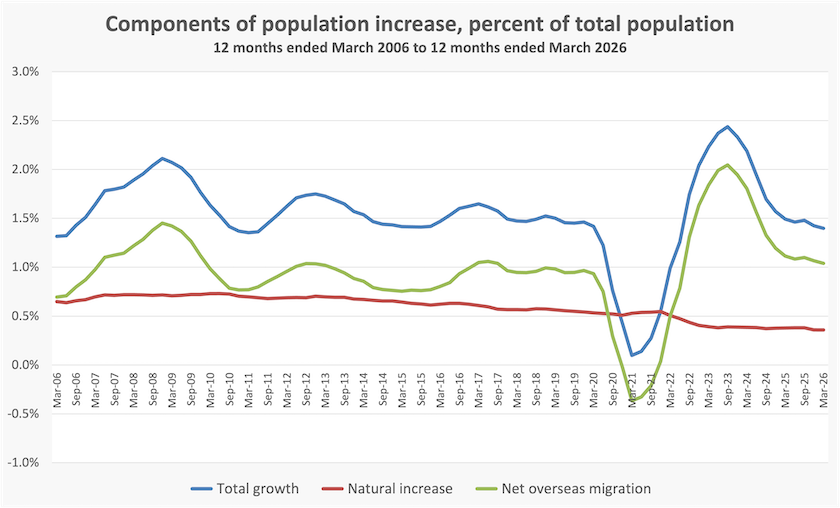
The most recent data shows that immigration is running at 1.0 percent of our population. That’s the same as the average over the entire last 20 years, and the same as it was in the years leading up to Covid.
If we are concerned about pressure on housing and infrastructure, it’s more relevant to look at the rate of population growth, and that shows a sharp drop, from 1.6 percent in the pre-Covid period, to 1.4 percent now, and that’s explained entirely by a fall in the rate of natural increase, which is clearly evident in the red line.
So why the fuss?
Surely those men and women in the Labor, National and Liberal parties who talk confidently about “parties of government” (a new term in our political lexicon), aren’t letting some populist rabble-rouser set the agenda.
Or are they?