Public ideas
Living together in the political agora
We need something more uplifting than transactional politics.
Two contributions, both by respected journalists who contribute to US and British quality media, address questions around the age-old problem of the failure of elected governments in democracies to make wise decisions in the national interest.
The problem goes back more than two thousand years, but it commands renewed attention because of the seriousness of unresolved problems, particularly climate change and widening wealth disparities, because of democratic backsliding and the associated rise of populist far-right parties, and because of the emergence of technologies, including artificial intelligence, that make it easy for political actors to manipulate public opinion.
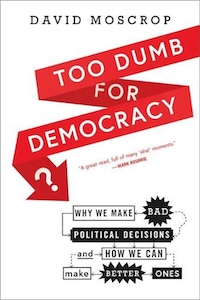
The first is a talk at the Melbourne Writers’ Festival by Canadian journalist David Moscrop, mounted by the ABC on its Big Ideas website. His address – Too dumb for democracy? Why your brain struggles with good political decision-makingwas delivered three months ago, but in view of the terrible decision made by voters in a Perth outer suburb it is timely.
His approach is one that is familiar to behavioural economists, concerning our tendency to make quick, inadequately researched decisions on important matters. The usual behavioural biases apply, and in our political arena our capacity to apply rational processes are further overridden by forces of tribal identity. His most recent book is Too dumb for democracy: why we make bad political decisions and how we can make better ones.
The other is a podcast on the US Prof G Conversations program in which David Brooks is the guest, with the topic: America has a moral problem, not a political one. (Brooks would be known to many Australians for his appearances on Late Night Live.) As the title suggests, he is concerned by the amorality of life in the political sphere, where the arithmetic of transactional relationships has crowded out norms of behaviour that should guide the way we live together and make collective decisions.
He fears that in the public sphere Americans have lost their “humanistic core, a sense of purpose, a sense of meaning”, allowing politics to be driven by resentment, an emotional state that leads to withdrawal from any sense of shared purpose. Nobility is seen as a fake affection; kindness is seen as weakness; generosity is reinterpreted as a performative strategy.
Some of this he attributes to Trump, a person who “exemplifies resentment because he does not acknowledge the higher registers of human nature”. This behaviour may be in Trump’s hard wiring, but in our country we can see politicians on the right deliberately emulating Trump’s behaviour. As an example we can reflect on the disgraceful “what’s in it for me” reaction to the recent tax changes.
Brooks does not confine his discussion to elective politics: the discussion goes into ideas about the ethics of education and journalism, both of which are having to cope with the challenges and opportunities of artificial intelligence.
As Churchill said “democracy is the worst form of Government except for all those other forms that have been tried”. That leaves plenty of scope for improvement.