Politics
TheSecret Harbour by-election
One Nation’s success in Secret Harbour was predictable because there were the same swings in similar electorates in South Australia, but those electorates are not representative of the ethnically diverse Australian voting public.
What the figures reveal – the pundits shouldn’t be surprised
Journalists and politicians tend to see Labor’s loss of the Secret Harbour by-election in two-party terms – as a disaster for Labor (24 percent primary vote, 21 percent swing), or as a disaster for the Liberal Party (17 percent primary vote, 7 percent swing).
The One Nation primary vote of 39 percent (up by 30 percent) seems to have taken many by surprise, when much of the talk has been about One Nation having peaked, about its confusion about immigration, and about rumours that its newly-elected federal Member for Farrer plans to leave the party, reported by Jason Koutsoukis in the Saturday Paper. That 39 percent is certainly much higher than the 25 to 30 percent support for One Nation reported in William Bowe’s collation of national polls.
But the result seems to fit more with established national patterns, particularly those observed in the South Australian election, when we look more closely at the Secret Harbour electorate, drawing on an electorate analysis using 2021 census results prepared by the Western Australia Parliamentary Library.
An economist looking at that analysis would see a picture of aspirational middle-class prosperity in a comparatively young electorate: a median age of 34 years, compared with 38 years nationally. Average household income is 21 percent higher than the national average and 13 percent higher than the Perth average. Unemployment is low and labour force participation is high. Houses are large – 73 percent have 4 or more bedrooms, compared with 42 percent nationally. And 67 percent of households have 2 or more cars compared with 57 percent nationally. Almost all houses in Secret Harbour are stand-alone rather than apartments or townhouses.
On these figures it is about as far apart as one could imagine from the hardscrabble rural electorates in South Australia, and the far-west regions of the Farrer electorate in New South Wales, where One Nation has done so well.
But such highly-aggregated economic data does not explain much about what seems to have driven many voters away from Labor – the only significant party that is trying to improve the material conditions for people in such electorates. Some additional data, differentiating Secret Harbour from the rest of Perth and Australia as a whole (again drawing on the state Parliamentary Library) is shown below.
This table reveals two aspects of Secret Harbour that may have resulted in people being attracted to One Nation –one about financial stress, the other about ethnicity.
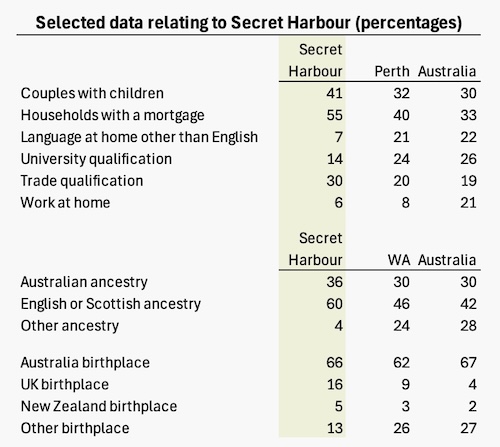
First is evidence that although household incomes are reasonably high, demands on that income are high, including the outlays associated with bringing up children. The other big demand is mortgage payments, and we know that many of these houses are large. In 2021, in Secret Harbour three quarters of households with mortgages were paying between $1000 and $3000 in monthly housing loan repayments. In fact 40 percent were paying more than $2000 a month.
Many of these loans would have been taken out in the pre-pandemic years, when interest rates were ridiculously low. We don’t have much to go on, but it’s a fair bet that some people holding those mortgages would now be paying up to twice those amounts. A detached observer would see the problem in terms of the economic indolence of the Morrison government, lax lending standards of the time, and global economic structural problems in the post-GFC period, but such has been the effectiveness of the lies and misinformation promulgated by the Coalition, One Nation and partisan media, that people are blaming the incumbent government for their worsening financial stress.
Incomes and labour-force participation may be relatively high, but it is probable that this reflects people’s need to work to sustain demands on their household budgets.
Even an indicator like car ownership is telling. Perhaps, fifty years ago car ownership was an indicator of prosperity. But it is also an indicator of need. Secret Harbour is served by a suburban railway system, but such systems are best suited to people with well-paid regular CBD jobs, not to people who have to turn up to building sites who may be involved in shift work. Each car carries the burden of registration and compulsory insurance costs, which tend to be much the same for a 15-year-old Mazda or a new Mercedes.
Second is the ethnic makeup of the electorate. It looks like a piece of Australia out of the 1960s, in the years before the Fraser government abolished White Australia. For a long time Western Australia has been a magnet for English and South African immigrants, whose numbers don’t show up strongly in state figures, but which are prominent in the outer southern fringes of Perth.
In the roundup of 10 October last year there was a post Andrew Hastie’s little corner of the world, describing the particularly “white” ethnicity of Hastie’s Canning electorate, one of the Liberals’ few urban electorates nationally, and their only Perth electorate. The northern parts of the Canning electorate overlap significantly with the Secret Harbour state electorate.
Hastie, though hardly a “moderate”, is one of the few Liberals committed to preservation of a distinct party, rather than opportunistic ideological merger with any available gathering on the right. He finds himself in the difficult position as the representative of an electorate where Pauline Hanson’s racism has strong resonance.
Although Hastie undoubtedly feels threatened by One Nation, what Labor is facing seems to be a repetition of a pattern in its far-northern Adelaide electorates – Elizabeth, Taylor and Light – up to 40 km north Adelaide’s CBD. (Secret Harbour is 40 km south of Perth CBD). These three electorates have an ethnic mix similar in many ways to that of Secret Harbour. In the South Australian state election One Nation did very well in all three, winning between 33 and 35 percent of the primary vote and TPP swings up to 20 percent. In all three electorates the far-right authoritarian Family-First Party (which wasn’t running in Secret Harbour) picked up another 4 to 6 percent of the vote. Labor held on to all three seats, but with very much reduced margins.
So One Nation’s 39 percent in Secret Harbour shouldn’t have come as a surprise to Labor. It doesn’t necessarily mean all their outer-suburban seats are at risk either federally or in the upcoming Victorian election, because most of those seats are ethnically mixed in the way that Secret Harbour and the northern Adelaide electorates are not. They may be under threat from strong independents, however, and they would be under threat from the Liberal Party if it had the moral courage and commitment to Australia to dissociate itself from One Nation.
Kos Samaras on portents for Victoria and the nation
The ABC has a 9-minute interview with Kos Samaras who discusses with Patricia Karvelas the implications of the Secret Harbour results for the Victorian election in November and the national election in 2028.
In Samaras’ view, local Western Australian state matters had little to do with voters’ choices. Rather, “it’s about the two-party system”, he says, and One Nation is doing well in non-diverse outer-suburban electorates, particularly where voters are suffering high mortgage stress. There are similar electorates around Melbourne where One Nation will probably pick up seats, but other outer-suburban electorates are more representative of Australia’s cultural diversity.
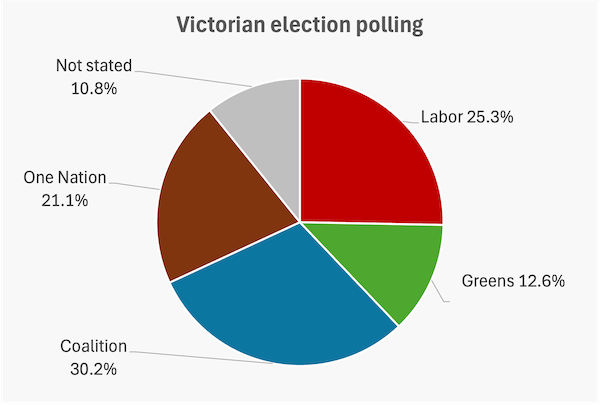
Regarding Victoria, pollsters believe it’s almost certain that Labor will lose office. Primary support for parties, taken from the most recent BludgerTrack figures, is shown in the pie chart below. It would be extraordinary if Labor could hang on to office with a 25 percent primary vote, but in TPP terms the Coalition’s lead is only 52:48. Preference flows will count.
Also, in view of the state Liberals’ extraordinary hostility to renewable energy, it is surprising that support for the Greens is not higher. Are the pollsters missing Green voters? Or are the Greens missing a political opportunity?
Samaras seems to be tilting towards a Coalition majority in Victoria, but he isn’t ruling out a Coalition minority government, in some arrangement with One Nation.
In this regard it is notable that no one is speculating on some form of a Liberal-Labor agreement, an arrangement that would be commonplace in northern European democracies, where centrist parties rule out deals with extremist movements.
We are witnessing the consequence of a long period in which Coalition politicians, rather than seeing Labor as a legitimate rival for office, have portrayed Labor as a “rotten” government, to use Taylor’s statesmanlike language, and have made defeating Labor rather than winning office their political objective. Such a vitriolic approach to politics may not have mattered when the “Westminster” two-party system dominated, but it is dangerously corrosive in our now-established multi-party system.
On federal implications Samaras simply points to the polls, most of which suggest there is little risk of a Coalition majority government, and he reminds us that neither One Nation nor the Liberals are travelling well in our urban centres.
If, as Samaras suggests, the main driver of One Nation support is annoyance at the established parties, rather than their racist and economically destructive policies, the next 18 months should give an opportunity for more independents to establish themselves in voters’ consciousness.
The government’s reaction – a challenge to the Liberals
The Albanese government, determined to be seen as the natural party of government, and reluctant to be seen lowering itself to Taylor’s or Canavan’s negativity, rarely mounts widespread criticism of other parties. But at the Queensland Labor state conference both Albanese and Chalmers warned about “the threat to our country and its cohesion, its people, and our economy posed by a dangerous and divisive coalition of chaos – a three-ring circus of Liberals, Nationals, and One Nation”.
As reported in The Nightly, Chalmers said:
Today the biggest fault lines in our politics aren’t just between the centre-left and the extreme right, but between those of us who want to address and alleviate the legitimate frustrations that people feel about the cost of living and other pressures, and those who just want to pick at them and prey on them, to politicise them and capitalise on them, while leaving our major challenges largely undisturbed.
It’s a call to those in other parties, particularly the Liberal Party, to put forward ideas that might deal with the grievances that drive people to support One Nation, rather than trying to follow Hanson into the darkness of cheap and deceptive populism.
The antisemitism commission
The government has failed to stand up against a powerful and petulant lobby that deliberately conflates criticism of the Netanyahu government with antisemitism.
The picture below is of a small gathering of German Jews at the Brandenburg Gate, demonstrating against the policies of the Netanyahu government. Rettet die Israelische Demokratie – “rescue Israel’s democracy” reads the group’s main placard.
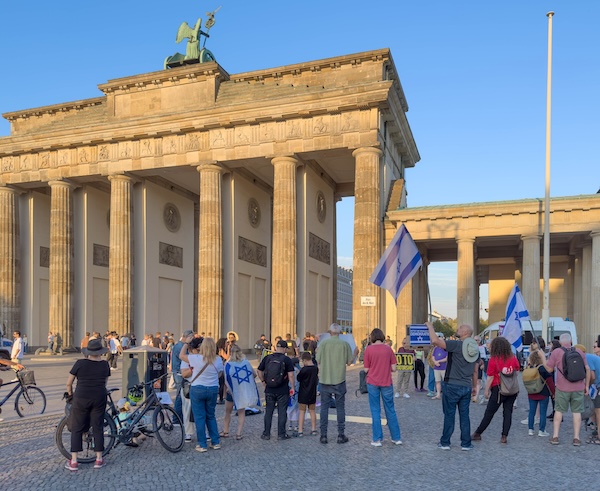
This demonstration is in a country that for the last 80 years has been extraordinarily tough on antisemitism, for reasons that need no explaining. Its government under different left and right regimes has gone out of its way to forge a firm relationship with Israel.
But Germans also have the right to free speech solidified in its basic law, its constitution, and their political culture is mature enough to distinguish between antisemitism and the behaviour of a government that is exhibiting some of the same practices that its own murderous government did between 1933 and 1945.
In view of the opportunistic politicisation of antisemitism in Australia, particularly since the October 2023 atrocities and the Bondi murders, one may wonder if such a dignified demonstration, obviously with no hint of antisemitism and with a strong protest against the Israel government, could take place in Australia.
In a speech at the Festival of Dangerous Ideas (really a weekend set of fairly uncontroversial lectures on politics and society) Richard Flanagan presented a frank assessment of the political culture in Australia in regard to the way politicians and some who claim to speak for Jews in Australia have deliberately conflated antisemitism with criticism of the Israel government.
A transcript of his speech – The new McCarthyism: Gaza and Australia – is on the Deepcut News website, but it’s worth listening to his 45-minute speech for the clarity in his presentation, his description of atrocities committed by the Israel Defense Forces, and the sombre reaction of the 500 people in the audience.
His presentation is around the centrality of freedom of speech and expression, a theme that takes him into the behaviour of the lobby that calls for less exposure of the behaviour of the Israel government and is trying to suppress protest.
To quote Flanagan:
This matters—and it matters enormously—for the guarantee of Australian democracy is not to be found in parliament nor with our elected representatives but in freedom of speech and expression and the right to protest.
And these freedoms are now endangered in Australia by the politicisation and weaponisation of the Bondi massacre by what no less a figure than Australia’s former foreign minister, Bob Carr, has described as a foreign influence operation—an operation led by those Carr and many others call the Israel lobby.
The Israel lobby is not the same thing as the Australian Jewish people nor is it composed solely of Jews—ask Chris Minns— while some of Australia’s leading Jewish figures—the likes of Louise Adler, Sarah Schwarz, Antony Lowenstein and David Leser—have spoken out against the Israel lobby and tried to warn their fellow Australians just what is at stake.
He calls out the behaviour of the “Special Envoy for Antisemitism”, Jillian Segal, and her supporters who have mounted campaigns against independent publishers and against our public broadcaster.
That criticism concerns the ABC’s coverage of the IDF in Gaza and the behaviour of settlers in the West Bank. Because the ABC has given more attention to these conflicts than it has to conflicts in Sudan and Ukraine, suggesting that there is bias in its reporting.
That’s a misunderstanding or misrepresentation of the public’s concern, which is based in large part on the way people hoped that after the Holocaust the Jews, a well-educated people, would establish a decent state in Israel. Israel had its flaws, but it stood out as a democracy in a region dominated by tribal states. When the October atrocities occurred, the reasonable expectation was that Israel would direct its response against the terrorists who planned and carried out the attack.
But the way the Netanyahu government responded with an all-out war, bombing entire apartment blocks because of the alleged presence of one terrorist, targeting journalists and aid agencies, overlooking the crimes of settlers, and closing the borders, shocked people, particularly those who had some sympathy for Israel, in a way that people were not shocked or surprised by the behaviour of the Russian or Sudanese governments. There is a feeling – a mixture of anger and disappointment – that the Netanyahu government has foolishly spent down all the goodwill it accumulated in the wake of the Holocaust, that its behaviour is disrespectful to those 6 million Jews murdered in Europe. By no measure can that assessment of the Israel government be called antisemitic.
Flanagan’s criticism is not so much against the Israel lobby, as against the Albanese government – “a government with all the spine of a liquorice stick” – that has been so acquiescent to its demands. As Canberra observers know, a lobby will go as far as it can until it meets the resistance of institutions and conventions designed to protect the public interest. These constraints were absent, because the Albanese government was frightened of upsetting the Israel lobby.
Flanagan acknowledges the strength of hatred directed against the Albanese government. The Bondi murders gave Albanese haters an opportunity to blame the government for antisemitism, and they took that opportunity:
Albanese – after being savaged by Netanyahu, after being falsely accused by the Israel lobby for ignoring the plight of Australian Jews, after the Bondi memorial service where Alex Ryvchin in a most appalling and disrespectful way did nothing to stop the crowd booing Albanese, who had after all come as prime minister to grieve with Australian Jews. After all that, Albanese caved to the lobby’s demands.
Flanagan notes that there has been a rise in antisemitism, but he systematically rebuts partisan claims that the Albanese government or the “left” have contributed to it. In fact the Israel lobby may have aggravated the situation:
A question needs to be asked: to what extent has the Israel lobby itself contributed to antisemitism in Australia by consistently advocating for Israel’s war in Gaza in a highly aggressive fashion, always seeking to identify all Australian Jewish people with Israel’s actions and with the lobby’s own heavy-handed attempts to silence Australians?
The Israel lobby and the Coalition have tried to associate the Australian “left” with this rise in antisemitism, but Flanagan identifies the more likely sources, including the Iranian government and online international terrorist groups who have been stoking hatred against Australian Jews. In fact when one considers the behaviour of organizations such as Hamas, Hezbollah and IS, they clearly belong to the most extreme theocratic, misogynistic and authoritarian right, separated from the more established right only in their explicit resort to terrorism and other forms of violence. They stand for everything the left opposes.
Let’s have an age-weighted franchise
Our voting systems are biassed in ways that favour the old and contribute to short-term policies.
Why do people have to argue the case for lowering the voting age to 16? Young people aged 16 and 17 are better schooled than many aged baby-boomers who are voting for populist right-wing parties exploiting the politics of grievance, selfishness and ignorance and are offering nothing for Australia’s future.
Bernard Keane, writing in The Guardian, goes one step further than lowering the voting age. He argues for a blatantly discriminatory voting system that would weight people’s vote according to the number of years they are expected to live according to life-expectancy data.
Keanes’ proposal is modest, suggesting that younger people’s votes should count for about 30 percent more than older people’s votes. That means 40 votes by younger people, when scaled up by 30 percent to 52, would defeat a counter-proposal supported by the votes of 50 older people.
A less modest proposal would be to weigh votes strictly in accordance to voters’ remaining life years. If we assume a life expectancy of 90, a vote cast by a 20 year-old would carry 7 times the weight of a vote cast by an 80 year-old, for example.
Any age-related weighting is particularly relevant for policies relating to climate change, and decisions about projects with a very long lead time, such as investment in a high-speed rail network. The case rests on the idea that younger people have to live much longer with the consequences of their collective decisions than older people do.
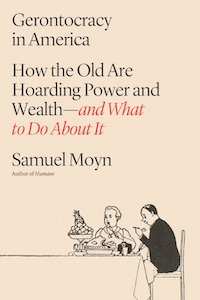
The more general issue of older people concentrating power, financial wealth, and public office, to the relative detriment of younger people, is covered in a Late Night Live session Gerontocracy: how the dominance of the old is holding America back in which David Marr interviews Samuel Moyn, author of Gerontocracy in America: how the old are hoarding power and wealth, and what to do about it.
Marr and Moyn mention in passing the benefit of compulsory voting, pointing out that in the US the median age of those who turn up to vote is significantly higher than the median age of the population eligible to vote. That builds a clear age-related bias in the franchise.
The undue influence of the aged is manifest in public policy priorities. An aged legislature resists action to deal with climate change, opposes spending on education and lines up with the hard right in opposing immigration – although it makes no sense, even in terms of self interest, that older people should be opposed to immigration.
They draw attention to two prominent cases with significant consequences – Joe Biden and Ruth Bader Ginsburg – where individuals’ decisions to hang on to office have been of benefit to Donald Trump’s quest for monarchical power.
Their discussion is about the USA, but we might observe how the old have manipulated public policy to do well for themselves in Australia. The greatest injustice has been in the tax system, particularly the extremely light taxation treatment of earnings from superannuation funds in pension phase. Less attention is given to the huge subsidies in private health insurance, in which the premiums are structured so that younger policyholders are required to subsidise older policy holders. There is presently a government proposal to reduce private health insurance rebates for policyholders aged over 65, and you can her the petulant squeals of protest all the way from Double Bay to Toorak.
Ages of party “leaders”
Matt Canavan 45
Larissa Waters 49
Angus Taylor 59
Anthony Albanese 63
Pauline Hanson 72
The discussion ends with questions about the supposed wisdom of the old – what voice they should have in the public arena. Maybe the old are urging the young to repeat the mistakes of earlier generations. But there does seem to be value, particularly when we have a government as secretive as the Albanese government, in hearing the considered opinions of retired politicians and public servants, free of the shackles of party discipline and restrictions on public comment.
The aged may also have a sense of the long term that is often overlooked by busy policymakers, whose time horizon is constrained by the three or four-year election cycle.
Unfortunately those policymakers who experienced the horrors of the mid-twentieth century and helped shape the postwar liberal order have passed on. They didn’t get it all right, but they understood how totalitarianism arose from its earliest shoots. They understood the Greek philosophers’ warning about the fragility of democracy – not because they were dedicated scholars of Plato, Aristotle and Thucydides, but because they observed what had happened in Germany, Italy, Spain and Japan, and the way “western” countries underestimated the threats their regimes posed.
As the USA slides into totalitarianism, as the extreme right reasserts its presence in other democracies including Britain, Germany, Israel, Argentina and Turkey, and as an increasing number of Australians are drawn to racist right-wing populism, we miss those voices that would be sending us strong warnings.