Public ideas
On state capacity
Rebuilding state capacity, eroded by neglect and by deliberate neoliberal policies, is difficult and cannot follow any one model.
“If we pay taxes, will our government provide more of the things we need? If we engage in the political process, will we get the outcomes we seek? Increasingly, the apparent answer to these questions is no.”
That’s the problem to be confronted – an age-old problem – addressed in a Foreign Affairs article by Jennifer Pahlka and Andrew Greenway: Democracies need creative destruction: how to make government work again.
They describe ways state capacity – the ability of governments to do the tasks citizens have asked them to do – has been eroded. The shortcomings they mention are familiar to Australians – slow and tedious decision-making, excess risk aversion, lack of delegation to staff delivering services, and conflicts between agencies.
They provide short case studies, mainly from the USA and the UK, and one from New South Wales, of agency reforms that have worked and of attempted reforms that haven’t worked. Sometimes reform is carried out within existing agencies, but this is the slow and difficult path. Sometimes new agencies are created to replace old ones. That explains the reference to Schumpeter’s “creative destruction”.
There are instances when establishment of a new agency works well, particularly when some new technology or external change requires a government response. The Climate Change Authority comes to mind as an example.
Schumpeter’s model of destruction and resurrection works in the private sector. Firms disappear and new ones emerge from the rubble. Customers may suffer some supply disruptions, (and Angus Taylor manages to claim that closures are due to Labor’s hostility to business), but the new firms that arise generally serve customers better than the ones they displace.
This model doesn’t work so well for vital public services, such as health care and policing, which must go on providing services. The authors acknowledge that Elon Musk’s “move fast and break things” approach to federal agencies hasn’t really worked.
They also recognize that sometimes institutions have assets that cannot be rebuilt from scratch. Those assets are often in the form of (unrecognized) human capital. We could imagine the disruption and loss of knowledge if we tried to rebuild the ABS or the Treasury Department.
The authors make the reasonable assumptions that governments seek to be in charge of capable agencies that serve the public. But as is often the case in Australia, governments treat the departments they run as political secretariats. To our right- wing parties, particularly the Liberal Party, the idea of state capacity is anathema. Their administrative model is one of staff cuts, privatization, and the use of tax cuts to starve agencies of the resources they need to do their job. State capacity is a curse that deprives the private sector of monopoly profits.
Hewson on patriotism
In America crude and gauche nationalism has replaced patriotism, dividing the country. We should not take the same path.
Not to be outdone by Sussan Ley, John Hewson writes about his Greyhound bus travels through Saskatchewan, the Dakotas, Minnesota, Wisconsin, Illinois, Pennsylvania and Maryland, when he was a graduate student in North America.
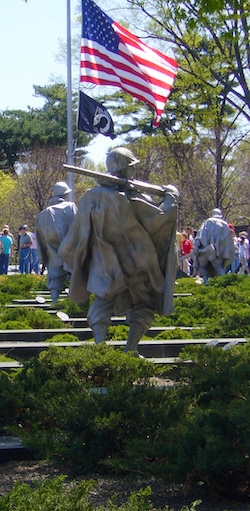
At least they have their own flag
The context is his essay What is a patriot? in the Saturday Paper, in which he reflects on the damage the Trump administration has done to Americans’ sense of public pride.
Australians visiting the US are often impressed by Americans’ sense of patriotism, even if some of its manifestations can be cringeworthy and a misinterpretation of history. Commemoration of obscure military campaigns, and token privileges for soldiers (boarding priority on airplanes) are noticeable public manifestations of patriotism.
But those public displays conceal something different below the surface. Hewson points to Gallup polls revealing that only 53 percent of respondents report that they are extremely proud to be American. During the Bush and Obama administrations there was 80 percent agreement with that sentiment.
Hewson suggests that Trump’s contempt for America’s finest achievements, and his pursuit of crude and exclusive nationalism, have contributed to this growing sense of shame.
Australia is more resilient he believes, but he sees our three right wing parties being drawn to the same sort of divisive nationalism as Trump employs. He concludes:
We should be building our national identity from the bottom up. Patriotism should be encouraged universally and not owned and harnessed by any one political party. American patriotism, which was once much admired and applauded, has become something dangerous, lifting some and crushing and terrifying others.
The road to American disunity is complete. Why any political party would seek to emulate this is beyond comprehension. We are watching a horrible passage of human history unfold in very vivid red, white and blue. Let it not be ours.
One symbol respected by almost every American, left and right, is their flag. But 125 years after Federation instead of our own flag we still make do with a design dictated by a foreign power, the canton corner of which is occupied by the flag of that distant country. Nazis on their way to demonstrate outside our oldest Parliament dressed themselves in that flag, as did those who assembled on Cronulla Beach to beat up Muslim Australians. It has become the flag of traitors: we need something that symbolizes the Australia we love.
Reds under the bed
The red scare, dormant for 70 years, is back.
Older Australians listening to politicians on the right might feel they have been carted back 70 years, to the days when the Menzies government and its supporters endeavoured, with considerable political success, to accuse Labor of alignment with the Communist Party.
The reality is that communists and social democrats have traditionally been bitter enemies. They may both have espoused principles that can be described as “socialist”. but communists have traditionally despised social-democratic parties because they endeavour to make capitalism work as well as it can, while communists want to overthrow capitalism and start again with an entirely new order.
We are hearing those same claims of association again. Andrew Bragg, in his post-budget comments, frequently accused the government of being communist – to the extent that Rachel Withers, writing in Crikey, asked Does Andrew Bragg know what communism is?
But he hasn’t learned from Withers’ explanation. In his National Press Club address is the following extraordinary statement:
Today I announce we will seek to amend Labor’s terrible SMSF ban –- to permit borrowing to invest in new housing. By law, the owners cannot live in these houses so all this ban is doing is stopping new housing. These communist style taxes are nonsensical.
An AI search of Soviet history for references to the comrades holding self-managed superannuation reveals no responses.
The red scare refuses to die, and writing in The Conversation Theodore Zorn of Massey University explains why, in his contribution: Return of the Red Scare: how the US right is weaponising the word “communism”.
The word “communist” has become a floating signifier. That is, a word to which its user can convey a large range of meaning. He provides a short history of the use of the word by politicians on the right:
During the Cold War, communism evoked not just a political and economic system, but ideas about revolution, atheism, dictatorship, subversion and treason. Political opponents became enemies within.

Dangerous badge sellers
Bragg’s red scare is probably outdone by a statement Pauline Hanson made on Sky News, shortly after the Commonwealth budget was announced. Her words for the government were: “Far as I’m concerned, they’re nothing but socialist, communist, Marxist government”.
The irony of her stance is that of all our significant political parties (if her ragtag movement can be called a party), One Nation is the closest we have to a communist party. Its platform is based on class-based resentment, and like the Bolsheviks it is committed overthrowing the established political system.