Economics
Superannuation
How the right sees compulsory superannuation: it must be bad because it was a Labor initiative and it makes it hard for finance sharks to rip off investors.
An outstanding feature of Australia’s superannuation scheme is its heavy reliance on the private sector, setting us apart from practices in most other “developed” countries that rely on government-administered social security systems.
For example our scheme is quite different from the US social security system, a federal-government administered scheme, to which all employers must contribute by way of a tax on their payroll. A comprehensive comparison of the Australian and American schemes is in a paper by Boston College’s Center for Retirement Research: Can an Australian Approach Save the U.S. Retirement System?
The “small government” libertarians surrounding Trump are enthusiastic about the US adopting something resembling our scheme. For administrative reasons that’s unlikely to happen, and the one criticism of our scheme in the Boston College paper is that it may be too subject to the risk inherent in private sector capital markets.
So it is strange to hear our politicians on the right criticising our scheme, on the grounds that it somehow involves the government taking our money, when others on the right are holding it up as a private sector model.
One line of criticism is from Andrew Bragg, who in an interview on Radio National mounted a strong attack on our superannuation scheme. After he made some silly claims about ACOSS’s superannuation policies, Sally Sara asked him to explain why he dislikes compulsory superannuation. His reply:
Well, because it hasn't worked. I mean, it's one of the biggest public policy failures since Federation in the sense that it hasn't helped the Budget, and it has not really helped many people get off the pension. What it has done is it has created a huge viper's nest for banks and financiers and unions to pilfer. Which is why what you saw at the Labor Party conference was, now you're going to have super for under-18s and soon you'll have super for cats and dogs.
Such a sloppy statement does not deserve the respect of a considered response, but The Guardian’s Patrick Commins rebuts his claims in a well-documented article: Rightwing critics argue we might as well scrap super. Here’s why that could spell disaster for Australia’s finances. Drawing on Treasury data he shows that our compulsory superannuation scheme is doing a sound job at reducing the need for public spending on the age pension, even while the population ages.
Hanson has joined the bandwagon, suggesting that the current system is “broken”, and that Australians should have much easier early access to their funds, including for mortgage repayments, a view supported not only by Andrew Bragg, but also by Liberal Treasury spokesperson Tim Wilson.
It’s not clear what lies behind these ideas. Perhaps Wilson and others inclined to financial libertarianism dislike our scheme because in their view it is subject to too many rules and too much oversight. These effectively limit the cut the finance sector, particularly the small-business dominated industry of financial advisors, mortgage brokers and so-called “wealth managers” can take out of people’s savings. Or perhaps it’s just a partisan feeling: the system must be bad because it was a Labor initiative.
Let’s see what happens when people can get around the compulsion of superannuation.
A $38 billion experiment confirmed what behavioural economists (and most people) already knew
The ABC’s Gareth Hutchens has a detailed post describing current provisions that allow people to access superannuation early, and explains the consequences of doing so.
The ATO allows withdrawal of superannuation on specified compassionate grounds. The table below shows that most of the $1.4 billion drawn in 2024-25 was for medical reasons, a category that includes weight-loss treatment and dental care. Medical care is by far the largest category and is subject to strongest growth, having almost doubled in two years.
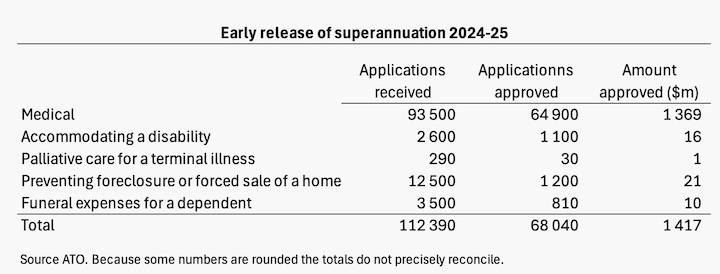
The growth in medical withdrawals should be of concern to the government. The $1.4 billion is small change in relation to the huge amount invested in and continuously contributed to superannuation, but it confirms that there are gaps in Medicare’s claimed universality.
Apart from that small leakage, the design principle of preservation – “it’s your money but not yet” – is pretty well enforced.
During the Covid pandemic, however, the Morrison government provided an 8-month window which allowed people experiencing financial distress to withdraw up to $20 000 from their superannuation. Over that period $38 billion was withdrawn. Most applicants had low to middle incomes, and 40 percent were aged less than 35 – the people who, over their lifetime, have most to lose from the compounding effect of early payments.
Drawing on research conducted by Nathan Wang-Ly of the University of New South Wales and Ben Newell of the Commonwealth Bank, the ABC’s Peter Ryan found that about 13 percent of those withdrawals were spent on reducing debt, but the rest was spent on current consumption, including about 10 percent spent on gambling: Superannuation withdrawals spent on gambling, alcohol, takeaway food.
This de facto experiment gives some idea of the consequences if superannuation withdrawal rules are relaxed. Very little goes into paying down debt, or is directed to other investments.
The idea that people should be able to withdraw superannuation to pay a house deposit is particularly stupid, in the same way that the government’s five percent deposit scheme is stupid: given the price inelasticity of demand for housing, it would simply set off another round of house price inflation.
The Liberals have tried to distance themselves somewhat from demands to make it easier to withdraw from superannuation, but it’s a delicate political situation when Bragg is calling compulsory superannuation a “loss of liberty” and Treasury spokesperson Tim Wilson is showing similar libertarian sentiments. Treasurer Jim Chalmers says, with some justification, that he would love to run an election on superannuation.
The Covid experience confirms what most of us realize at some early time in our lives: it’s bloody hard to save. In fact we are usually thankful for the presence of some authority that forces us to save. Putting this into a rigorous academic framework was the work late last century of serious economists, including Colin Camerer, George Löwenstein, Thomas Schelling, Cass Sunstein and Richard Thaler to name some of the group known as “behavioural economists”.
In simple terms it’s about the choices we want to make over a lifetime. If I’m aged 20 I can rationally think of myself in 40 years, pleased with my having chosen to save back when I was 20, when there were pressing demands on my finances from all quarters. The “me” at age 60 well be pleased that there was some agent back then forcing “me” at 20 to exercise my lifetime choice. That’s the way Schelling put it, using examples ranging from Ulysses and the Sirens through to the placement of alarm clocks.
Is superannuation beyond criticism?
Not all the critics of superannuation are right-wing zealots or greedy commission agents eager to help themselves to a cut from people’s savings. Many observers quibble with the 12 percent contribution, some arguing that it should be higher, others arguing that it should be lower. There is no easy resolution of these arguments because there are too many variables about which assumptions have to be made – assumptions about people’s future earnings and life expectancy many years down the track.
One key point, however, is that early contributions count. A contribution of $1 000 at age 18 will accumulate to $10 000 in real (inflation-adjusted) terms at age 65, if invested in a fund with a 5 percent return. That’s why superannuation for young workers in the gig economy and for women taking maternity leave is so important. It’s why fees are so important: a finance shark taking a 2.0 percent fee will reduce that $10 000 accumulation shown above to a mere $4 000.
An area calling out for reform is the generosity of tax treatment of the income from high balances in retirees’ superannuation funds. Someone with a superannuation balance just below $3 million (the point at which a light 15 percent tax on earnings cuts in), could be earning $150 000 in tax-free income from his or her fund, and another $18 000 from other investments outside superannuation, paying no tax on an income of $168 000 a year. A PAYG taxpayer with a similar income would be paying $43 000 in income tax. Double those amounts for a couple.
According to Treasury, in its 2025-26 Tax Expenditures and Insights Statement, concessional treatment of income from superannuation earnings is costing $26 billion a year, and is growing quickly. The chart below copied from that statement, shows that those concessions are disproportionately enjoyed by those in the highest-income decile.
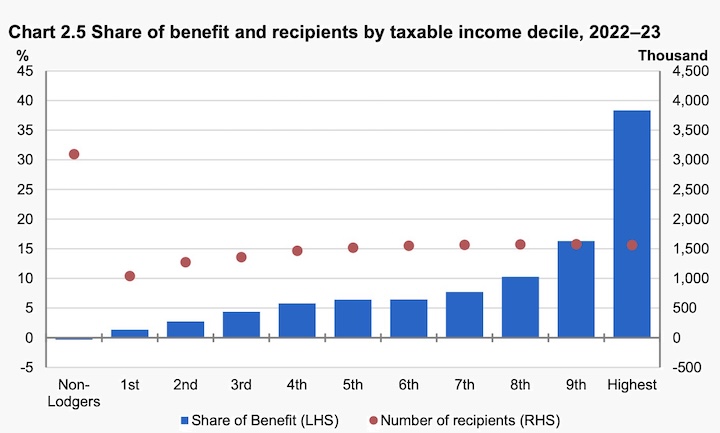
The government, to its credit, has reformed capital gains taxes and taxes on “investment” properties, based on the principle that those whose income is from idle investment should be taxed at the same rate as those whose income is from work. Hardly a radical idea, and one that should be extended to revenue from superannuation, particularly in the retirement phase.
Good riddance card surcharges
The coming prohibition of card surcharges is a small but meaningful victory for competition.
On October 1 we can celebrate the eradication of a curse that has plagued Australia. We will still have rabbits, private health insurers and junk mail, but we will be free of card surcharges.
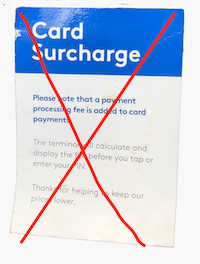
Crispin Hull has a concise history and explanation of these surcharges, and the likely consequences of their removal, in his post Rewarding captive customers.
In short their removal will help markets work more efficiently in the interests of consumers, and could help protect public revenue.
The obvious way they improve the functioning of markets is that there will no longer be an annoying discrepancy between the posted price and the price you pay. That’s a win for transparency.
The more significant way they help consumers is that they make credit card “rewards” systems less attractive to merchants, as Hull explains. The surcharges were originally justified, in 2003, as a means of ensuring that customers using cards were not unfairly subsidized by customers paying cash. That was because credit cards carried the benefits of “rewards”, usually in the form of frequent flyer points.
Since then much has changed. Debit cards, incorporated in phone banking apps, have largely replaced credit cards: mostly they carry no “rewards”. And as any industrial engineer can point out, the argument about unfair cross-subsidization has been turned on its head. For merchants cash transactions incur a bundle of costs that card transactions don’t. Think of reconciling cash registers, security, insurance against break-ins, trips to and from banks to manage cash reserves, and idle working capital.
Consequently, “rewards” have been losing their value because there is less revenue in the surcharges. Hull mentions that frequent flyer credits have lost much value as redemption into airfares or upgrades. He could also have mentioned that since 2003, air travel has become an even more ghastly experience: for many credits for colonoscopies or root canal therapy would be more appealing than airline reward points.
If, as a result of these changes, “rewards” systems disappear, the costs to consumers of two anti-competitive practices – bundling and customer capture – will be eased.
The textbook example of “bundling” occurs when a customer wants to replace an axe handle but finds she has to buy a whole new axe. You may want a specific part for your car, but you have to buy a complete assembly. Some bundling, such as the inclusion of useless extended warranties, is prohibited by consumer law.
Your taxes at work for cash lovers
In fact until 1980 South Australians were protected by the 1924 Trading Stamp Act that prohibited all bundling, including trading stamps and customer loyalty schemes. That law was designed to ensure that markets worked in the interests of consumers – the textbook competitive model – but for the last 50 years governments, particularly governments of the right, have been more concerned to intervene in markets to help powerful business interests.
Customer loyalty schemes, more accurately known as “customer capture”, are specifically designed to prevent us from shopping around for better deals, and “rewards” points are the ideal way to recruit customers and to hold them.
The other point Hull mentions is the cost to public revenue of providing cash. That includes the cost of printing, distributing and accounting for banknotes and coin. It also includes the cost of tax evasion through use of cash: Hull cites a figure of $16 billion a year as the Tax Office’s estimate of the loss to public revenue facilitated by cash transactions. Well-meaning people protesting against moves to a cashless society, should think of the cost of sustaining a system that makes life easier for criminals.