Public ideas
George Megalogenis on shocks
Megalogenis writes about the developments that creep up on us and force us to rethink our public ideas.
Ideas that form the basis for public policy and the strategies of political parties can live on long after they have become out of date. Changes can be occurring in plain sight, but when they are occurring slowly they do not necessarily re-shape public ideas.
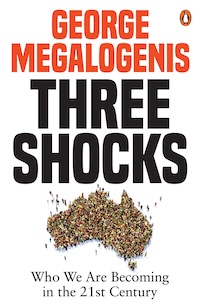
In his just-released book Three shocks: who we are becoming in the 21 st century, George Megalogenis presents three basic developments in Australia that are still not fully absorbed into the way the political class thinks, particularly those on the right.
They are not shocks that suddenly appear, such as a pandemic or the election of a narcissistic madman as US President. Rather they are the “shocks” of suddenly coming to grips with something that has been developing over a longtime.
The first shock is demographic. He actually nominates a year – 2018 – when the majority of Australians could be defined as once again “immigrant” as we were in colonial times – either immigrants ourselves or first-generation children of immigrants (including himself). The origins of those immigrants, once dominated by the UK, has changed, and more recent immigrants have become increasingly concentrated in two cities, Melbourne and Sydney.
The second is about our workforce, which has becoming more feminized. He nominates 2015 as the year in which the number of professional women overtook the number of professional men, and among non-professional ranks of workers women are catching up fast.
The third, to which he does not nominate a specific year, is the changed geopolitical world in which Australia finds itself. We cannot assume, as we once did, that there is any country that would come to our aid as needed. We now live in a world of “capricious allies and trading partners”.
In a 40- minute podcast hosted by the AGE-Sydney Morning Herald as part of their GoodWeekend Talks series, he describes these shocks, particularly the first two, in an interview with Gay Alcorn. He does not suggest that the developments leading to these shocks have bad consequences, but he does point out that politicians, particularly those in the Liberal Party, have been slow to appreciate how these developments have re-shaped the nature of the Australian electorate.
To an extent he is referring to the long-established distinction between urban and non-urban Australians, about which authors like Henry Lawson wrote. But the distinction could be resulting in more polarization, because urban Australia, particularly in our two megacities, is increasingly looking very different from our non-urban population. Labor strategists understand this in a way that Liberal strategists don’t.
He sees the rise of One Nation in this context. Commenting on the non-urban voters who have turned to One Nation, he says about their attitude to the Coalition:
They’re not going to win an election anytime soon, and I’m never going to vote for bloody Labor, so I’m going to send a “smash the system” signal.
Megalogenis does not want to see the system smashed, because he sees dangers in localized tribalized politics. He wants to see the Liberal Party, now largely banished from our population centres, become relevant to urban voters – not the “white” male battler voters of Menzies’ day and even of Howard’s day, but the urban voters as they have become.