Politics
Gambling
Negotiations about gambling reform are political theatre. The underlying issues are about the two-party system, the power of executive government, media funding, and the commercialization of sport.
The Senate negotiations over gambling reforms are ideal feed for journalists reporting on strategies, deals and compromises between three political parties.
It’s so much easier to report on politicians’ positional bargaining than to take a step back to analyse and observe the underlying issues that have brought our Parliament to this situation.
The Canberra Times editorial – Prime Minister, what’s gambling really costing you? – puzzles over the government’s hard line:
It’s difficult to understand this refusal to clamp down on something that is manifestly harmful, and so obviously targeted at new generations via the phones they can’t put down, while defiling the televised live sport that families used to be able to enjoy together without being subjected to constant inducement to gamble away grocery money.
We don’t learn much from the three established parties. Apart from a few brave individuals, such as the Liberals’ Simon Kennedy and Labor’s Alicia Payne, most Labor, Coalition and Green politicians are sticking by their party bargaining ploys, which are about ostensible displays of political power. Whatever its content a Greens-Labor deal would be a marvellous victory for the Greens and a Coalition-Labor deal would be seen as a soft rebuke to One Nation. That’s the political game.
For an impression of what comprehensive gambling reform would look like, independent Senator David Pocock has a six-point set of amendments to the government’s bill, reproduced in full below:
- Comprehensively ban gambling ads on all platforms, commencing three years after the start of this Bill, in line with recommendations of the Murphy Review.
- Ban all gambling inducements, which the Murphy Review said should be banned “without delay” as they had “no place in Australia”.
- Require that any opt-out mechanism must be easy to find, straightforward and that it must not be designed in a way to discourage people from opting-out.
- Ensure Smart TVs are captured by the Government’s reforms, to prevent ads from shifting from TV programs to TV home screens.
- Implement from 1 January 2027 the Coalition’s policy of a comprehensive ban on gambling ads during live sport, including an hour before and an hour after - regardless of the time live sport plays.
- Require an independent review of the effectiveness of these reforms three years after they commence and delivered within 12 months.
These are worthy reforms, and even if, as is likely, the government does a dirty deal with the Coalition, or a slightly better deal with the Greens, Pocock’s proposals should be held up as something to strive for under a different administration.
But whatever deal is made, it will simply push down the line serious issues that have made gambling reform such a difficult problem over the three years since the Murphy Report – You win some, you lose more – was presented to Parliament.
Independent MP Kate Chaney picks up the most serious issue in an interview on Radio National Breakfast, where she reminds us that the government is “listening to the money and the power, not the people”.
It’s a comment about the power of executive government in what is supposed to be a parliamentary democracy. It’s a fair bet that if every parliamentarian were to leave their party identification behind them, we would have something resembling the Pocock reforms. But we don’t, because retaining that power of executive government is in the joint interest of the two-party duopoly, which is why the Albanese government is so keen to do a “bipartisan” deal.
Such is the investment in that two-party “Westminster” model, that the political establishment in Canberra, including many in the press gallery and in universities who research and write on politics, don’t want to look at the evidence that the two-party system is past its use-by date, and that we are heading to a different form of democracy. That evidence is in recent elections and is confirmed in recent polls, which now have the combined Labor plus Coalition vote at around 50 percent. And it’s evident in the rise of One Nation, running on a grievance platform blaming the established parties for all the nation’s problems, real and imagined.
Yet in political commentary, we still hear that word “bipartisan” as if our political landscape is the same as it was fifty years ago. Journalists would do well to wipe their computerised address books clean, and develop a set of political contacts representative of Australia in 2026.
It is possible that the so-called “teal” independents, presently united in their views on integrity and climate change, will add gambling reform to their shared views in the runup to the next election.
The power of executive government and the demise of the two-party system cut across many areas of public policy. The specific concerns about gambling reform raise two more unresolved issues – funding of media and the commercialization of sport.
To put the first issue bluntly, the argument seems to be that although sports-bet gambling is an unsavoury business, exploiting money from the most gullible and ruining lives, it must be sustained to preserve independent media, battered around by years of declining advertising revenue. That may or may not be the case: similar arguments were raised in relation to cigarette advertising and the worst predictions didn’t materialize. But it is becoming clear that the business model of traditional media – news, information and entertainment funded as a byproduct of advertising – is unsustainable, and even if it were sustainable it remains the most regressive way imaginable to fund a public good.
This issue of sustainable funding was taken up in the 2021 Senate inquiry into media diversity and it remains unresolved. You can see a short response made at the time by the Public Interest Journalism Initiative.
The commercialization of sport – or the commodification of sport as some put it – is another issue. There was a time when most sport, including football and the Olympics, was amateur, and Melbourne was no less football-obsessed than it is now. There was a time when politicians and public servants could not be bribed with tickets to the VIP boxes at football games, not because politicians and public servants were more moral, but because there were no VIP boxes and they had to mix with the hoi polloi.
It’s taken a long time for the public to appreciate the extent to which big money has corrupted sport. Worldwide public attention has been brought to this problem by exposure of corruption, allegations of corruption and practices such as unaffordable tickets in international soccer (FIFA). Closer to home is a bid by sporting bodies to have taxpayers spend billions of dollars for a stadium in Hobart – an extortion bid that so far has “bipartisan” support from state politicians. You can read Nick Gruen’s assessment of the Hobart Stadium in Sam McClure’s article in The Age – “Hard to think of a more wasteful project”.
Perhaps the government could make some amends for its gutlessness on gambling by re-directing the $1.2 billion it is spending on sports away from stadiums for the Olympics and putting it to helping participatory sports. Measured GDP would fall a little as sport is liberated from the shackles of big money, and the overpaid sport executives would have to go and get real jobs. And there would be nothing stopping mates laying bets with one another at the Wagga vs Temora rugby game.
Sussan the easy rider
On a Greyhound bus ride a former Australian politician discovers another America that’s gone past the politics of grievance.
If you have a quarter of an hour you might learn a lot from a story on the ABC’s 730 program about Sussan Ley’s journey in the United States.
In the days when Australians used to find the US an appealing travel destination, the coast-to-coast drive almost assumed the status of a pilgrimage. But Ley’s journey was different – she did it from North Dakota south to the Mexican border. These aren’t the very poorest states (those are in the old South), but as Ley explains, they are where people seem to feel most disadvantaged. And she did the journey in Greyhound buses, a mode of transport few Australian travellers would choose and a universe away from the Chairman’s lounges she would have experienced as opposition leader.
In the interview with Sarah Ferguson she insists that she is not making any political statement, but it’s not up to her to determine people’s interpretation of her adventure.
Her observations about the people she travelled with on that journey reveal a condition that goes beyond grievance. There is no fight left: they’re “disconnected” to use her term. “Past carin” as Henry Lawson put it. It’s a step down from the mood she might have experienced travelling across her Farrer electorate.
That’s a strong political observation.
And surely her appearance as someone who is prepared to mix with the people one meets riding Greyhound buses and drinking in small town bars says something about her style of politics, even if she really didn’t intend to make a political statement. These are the same qualities that ensured the people of Farrer kept voting for her.
Whether she wishes it or not, every time she comes to the public attention people will be reminded how the men of the Liberal Party made her a scapegoat for the party’s failings, and will be reminded that for nine months there was a vision of what the Liberal Party might have been.
Have we reached peak Pauline?
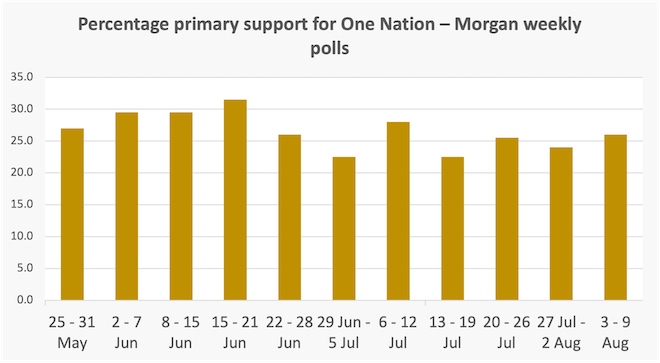
Peak Pauline is probably behind us, but her support seems to be stabilising at a high level.
The weekly Morgan polls suggest that One Nation’s support, after reaching about 30 percent in June, has fallen by about 5 percent, and is now hanging around the 25 percent level.