Other economics
The Reserve Bank’s non-surprise
Having decided to hold interest rates at 4.35 percent, will the Reserve Bank have the good sense to maintain a steady path of monetary policy?
The commentariat must be extremely thankful to Donald Trump and Mojtaba Khamenei, because they can carry the blame for their rapidly-changing predictions about inflation and interest rates. Not long ago a rise in interest rates was close to a certainty, but by the start of this week it was not to be contemplated, even though the Strait of Hormuz remained closed and there has been no change in domestic economic conditions.
As has often been pointed out in these roundups, much of the problem of instability results from the Reserve Bank’s use of the twelve-month movement in the CPI as an indicator of inflation. Too much attention is paid to small moves in that series – statistical noise in cases. (In fact, because the July 2025 CPI was abnormally high, it’s a fair bet that the July 2026 CPI, due on 26 August, will be low, setting off speculation in the opposite direction.)
The Bank’s statement accompanying its decision to hold the cash rate target at 4.35 percent could be seen as an example of deliberate bureaucratic vagueness, or as an admission that the board is unsure about the trajectory of the Australian economy, and even unsure about what it is supposed to be doing.
The general message is that “financial conditions have tightened”, that “labour market conditions have eased by a little more than expected” (i.e. workers are having a tougher time), that “consumer spending growth is slowing gradually” and that demand pressure on the housing market has eased significantly. “The economy appears to be slowing as expected” they write.
That all points to monetary policy doing its job. But the board members cannot shake off their obsession with those CPI numbers: “inflation is still too high” they state.
Also they’re frightened about global energy prices flowing into the CPI. They could well do so, but is this the sort of self-sustaining inflation with which monetary policy should be concerned, or is it a signal of a necessary structural adjustment – a once-off price shift, prompting a re-allocation of resources, away from high-cost fossil fuels?
In fact their statement of monetary policy makes no mention of renewable energy, except in the context of data centres, and even projects Australian energy prices to be rising, which is contrary to AEMO’s forecast. This is probably because monetary policy treats the economy as one big fungible blob, with a certain “capacity”, unable to adjust to changing relative prices, rather than as a system characterized by interactive complexity, with underutilized resources in some places, and overheated demand in others.

They don’t have enough levers
The limitation of that “one big blob” model is illustrated in the latest ABS Monthly Household Spending Indicator, which reveals strong rises in spending on transport and on recreation and culture. The ABC’s Hanan Dervisevic reports on her interviews with ABS staff who point out that spending on electric vehicles and travel accounts for much of this boost. If our spending is boosting the Chinese electric vehicle industry and international airlines, that’s money leaving Australia, suppressing domestic demand and reducing demand-side inflation, but that sort of complexity is not picked up in the “one big blob” model that underpins monetary policy.
As summarized in their press release, the Reserve Bank’s economic forecast points to a slow improvement in most economic indicators over the next 30 months, apart from a small rise in the unemployment rate (which the board sees as a positive). That is, if they don’t panic because of a rogue jump in the CPI and send the economy into a recession.
There is a notably different tone between the generally positive message in the press release and statement on monetary policy, and the governor’s more dismal explanations at the media conference. Governor Bullock seems to be expressing a personal view that more has to be done to combat inflation.
The statement on monetary policy includes a statement of risks, including those that are consequent on developments in the Middle East. The risk they do not mention is the election of a Coalition or a Coalition-One Nation government. Even opinion polling showing the likelihood of such a government being formed, with an ill-matching mix of Thatcherite austerity and populist concessions, could precipitate a collapse in business confidence, and would stop our industrial transformation in its tracks.
For what it’s worth, below is a chart of the Reserve Bank’s CPI forecasts. Note that their headline and trimmed mean estimates converge from December 2027.
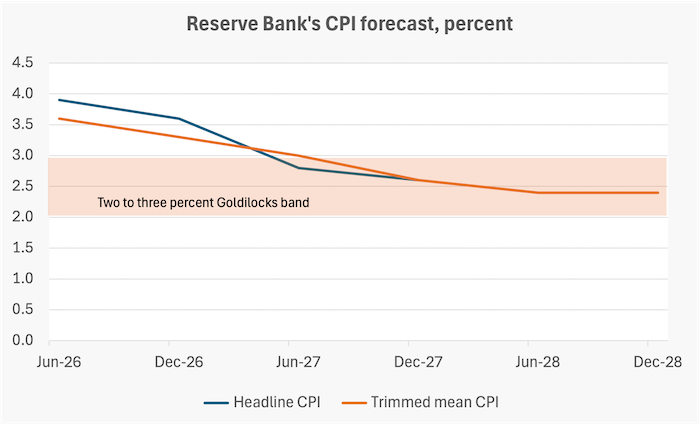
I include this graph because of misleading press comment that Australia won’t have inflation under control until 2028. That commentary is based on the disputed idea that the CPI is a sound indicator of inflation; it ignores the Bank’s own forecast the CPI will reach the upper limits of the comfort zone within the next twelve months; and the CPI figures it uses are historical which means they overstate inflation in a time of falling prices.
The “inflation” you experience is not the same as the Reserve Bank’s “inflation”
That difference has consequences.
When the ABS announces that the CPI has risen by X percent – the last X was 3.8 percent – have you ever had the feeling that it doesn’t align with inflation as you experience it?
In the roundup of 25 July was a link to what the Reserve Bank sees as the public’s misunderstanding of inflation and interest rates. (It may be that the Reserve Bank doesn’t quite know how its big monetary lever works).
Possibly prompted by that supposed misunderstanding, the Australia Institute’s Greg Jericho, in an interview with Eleanor Johnston, has devoted a podcast in its 30-minute Dollars and Sense series to an explanation of inflation.
If you’re familiar with Microeconomics 1 theory you can skip over the first 12 minutes, where Jericho goes into the processes of estimating inflation and explaining the basics of monetary policy. (If you’re a teacher, however, it’s worth watching Jericho’s example of a very clear explanation).
The interesting stuff is from then on, where Jericho talks about the choice of data that drives the RBA’s decisions. People with a mortgage experience a rise in the mortgage rate as a rise in the cost of living, but the statistician doesn’t and therefore the Reserve Bank doesn’t. But as Jericho explains, even the Reserve Bank governor gets tripped up on the distinction. No wonder the public is confused.
He also explains situations where higher interest rates do flow through to higher prices, and the salience of gasoline prices in influencing the public’s ideas about inflation.
The Reserve Bank and the government have a lot of explaining to do.
Telecommunication policy – it’s always been tough in the bush
Policymakers are surprised to learn that not all Australians live in urban regions with 5G mobile coverage.
The last thirty years have seen extraordinary advances in telecommunications in urbanized regions, heightening awareness of the lower quality of service in less populated regions. That relative deprivation, going back more than 100 years, involves questions about what standards should be regarded as adequate in remote regions, how the cost of such expensive services should be distributed, and whether a privatized system with competing providers can serve those living and working in our sparsely populated regions.
Recent outages of Optus and Telstra services have brought forward these issues on the policy agenda.
The Telecommunication Industry Ombudsman’s report
On Thursday the Telecommunications Industry Ombudsman released a report: Left behind: experiences of telco consumers living in regional, rural and remote Australia. It is summarized in four “key findings”:
- Remoteness can make everyday telco issues harder to resolve.
- Mobile connectivity can be unreliable and fall short of what consumers need.
- Limited choice and low awareness of telco technologies can leave consumers without alternative options.
- Outages and unreliable services create significant safety risks and disruptions for business.
Anyone who has lived in the bush would be unsurprised by these findings: they could have been made fifty or a hundred years ago. It is possible that expectations of what can be provided have run ahead of what can be provided at reasonable cost.
Domestic roaming – a National Party MP becomes bushwhacked
National Party MP Anne Webster was in the northwest of her Mallee electorate, near Ouyen, when she found she was out of mobile range, which also meant that Apple Car Play, the navigation system on which many people rely, dropped out. She describes her ordeal in an interview on Radio National, for which she has provided a transcript.
She has used the experience as a case to join others calling for domestic roaming. That is the arrangement whereby if you have an account with one mobile provider and are out of range, you can use another provider’s service if you’re in their zone, seamlessly and without paying an extra fee.
It’s not the first time the issue has been raised. In 2017 the ACCC examined the case, and decided against roaming, on the basis that it would not promote competition and would make it harder for new providers to enter the market.
The issue has come up again, partly because of the publicity around Optus’ and then Telstra’s outages, and issues around 000 outages, although emergency calls are already subject to roaming.
Last week the ACCC launched another inquiry into mobile services. Writing in The Conversation – What is mobile domestic roaming? Here’s why Australia needs this policy – Mark Gregory of RMIT University presents the case for roaming, drawing attention to roaming arrangements in other countries, including Canada, a country that resembles Australia with regions of concentrated settlement separated by large sparsely populated spaces.
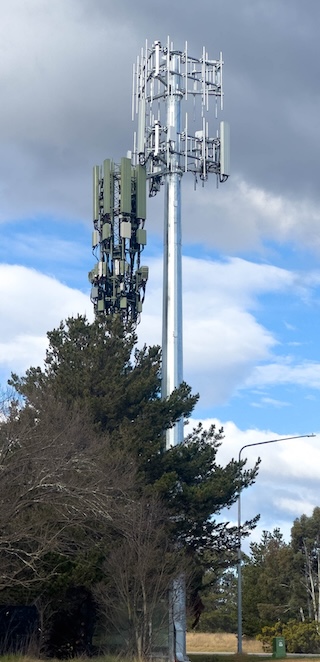
If you compare the coverage maps of Telstra, Optus and Vodaphone you will see that Telstra has the widest coverage, while the other providers are more concentrated in urban areas and along highways. Unsurprisingly therefore, having invested in services in the least lucrative, least settled areas, Telstra has no enthusiasm for roaming.
Misallocated resources
Discussion of the issue is centred on the assumption that competition is an unmitigated good, and the more competition the better. But the case for a single, government-owned monopoly, with a strong community service mandate, should also be made. Roaming advocates are essentially asking city dwellers to cross-subsidize those who live in non-urban regions. Nothing wrong with that – we do it with postal services, and we did it with Telstra (previously known as Telecom Australia, and before that the PMG) as a monopoly telecommunication provider, until there was an orgy of privatization in the 1990s. Telstra had an edge, having already established a basic mobile network, and the new entrants, naturally, went for the most concentrated regions, particularly the capital cities, often resulting in the waste of duplicated infrastructure. And once the market became contestable all providers operated with the cost consciousness of firms in a competitive industry – a culture that’s at variance with the need for redundancy in crucial services. The case for re-nationalization, with appropriate compensation for Optus and Vodaphone, should be examined by the ACCC.
As for Anne Webster’s predicament, it’s doubtful if roaming would have helped. She claims she was on a “major highway”, near the settlement of Speed, but an examination of Optus and Vodaphone maps suggest their coverage in that region is patchy at best. Anyone who has been out in that area knows that Sunraysia Highway is the sort of road where traffic is so light that locals are still in the habit of lifting a finger from the steering wheel in a friendly gesture to other drivers they may encounter.
Nothing beats an old-fashioned road map and situation awareness in those regions, but perhaps Webster does find geography a little difficult: it was she who mistook the Vietnamese flag for the Chinese flag last Tuesday – a minor event that the Vietnamese have politely ignored (even though the mistake is akin to confusing the Irish and British flags). When there are minor diplomatic gaffes and indiscretions around flags and melons grownups laugh them off and get on with the serious job of foreign relations.