Closing the Gap
Closing the gap – the indicators
Encouraging news on early childhood education, but terrible figures on child and adult justice.
Unsurprisingly the government has reminded us of a success in closing the gap between indigenous and other Australians in preschool enrolment, because the target of 95 percent enrolment among ATSI children has been exceeded.
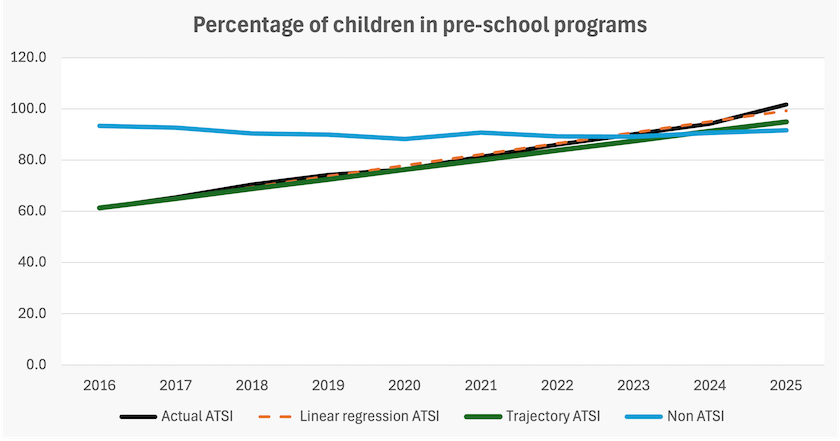
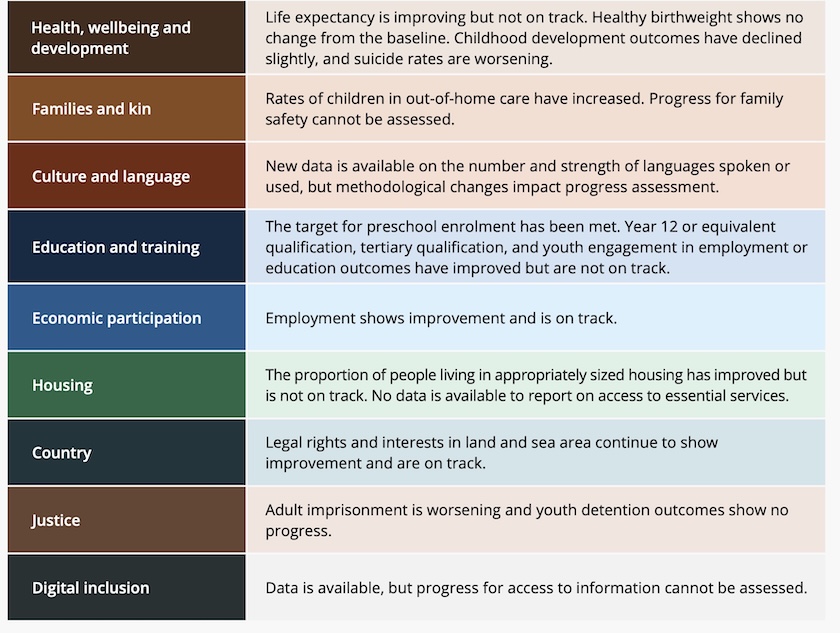
In view of the importance of education as a precursor to further development, this is an important achievement, but there are 18 other targets, 4 of which are worsening and 20 of which are below the trajectory of improvement. The diagram below, copied from the Productivity Commission’s Annual Data Compilation Report, summarises general progress towards closing the gap.
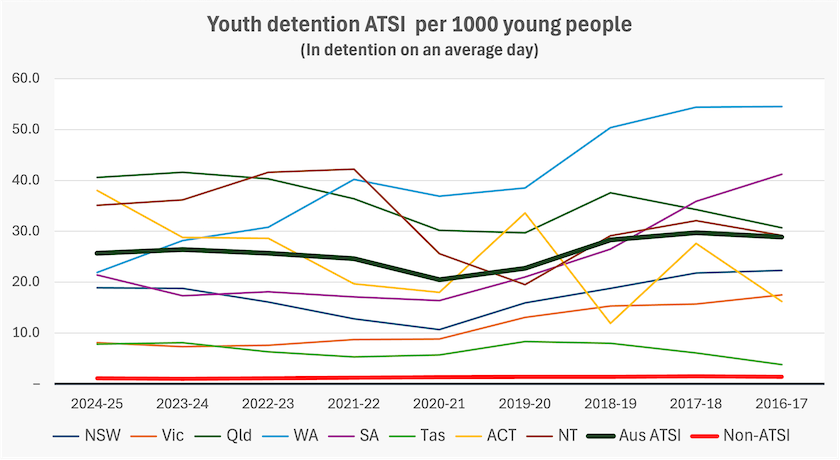
ABC indigenous affairs journalists Brooke Fryer and Kirstie Wellauer write about a prominent area where the situation is going backwards, youth detention: Closing the Gap data reveals rise in First Nations youth held in detention without sentence.
A graph of youth detention shows that the gap – the distance between the black line (indigenous) and the red line (all other young Australians) – is wide and is getting wider, particularly in the Northern Territory.
Those who work with young indigenous Australians want to see governments invest more money into early intervention programs that would prevent them from youth entering the justice system in the first place. The gap won’t be closed in our jails.
Closing the Gap – Noel Pearson on maps and governance
Noel Pearson puts forward ideas that re-arrange Commonwealth and state responsibilities for policies towards indigenous Australians
Noel Pearson used his speech at the Garma Festival to put forward a major challenge to the established indigenous policy framework of Commonwealth and state governments.
His article in The Guardian – The inability to deliver the changes Indigenous Australians need is no longer just a moral failure but a civilisational one – outlines his idea for the Commonwealth to bypass state governments in their funding of programs for indigenous Australians. As he describes it:
A direct funding relationship between the commonwealth and the organisations representing and serving these communities would enable development agendas such as the personal responsibility and opportunity act of Cape York Peninsula to receive the budgetary support it needs to close the gap.
His proposal is driven, in part, by the history of regressive policies in states, particularly Queensland, whose hard-right governments including the Bjelke-Petersen government, enacted particularly regressive and unjust policies towards Aboriginal Australians. Not that he confines his criticism to one party:
Until political parties sever ties with vice industries − grog and gambling − little will change. The poor are a goldmine, said the economist Thomas Sowell. The CLP, LNP and ALP, when in power, believe it is the divine right of the vice industries to make a profit from the immiseration of our people.
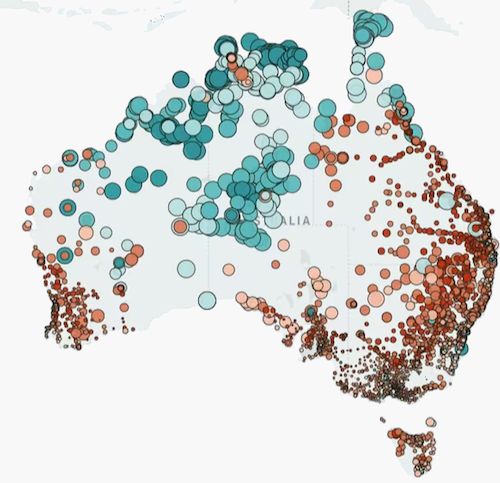
Pearson’s proposal is also guided by a geographical reality. When the First Australians came to this land they paid no respect to the borders that were to be drawn by the colonial administrators 60 000 years later. Pearson uses a map, prepared by the Electoral Commission, to show where his model would be most relevant. This is a map of the strength of the “Yes” vote for the Voice, the blue circles depicting the places where support was greater than 50 percent. Note the distribution between states and territories, illustrating one of the present jurisdictional problems.
Pearson does not suggest anything as radical as a Commonwealth takeover of these regions. In a report on his speech he is quoted as stating:
These communities and their lands would still come under the shared jurisdiction of the relevant states and territories for most functions governed by the state’s constitutional responsibilities, but the administrative relationship for Aboriginal affairs would lie with the Commonwealth.
It is not a particularly radical idea. It would have easily fitted into the portfolio responsibilities of the old Department of the Interior (abolished in 1972). The only impediment now would be re-establishment of expertise in the Commonwealth public service, the capability of which has been gutted in ideological waves of privatisation and contracting out.
In fact Pearson’s model comes across as no more than an incremental administrative practicality when compared with the proposal by ANU’s Elise Klein to do away with Closing the Gap and to redesign indigenous policy around a social justice framework.