Economics
Our stable workforce – impeding productivity?
Australians are staying in their jobs longer. Does this mean we are drifting into a low-productivity form of cosy capitalism?
Fifty years ago work was different, wasn’t it? Your first job on leaving school was at the bottom of the hierarchy – filing, making coffee or cleaning up the building site. If all went well you would move through the ranks and retire from the same firm or government department having achieved a middle or senior rank. That was before there was a gig economy, before computers allowed people to set up their own microbusinesses, and before the word “precariat’ had been coined.
What a pity the ABS has challenged this myth with hard data in their annual series on Job Mobility. In the 1970s on average 17 percent of workers changed their employer or business in any one year: now only 8 percent of workers do. We’re staying much longer in our jobs. This series, going back to 1972, is shown below.
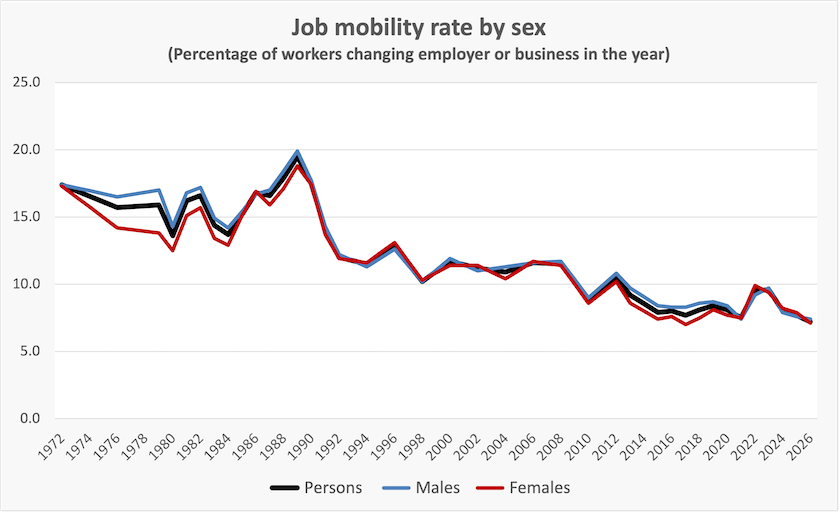
The trend is clearly towards less mobility, interrupted by the occasional economic shock – the “recession we had to have” in 1990, and the pandemic in 2020.
One might have expected that increased female participation in the workforce would have seen more mobility, but women have followed the same trend as men: after the mid-1980s the male and female lines are indistinguishable.
Tracing cause and effect would involve a large research task, but there are some plausible explanations.
One is that the workforce has become more professionalized. There are fewer short-term unskilled vacancies, and fewer workers lacking any post-school skills. Work has become a more serious commitment by both employees and employers.
Another is that the cost to the individual in changing jobs has increased. This requires some explanation, because it is not immediately obvious.
Over the last half century there has been a significant fall in personal savings. Fifty years ago we were saving about 15 to 20 percent of household income . Now our savings are between 2 and 5 percent of income. This is partly a statistical artefact, because we are now accumulating savings in compulsory superannuation. But in terms of liquidity, such as ability to tide oneself over between jobs, it is a real constraint. The ABS Making ends meet survey shows that 27 percent of households would be unable to raise $2000 for something important within a week. We are carrying more personal debt, not because we are spendthrifts, but because some debt, particularly student debt, has been forced upon us, and runaway housing prices have increased the burden of mortgage debt.
To illustrate this fall in savings, we note that the days of long strikes are well behind us. Now a one-day strike is newsworthy. In times past strikes could stretch out for weeks and no industry was immune: in 1973 Sydney’s King’s Cross strippers went on strike for up to two months.
Some workers now are restricted in their mobility by non-compete clauses. Many workers realize that shifting to another job probably involves going through a probationary period, with an uncertain outcome. The associated risk of unemployment has to be weighed against the lower risk of continued employment in a comparatively secure but less satisfying job.
We have allowed our economy to evolve into what may be called a pattern of cosy capitalism, where businesses have a compliant and stable (if not necessarily content) workforce. It works for business not only in terms of power in the labour market, but also in the broader economy. Consumption is sustained by innovations such as buy-now-pay-later schemes, heightening dependence on regular pay. People with no cash in reserve depend on car loans and are unlikely to risk taking low-cost-high-deductible home and contents insurance. It’s all very convenient for the finance sector.
Cosy capitalism is low-productivity capitalism, because it throttles the dynamics of capitalism. Workers become trapped in low-productivity jobs, and entrepreneurs trying to establish new businesses find it hard to attract labour. Existing firms have little incentive to boost labour productivity if they feel assured that they can hang on to workers in low-productivity jobs and don’t have to increase their pay.
There are certain things governments can do to boost productivity that involve removing friction in the system. The government has committed to banning the unjustified use of non-compete clauses, for example. State governments could make it easier for people to move by abolishing real-estate transfer taxes and replacing them with land taxes. The Commonwealth could boost Jobseeker payments and remove some of the spend-down provisions in its asset test, shifting its design from a scheme of distributive welfare to one of income insurance. More could be done to allow for transfer of long service leave and sick leave between employers.
Such policies would boost productivity, but they wouldn’t be met with many thanks from those who do well for themselves in our pattern of cosy capitalism. Business lobbies may speak for the short-term interests of existing business, but not for the interests of business in its wider sense. The distinction is important.
Electric vehicle shock
A rapid uptake of electric vehicles has caught policymakers off guard. (It shouldn’t have.) There is a risk that they will respond with poorly-considered road user changes.
Last Monday the Commonwealth restored the full 53.7 cents per litre of gasoline and diesel excise, and restored road user charges for heavy vehicles.
Well before the restoration of excise, sales of vehicles with conventional internal combustion engines (ICE) had fallen to half the new vehicle market, the other half being hybrids, plug-in hybrids, and battery electric vehicles (BEV).
The chart below, constructed from Australian Automobile Association data, shows this sharp fall in ICE vehicles, and equally sharp rise in BEV sales up to June this year. With excise now back to its full level, continuing uncertainties about oil supply, and the withdrawal of some ICE car brands from the Australian market, it’s a fair bet that this trend will continue.
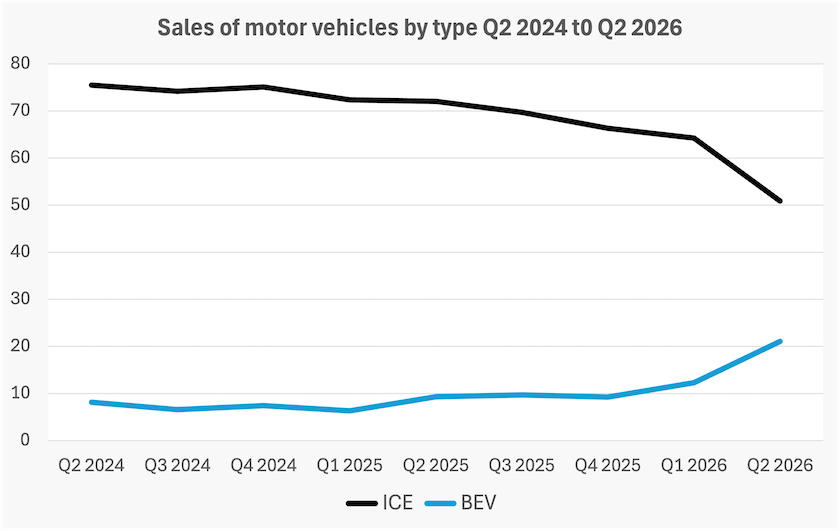
This development has probably surprised policymakers, who tend to think in terms of linear projections, rather than logistic (“S” shaped”) growth that occurs when demand for a good takes off, particularly when there are network characteristics influencing demand – the availability of chargers in the case of BEVs. Aggressive pricing by Chinese manufacturers locked out of the US market have contributed to this surge but once logistic growth is underway it becomes irreversible until some saturation is reached.
Most surprised would be the bureaucrats in treasury departments. The Commonwealth has been expecting that gasoline excise will steadily rise from $7.6 billion this year to $8.1 billion in 2029-30. (Tobacco excise all over again, but without the violence.) State treasurers, mindful of the importance of Commonwealth road grants, are also feeling the pinch, as Giles Parkinson of Renew Economy describes in his article in The Driven: A $440 million electric car tax looms for one state unless PM steps in with national scheme. That “tax” (really a user charge) to which he refers is the New South Wales decision to set a road user charge of 3.095 cents per km for EVs from next July or even earlier if EV sales reach 30 percent of the market. The Western Australian government has a similar proposal.
As Parkinson explains, the New South Wales government would prefer the Commonwealth to set and collect the charge. This is understandable politically: states are always happy when the Commonwealth collects taxation and passes it back to the states, as is the case with GST. But it’s also understandable administratively. Think how a New South Wales road user charge would be applied to owners of cars in the Tweed Heads region, particularly if (when) the Queensland government decides to apply a road user charge to EVs, or how it would work in relation to the settlements along the Murray. And as for the ACT – will the Minns government establish Checkpoint Charlie-type border crossings on the Monaro and Federal Highways?
Perhaps it’s all bluff, trying to force the Commonwealth’s hand. A commonwealth charge would overcome cross-border problems, but there are plenty of other problems in a hastily-established road user charge.
Should just one price be set? A figure of around 3 cents per km as proposed by New South Wales is about the same as 53.7 cents per litre on a car with a fuel consumption of 6 litres per 100 km.[1] That seems to make sense, but should not larger, heavier EVs, which cause more road wear and are more dangerous to other road users be subject to a higher charge, as is de-facto the case with fuel excise? Should road use incorporate a congestion charge, which would mean the fee would vary with location and time of day? These design problems are all technically soluble but they involve privacy issues we have not started to discuss.
How should it be collected? The Victorian scheme was based on mistrust, requiring people to photograph their odometers on June 30. With the help of AI photograph modification, and electronic hacks on car computers, it would set new but simple challenges for those skilled in the art of winding back odometers.
Then there are equity issues. Should road user charges be raised in order to lower the burden of registration fees and compulsory insurance – a burden that falls most heavily on those who least use their vehicles? Jack Buckley and Aditya Maitra of e61 have published a study – Who bears the burden of higher petrol prices – considering evidence on the elasticity of demand for gasoline and associated distributional implications. Those findings should be directly applicable to estimates of the elasticity of demand related to EV use.
They find that, in contrast to earlier studies, there is some elasticity of demand: a 10.0 percent increase in the price of gasoline leads to a 3.8 percent decrease in consumption. It appears that most of us, particularly those living in big cities, have more transport options than they had in the past. But that does not hold for those with higher motor vehicle reliance and those with lower incomes – groups with significant overlap. Shift workers and people living in the country are among those most affected by higher charges for motor vehicle use.
Pragmatically it may be best if the Commonwealth were to set an interim road user charge, applicable to all vehicles, but with a firm sunset provision while it works out a better scheme.
1. 6 * 53.7 = 322.2 cents; 322 cents per 100 k = approximately 3 cents/k. ↩
Stop complaining: Australia’s in good economic shape (mostly)
Naysayers who say the Australian economy is “on the wrong track” need to take a wider view.
That’s the original title of a regular article by Ross Gittins, published in The Age and Sydney Morning Herald, reproduced in Pearls and Irritations under the title Australia’s federation has survived 125 years of economic shocks.
Gittins summarizes and comments on a speech by former Treasury Secretary Steven Kennedy, who has presented a condensed history of Australia’s economy since federation.
Without being self-congratulatory, the main messages are that Australia’s governments have done a reasonable job in managing the economy and responding to economic shocks, and that our economic management has improved markedly over the last 30 years. Our economy has become much less subject to wild fluctuations than it was last century. Housing remains a pressing problem, but there is slow progress.
Gittins draws particular attention to the hysteria about government debt, but by historical standards, and in comparison with other countries, Australia’s government debt is quite small.
Gittins’ summary of Kennedy’s presentation covers his main points, but it’s also worth clicking on his speech, where you will find five graphs of economic indicators going back to 1900. Did you know that the unemployment rate in the 1930s Depression was almost 20 percent, or that inflation reached just on 20 percent in 1950 (and we still re-elected Menzies)? Those graphs look a lot smoother over this century so far, as we improve our capacity to deal with overseas-induced shocks.
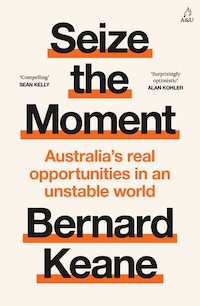
That’s a broad account of our economy so far. Complementing that historical account is an optimistic forward-looking perspective on Late Night Live where David Marr and Crikey political editor Bernard Keane discuss Keane’s new book Seize the moment: Australia’s real opportunities in an unstable world.
Keane points out that Australia is in a strong place to prosper economically. Thanks to good economic management by the Hawke-Keating government, Australia has been less battered around by globalization than other industrialized countries. We have lost some capacity to deliver good public policy, but our institutions are in good shape: we can re-build that capacity and succeed in ways we have succeeded in the past.
Unlike the USA and the UK, we have (so far) escaped the disruption of a “Trump moment”. That is:
… the moment in which the resentment, and the anger, and the disillusionment about free market economics and about a more unequal society erupts into not just discontent, not just marginal political parties, but erupts into the mainstream to demolish institutions, to threaten democracy, to shake society.
Keane hardly mentions the rabble calling itself “One Nation”. Rather he concentrates on the opportunities to capitalize on our renewable energy, and the need to raise more public revenue, offering some advice to government on how it can do that.