Politics
The many forms of opposition to climate change action – let us count the ways
Those who believe we shouldn’t reduce GHG emissions have many shonky arguments up their sleeves: when one is shown to be patently absurd they switch to another.
Opposition to action to dealing with climate change comes in many forms.
At one extreme is a refusal to acknowledge that climate change is happening. These are the outright “deniers”. Tony Abbott’s “climate change is crap” exemplifies this attitude, as does Donald Trump in his policies. A common view, held by about a third of Australians, is that “we are just witnessing a normal fluctuation in the earth’s climate”. In view of the strong variability in Australia’s weather that opinion is understandable: it’s hard for most people to detect the warming trend when there’s so much noise in the short term and when prominent right-wing politicians and “influencers” are spreading lies about climate change..
Some people dismiss the significance of two or three degrees: they’re small numbers, aren’t they? Then there are those who accept the science that climate change is human-induced and believe that we can adapt to it: look at those wonderful new vineyards in Tasmania. It’s hard for people to understand the fine balance of our planet’s climate systems and the scale of disruption resulting from rapid small changes.
There are also those who know that global warming is human-induced, that it presents a serious threat to our welfare, and that corrective action can at least arrest it, but who believe it’s pointless for a country like Australia, accounting for one percent of emissions, to do anything about it when big countries like the US, Russia and Iran are doing so little. That attitude shows up in regular surveys: between 2015 and 2020 around 50 to 60 percent of Australians believed we weren’t doing enough to address climate change. That proportion is now only 30 percent. That change in attitude, towards defeatism, roughly corresponds with growing awareness that the US federal government commitment to reducing emissions (the ERA initiative) was short-lived.
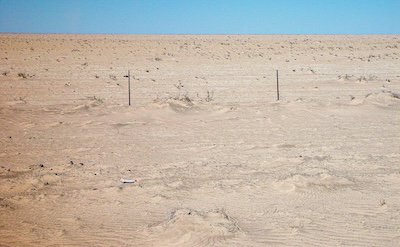
In an earllier El Niño
Caution by climate scientists and other experts surely plays an unintended role in climate denialism, because scientific scepticism leads to conservative predictions. In fact, some denialists, unfamiliar with research methods, call themselves “climate sceptics’. Writing in the Saturday Paper climate scientist Joëll Gergis describes the risk when experts’ predictions fail to materialize. They make their predictions within wide confidence limits – that’s sound professional practice – but the media tend to pick up on the scarier upper limit. In her article The threat El Niño poses to climate science Gergis warns “When a headline promises a ‘super El Niño’ and the season turns out to be bad rather than biblical, climate change deniers are ready to pounce, claiming scientists are crying wolf”.
One possible reason for complacency is that worldwide media coverage of climate change has been falling in recent years, as revealed in a study by the Spike Center for Sustainability Education at the University of Colorado, Boulder. You can hear Max Boycoff of the Spike Center discuss the study with Nick Bryant on last week’s Saturday Extra: As the climate worsens, media coverage is falling.
There’s no conspiracy to suppress reporting on climate change. Rather it’s about the way the media works, according to the Spike Center report:
Ongoing political economic headwinds, and newsroom consolidation and reductions have contributed to this diminished coverage. Moreover, there is finite news space for competing stories, with the Trump administration flooding the public sphere with news stories across several domains.
News editors and reporters may also sense that their readers are getting tired of reading and hearing about climate change when making decisions about what stories to cover. Furthermore, journalists may be hesitant to connect the dots between ecological and meteorological events like wildfires, and a changing climate due to the ongoing politicization of climate science, despite the fact that those links are clear within relevant expert scientific communities.
That failure to “connect the dots” is the subject of a Conversation contribution by Doug Specht of the UK’s University of Westminster: Wildfires: why media coverage doesn’t always make the climate connection. The fires in Europe are providing plenty of news – massive evacuations, a helicopter crash, footage of terrifying scenes in holiday areas. But the comparatively slow rise in temperature just doesn’t have the dramatic impact.
The Bryant-Boycoff discussion is about the way present styles of journalism do a poor job at covering slowly-developing phenomena, such as climate change – the “boiling frog” bias. There are no heroes, not many villains, no sudden and dramatic changes in temperature. The news is in the consequences of fires and floods, not the causes.
Although Bryant and Boycoff do not mention it, journalists in public media like the ABC may be reluctant to connect the dots because there is no direct causal relationship between any particular wildfire or flood and climate change. Poor forestry management, for example, may be the most important cause of a particular fire. But the scientific evidence linking increased wildfires is clear. There is probably a degree of self-censorship in the ABC because of fear of a hysterical reaction from the Murdoch media and from the troika of political parties on the right-wing fringe.
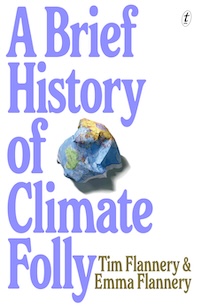
Hints of another contributor to climate change denialism is in the work of Tim Flannery and his daughter Emma, who discuss their book A brief history of climate folly in an Australia Institute podcast. (30 minutes + 10 minutes Q&A). Flannery describes many futile attempts to change local climates in times past – some with a modicum of scientific backing such as cloud seeding, and some that are way out such as a Soviet Union use of nukes to bomb a new channel. (They could have mentioned Australian examples, such as the 19 th century “rain follows the plow” myth, and a 1950s proposal to use a chain of nukes running north from Port Augusta to re-establish the inland sea.)
Flannery warns that these amusing stories carry the message that many people now believe that human attempts to do anything about climate is folly.
The gloomy mood of the present times – the Zeitgeist – intersects with the view that it’s futile to do anything about climate change. The1880s and the 1950s were periods of gung-ho enthusiasm for big projects in contrast to the present age of dismal cynicism about transformative ventures.
Flannery doesn’t share this cynicism. In fact he believes we should be doing much more than we are currently doing, because simply reducing emissions won’t arrest dangerous warming. We must complement those measures with geoengineering. He’s sceptical about some of the current efforts to sequester carbon, which comprise the backbone of emission trading schemes, but he believes we should put much more serious research into geoengineering, because emissions reduction is inadequate to prevent catastrophe.
Falling out of love with the USA
Around the world public attitudes against America are hardening. The implications for democracy are worrying.
In these roundups attention has been drawn to the annual Lowy Institute surveys showing declining confidence in the USA, particularly since Trump commenced his second term. Among Australians public sentiment to the US and its government is less positive than the pro-American attitude we see from the Albanese government.
The latest Lowy survey assesses our confidence in world “leaders” (i.e. heads of governments), revealing that we place Donald Trump in the same low-confidence classification as Vladimir Putin and Kim Jong-un. (Mark Carney tops the list.)
Australia is not alone in this regard. The world is giving up on America writes Pew Research Center’s Richard Wike in Foreign Affairs. He is reporting on Pew’s survey of the public in 36 countries, revealing not only a reaction against Trump, but also an increasingly negative view towards America, particularly among the public in European and Asian democracies. Attitudes in Africa and South America are generally still positive.
Anti-Americanism is not new, but historically it has generally been about American military imperialism and support of right-wing authoritarian regimes. Wike writes that this time it’s different, because:
… the world has grown increasingly pessimistic about the state of American democracy itself. In less than two years of Trump’s second presidency, a growing number of non-Americans have come to believe that the U.S. government does not respect the individual liberties of its own people.

Once upon a time we even admired their cars.
Just five years ago in most countries surveyed people believed that the United States government respected the personal freedoms of its people. Australia’s response to statements about America’s protection of civil liberties is typical of responses in other democracies. In 2021, 57 percent of Australians believed that the “United States government respects its people’s personal freedoms”: this year that has fallen to 33 percent.
These are public opinions. Constitutional and governance experts are likely to express their considered opinion that America’s Constitution was flawed from the outset and that there are better models of democracy, including ours in Australia.
But most people aren’t constitutional and governance experts, and are likely to see the failures in American democracy as a failure in democracy itself. That’s serious.