Public ideas
Angertainment
“Social media” (i.e. the open access gutter press) allows scare campaigns to morph into hate campaigns.
A world in which public ideas drive public policy makes sense. Much of the left-right contest over the twentieth century was about public ideas concerning economic returns to capital and labour, notions of equity, and the economic role of the state.
Public policy can also be driven by emotion. Scare campaigns play on emotion: if the other side gets into government you will pay $100 for a Sunday roast, Medicare will be privatized, aboriginal rangers will lock you out of national parks ….
It is easy for factcheckers, or reasonably well-informed citizens, to rebut the assertions of scare campaigns, but a scare campaign works by raising fear and anxiety among those who don’t bother with such analysis.
Scare campaigns are as old as democracy, but so-called “social media” have given them a new and powerful vehicle, and the anonymity of social media has allowed stronger forms of expression. The fear campaign becomes an anger campaign – anger against any chosen group – immigrants, people of particular skin colour, religion or sexual orientation – or anger against the whole “system”.
The most powerful aspect of such campaigns is the way the technology behind social media allows for rapid reproduction and can act like a rapidly multiplying virus, jumping over to traditional media. From a small seed – perhaps only a few irresponsible individuals – a campaign of outrage against some evil can be launched and promulgated with the help of bots, giving the impression of a massive wave of anger.
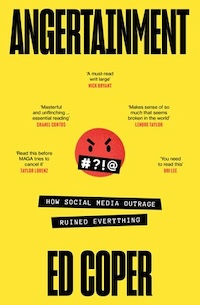
This process is described in a lecture at the Wheeler Centre by communication expert and strategist Ed Coper – author of Angertainment: how social media outrage ruined everything and introduced as the strategist behind Getup!.
He exposes the business model of angertainment. It’s lucrative for the owners of social media – an anger campaign commands attention, and attention drives revenue from advertisers, while “influencers” take a cut in helping the model work. In the political space it’s easy for a cashed-up right-wing political movement to kick in the money to get the process running.
The process itself is apolitical, but it is the political weapon of choice of the right and the far right.
Illustrating the technique’s effectiveness, and its lack of essential attachment to any ideology, Coper starts his lecture with a story about a scare campaign based on an out-of-context interpretation of a statement on gas stoves that turned into a hysterical scare campaign, thwarting a reasoned consideration about indoor pollution.

Subject to outrage
As he says about that campaign “You can kill a policy idea dead with 24 hours of social media outrage”. He goes on to cover the confected outrage against the Voice referendum.
He confirms that it is always easy to awake dormant grievances, to whip people into a frenzy of anger, and to make people feel hard done by, even when objectively they are living well. (That’s why the “cost-of-living crisis” has traction.) It is hard, however, to counter political feelings based on emotion with facts and evidence: once people are in an emotive echo chamber they don’t want to leave it.
Scare campaigns cannot be eliminated, but Coper sees some hope in forcing social media firms to be guided by a duty of care.