Politics
Victoria’s political drama
Pauline Hanson, the CFMEU, the hard-line “Christian” right, and Ben Carroll all make for interesting politics.
The dust is yet to settle on developments in the Victorian government. Most media comment about political developments between now and the state election on 28 November is speculative and much is through a right-wing partisan lens.
One view is that it is too late for the Labor government to redeem itself. Quite apart from the allegations of corruption, it is an old and tired government, having been in office since 2014.
The other view is that Ben Carroll’s dramatic move – calling a commission of inquiry into the building industry, appointing a special prosecutor, giving teeth to the state’s anti-corruption body (IBAC), and distancing himself from previous premiers – has reset the whole political landscape.
Those who claim that four months is too short to change anything don’t have history on their side. They may not have witnessed or read about the leadership spill in 1983 when Bob Hawke took over from Bill Hayden as opposition leader just as the election was called, and went on to win the election easily.
In any event most people aren’t journalists or political addicts. They tend not to engage with political choices until an election is imminent. Four months might be as good as four years.
A special Newspoll, summarized on William Bowe’s Poll Bludger, gives us something of an objective picture of the situation before last Tuesday. Labor was on 28 percent, the Coalition on 31 percent, One Nation on 19 percent, and the Greens on 13 percent, implying 9 percent for “others” or “undecided”. (Although Victoria is where the “teal” independents arose federally, up to now independents have been less prominent in state elections.) For comparison, in 2022 Labor won government with 37 percent of the vote, against the Coalition’s 35 percent, and the Greens’ 12 percent, while One Nation didn’t even make 1 percent.
Those polling figures were pointing to a significant swing to the right. Labor would lose government but there was no indication that the Coalition could form government on its own. Such is the spitefulness in Coalition ranks that they would never entertain the idea of forming government with Labor (broad left-right coalitions are common in European democracies). The default assumption is that the Coalition would deal only with One Nation or with other groups on the hard right.
A Conversation contribution by Zareh Ghazarian of Monash University traces the twelve-year history of the Labor government, including the way it benefited from disunity in the Liberal Party and the polarizing effect of the strong measures it took during the Covid pandemic: The Victorian Labor government had many successes. But it has also had its failures – and these have lost the voters.
Yee-Fui Ng, also of Monash University, has two Conversation contributions, both focusing on corruption in the state’s Big Build program. The first – Without a Royal Commission, we won’t know the scale of the corruption in Victoria’s Big Build – was on the Friday before the change in premier, and the second – How the “‘Big Build” corruption allegations brought down the Victorian premier – was published on the day of Carroll’s win, and goes into detail about his announcements.
Her articles, and a February post on the ABC website – Victorian CFMEU branch became 'hateful, greedy rabble' under John Setka, report finds – draw heavily on Geoffrey Watson’s report Rotting from the top: the CFMEU in Victoria during the Setka era, and on his rough estimate that corruption has added at least $15 billion to the cost of the Big Build.
This is important detail, because the ABC, the Monash Law School, and above all Geoffrey Watson, are non-partisan sources. It is not the usual political stoush of conflicting partisan attachments. Also, it should be noted that it is not about the CFMEU necessarily being corrupt. That’s the right-wing narrative that the Victorian government is corrupt because of strong union connections to the Labor Party. It is about the CFMEU becoming corrupted. To quote Watson:
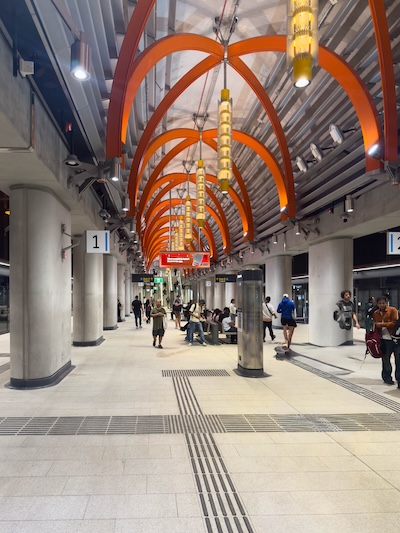
Nice subway, but did we pay too much for it?
As a lifelong believer in trade unions, it was shocking to see so much crime, so much corruption, such a perversion of values. The CFMEU was no longer on the right side of civil society, it was proudly on the wrong side. The Union was no longer the champion of the working class – the Setka era CFMEU turned to looking after gangsters, standover men, bikies, heroin traffickers, and even killers.
And it’s not just about alleged corruption in the CFMEU: there are other allegations of corruption apparently lacking any connection to the union. The issue is the government’s failure to crack down on crime, not its connection to unions.
The other main issue associated with the Big Build is that the state has run up too much debt to finance it. This is coming from the usual “small government” mob, who would like to ignore the fact that Melbourne is now growing faster than Sydney, and that it is at risk of shifting from one of the world’s most liveable cities to an ever-spreading congested urban blob. It needs that infrastructure.
A more valid criticism of the Big Build is that construction resources could have been allocated more efficiently. This applies particularly to the priority the government has given to the Suburban Rail Loop, ahead of an airport rail line (about 56 years overdue), and ahead of the Western and Princes highways, which are slow and deadly two-lane roads passing through towns for much of their way. ($15 billion could have gone a long way to bringing those roads up to freeway standard.)
Will Carroll and his cabinet be able to turn around what looks like a 10 to 15 percent swing to the right? Maybe he can. The poll numbers mentioned above are based on primary votes. The same poll suggests that on TPP terms the Coalition was sitting only on a 52:48 lead. That’s not insurmountable.
Writing in The Age before Carroll took over, Michael Bachelard reminds us that the Coalition doesn’t look too flash either: Victorian politics is a mess. Who on earth can you vote for in this state? The Liberal Party has been through a terrible conflict around Moira Deeming – who has finally resigned from the party. As has been the case in South Australia and New South Wales, forces from the hard religious right have been exercising a strong influence in the party, even though Victoria is probably the nation’s most secular and liberal state. Bachelard writes about the challenge to the Liberal Party’s leader:
Jess Wilson appears serious about formulating credible policies, but her party has spent so many years stacking branches with religious right-wingers and listening to Peta Credlin that it’s hard to see how a new, moderate leader – no matter her qualities – can wrangle her MPs together into a cabinet worth the name.
Mutterings from the party suggest that it plans to divert spending from the Big Build to spending on health and education. That would be the height of fiscal irresponsibility, because it would transfer part of the state debt from funding infrastructure (an entirely justifiable practice) to funding recurrent outlays (an entirely unjustifiable practice), which would surely raise alarm among the ratings agencies. The political message of leaving projects half built can be deadly – think of sitting in a traffic jam looking at an abandoned interchange that was supposed to help you get home sooner. The Liberals have to do better on both economics and politics.
Firearms – Why Labor fails where the Coalition succeeded
Following the Port Arthur massacre the Howard government implemented tough firearms laws, but the Albanese government has a tough time following the Bondi murders. Why?
Less than two weeks after the Port Arthur massacre in April 1996 the Howard government managed to convene an emergency meeting of the Australasian Police Ministers’ Council at which there was unanimous agreement on the need for far-reaching firearms control. The National Firearms Agreement, subsequently legislated by all states and territories, involved a prohibition of automatic and semi-automatic rifles, pump-action shotguns, large magazines, and types of handguns. A Commonwealth-funded buyback saw the surrender of 600 000 firearms, around 20 to 30 percent of all privately-owned firearms.
Writing in the Sydney Morning Herald Bevan Shields notes that by contrast the Albanese government’s post-Bondi reforms have pretty well fallen flat:
It took Howard just five months to announce, negotiate and begin his national gun buyback scheme following the Port Arthur massacre. By contrast, more than seven months have passed since the Bondi Beach antisemitic attack with no agreement.
His article, Australia had a chance to do something big. Then came weak leadership and fatal errors, explains some of the reasons the Albanese government have found little support among state governments.
Funding of any buyback is an issue: the Albanese scheme involves 50:50 sharing with the states. Shields also believes that Albanese failed to pursue his reforms with the same passion as Howard had. That is probably right – Albanese’s loss of vigour over firearms reforms has echoes of his similar behaviour once the Voice referendum started to lose support.
He overlooks the way the Coalition disgracefully made the Bondi murders a partisan issue. The clear message, reinforced by Israel’s Prime Minister Netanyahu, was that the Albanese Labor government was to blame for its “failure to keep Jewish Australians safe”.
Turning back to Port Arthur, could we imagine the then opposition leader, Kim Beazley, blaming the Liberal government of Tasmania for its “failure to keep Tasmanians safe”. Shields touches on this issue where he mentions that the National Party leader,Tim Fischer, threw his weight behind firearms reform, even though as member for Farrer he represented a typically heavily-armed rural electorate, now represented by One Nation. The National Party of 2026 is bound by no principle other than to oppose anything initiated or proposed by Labor, exemplified by Bridget McKenzie’s partisan response to the Bondi murders.
There is one other vital issue overlooked in Shields’ and most other comparisons between Port Arthur and Bondi. That is the timeline of events.
In both cases the prime ministerial responses, announcing firearms reforms, were rapid – four days for Albanese, eight days for Howard.
But the other timeline is electoral. Howard was elected on 2 March, his cabinet was sworn in on 11 March, and the Port Arthur massacre was on 28 April, when Parliament had only just resumed sitting.
It was a new government, elected after a 13-year run of Labor governments.
We can imagine how the Howard government – or any government – would have reacted had the massacre been a year later. By then the praetorian guard around the prime minister – the minders who warn him or her of the political risks of reform – would have been solidly in place. The lobbies would have developed their pathways to the prime minister’s office. The prime minister would have had 14 months of protection from interface with ordinary people. He would probably not have seen the letter written by Walter Mikak, whose wife and two daughters were murdered at Port Arthur: the prime minister, or a machine, would simply have signed one of the hundreds of responses prepared by bureaucrats.
The American political scientist and historian Richard Neustadt wrote about the isolation of presidents in his 1990 book Presidential power and the modern presidents. President Nixon’s judgement, for example, was severely distorted by the surreal atmosphere of the White House.
In Australia we have nothing quite as formidable as the White House, but we have seen something of the same phenomenon, particularly as concerns for physical security have risen. (Remember that there was no security detail to witness Harold Holt’s drowning, and his successor, John Gorton, was adept at shaking off his minders.)
It’s not only about physical security. It’s also about the psychological security of the minister’s or prime minister’s assurance that he or she is on the right track, a security reinforced by officials’ fear of offering advice that goes against established practice, or conveying bad news.
Perhaps we have seen something of that at the Labor conference last week, as debate on difficult issues was shut down. The prime minister can look strong and resolute, but is actually avoiding the hard work of leadership, which involves engaging with the community on difficult issues – taxation, firearms control, gambling and the brittle politics of the Middle East. He’s mixing with the wrong company.