Australia’s energy transitionn
Electricity prices continue to fall
Thanks to batteries wholesale electricity prices are falling faster than expected.
How long can the rabble of right-wing parties sustain their lies about renewable energy – that electricity prices are rising, and that they are rising because the government has prioritised renewable energy?
On Wednesday the Australian Energy Market Operator produced its latest Quarterly Report on Energy Dynamics, tracking changes in price and demand in the National Electricity Market (Australia minus Western Australia, Northern Territory and far northern regions). It summarises what has happened to prices:
NEM‑average wholesale spot prices averaged $74/MWh, down $66/MWh (-47%) from Q2 2025, and the lowest Q2 average since 2020. Increased renewable generation, higher grid-scale battery discharge during peak periods, and reduced evening peak demand contributed to lower wholesale prices and a flatter intraday price profile.
Quarterly wholesale prices for the last six years are shown in the graph below, copied from the AEMO report.
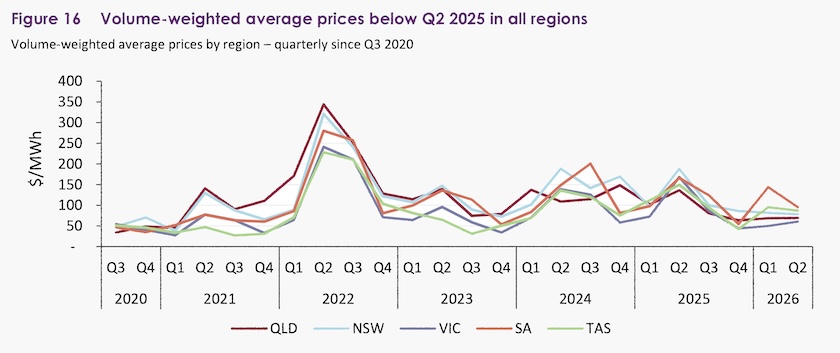
Note the 2022 surge, which the Coalition attributes to our folly in electing a Labor government in that year. What it really shows is our dependence on fossil fuels, the price of which was boosted by Russia’s invasion of Ukraine. As we have reduced our dependence on coal and gas the winter peak (Q2) has been falling.
Explainer
I wish AEMO would help us relate these wholesale prices to the retail prices we pay for electricity at our power outlets – usually about 30 cents per kWh. The relationship is simple: Each $10 per MWh is 1 cent per kWh. That means of the 30 cents or so you are charged, only 7.4 cents is for the electricity. The rest is for “poles and wires”, and for the commission agents called “retailers”.
The particularly good outcome this quarter is due in part to a mild onset of winter, and stronger winds driving wind turbines. But as explained in the AEMO report and in a Renew Economy article by Giles Parkinson – Wholesale power prices plunge as renewables surge, batteries boom, and gas hits 23-year low – it is also driven by an expansion of battery storage, including home battery systems, that have helped squash the evening peak.
This greater reliance on batteries is a significant development, as explained in a Conversation contribution by Joel Gilmore of Griffith University: Batteries are getting cheaper while gas gets pricier. Here’s why.
For some time the assumed model of electricity generation has been that wind and solar generators, concentrated in renewable hot spots, would provide enough geographically dispersed sources to hedge against the sun not shining and the wind not blowing. These sources were to be supplemented with gas-powered plants to cover evening peaks and periods of poor renewable supply. In time, hopefully, pumped hydro and possibly other sources such as geothermal would displace gas.
But what Gilmore is pointing out, and what AEMO confirms, is that batteries are now displacing gas, and they are doing it rather quickly.
That expansion of battery storage, particularly home battery storage, has long-term implications for consumer prices in two ways.
First, if batteries are well distributed, including those linked to panels on people’s rooftops, it should reduce the need for investment in high voltage transmission lines carrying electricity from renewable hot spots. Local and foreign anti-renewable movements have been waging a protracted scare campaign, mobilizing farmers and others to block expansion of transmission lines, solar farms and wind turbines in non-metropolitan regions, with ridiculous claims that renewable energy is “putting productive farmland at risk”. (In fact just one decent-sized cattle station could provide all the electricity Australia needs, and still leave room for stock to graze.)
It would be unfortunate for people in rural regions if, as a result, they lose the opportunity to enjoy the benefits of renewable investments in their regions, but that’s the consequence of a democratic process that gives licence to scaremongers who don’t have the nation’s interests at heart.
Second, batteries could be the mechanism that virtually eliminates hour-to-hour fluctuations in wholesale prices, just as water reservoirs eliminate the need for water authorities to keep changing water prices in line with stream flows. That could mean the electricity supply chain can operate without those parasitic “retailers”.
This optimistic outlook for retail electricity prices is based on two assumptions. One is that the Coalition is not elected to government with its anti-renewable policies. The other is that the government holds the line against data centres, who will demand to draw electricity from present sources before they can develop their own supplies, as explained by the ABC’s Daniel Mercer: Energy prices are falling but the rise of data centres could push them back up.
The Coalition, however, is using the expansion of data centres to push for nuclear energy – a power source that was shown to be demonstrably uneconomic for Australia two years ago and would be even more uneconomic now. The ABC’s Lexie Jeunewic explains the issues in her post: Renewables, nuclear, gas? Data centre boom energises political debate. Some of the Coalition’s stance is based on their treatment of renewable energy as an identity or cultural issue, rather than as an economic opportunity. It also seems to be based on the idea of “base load” power, a model that governed the first 120 years of electrification. The world has moved on to “dispatchable” power, but they seem to have trouble understanding this transition.
Elsewhere – our slower progress to net zero
While we’re making progress with electricity, and may be moving on transport, we’re lagging in the rest of the economy.
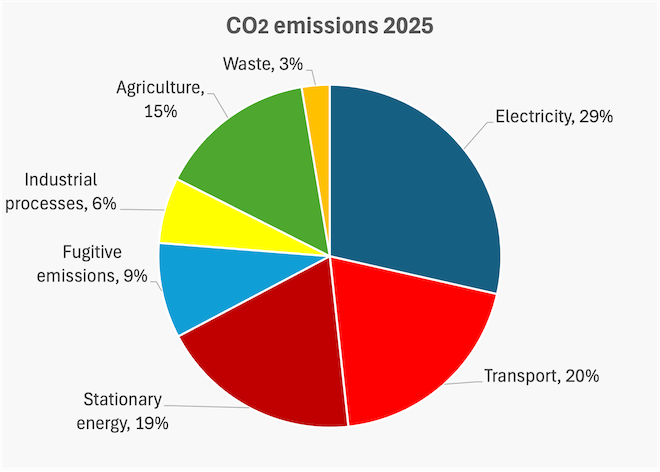
Because electricity has been subject to a torrent of lies and disinformation from the Coalition and its One Nation allies, it has attracted disproportionate attention in our transition to net zero, even though it accounts for only 29 percent of our emissions, as shown below. We have tended to overlook other sectors.
Offsets – are they effective or are they false accounting?
The Australia Institute has a well-researched report – Safeguarding the fossil fuel industry – claiming that Australia’s “flagship” climate change policy, the Safeguard Mechanism, is failing. This is the set of measures that allows the biggest emitters in the mining and heavy industrial sectors to buy offsets.
The mechanism provides credits for two activities – or more correctly one non-activity and one real but possibly ineffectual activity. The first is for avoiding doing things that would have caused a rise in emissions. (Like the farmer who is given a large government grant for not planting alfalfa in Joseph Heller’s Catch 22.) The other is for removing CO2 through processes such as carbon capture and storage. The authors’ assessment:
Carbon avoidance credits are untenable for use as offsets because at best they exchange new emissions for avoided new emissions, so no actual carbon dioxide is removed from the atmosphere; at worst, new emissions are not in fact offset at all because the ‘avoided’ action would have occurred anyway.
Carbon removal projects in the land sector at best only temporarily store carbon, so credits based on such projects can never truly offset carbon dioxide emissions from burning fossil fuels, a large fraction of which lasts for thousands of years.
Ken Henry, now Chair of the Australian Climate and Biodiversity Foundation, disagrees with those who criticize the Safeguard Mechanism. In a short (5 minute) clip on ABC AM – Dangerous times for climate policy – he compares the present political atmosphere to the period from 2013 when Tony Abbott used climate policy to divide the country. He believes that the Safeguard mechanism can be made more effective, but he fears it is under threat from both sides – industries who claim it’s too tough, and environmental movements who claim it is irredeemable. “It’s all we have so let’s make sure it works, lest we drop it altogether” is the way Henry’s case can be summarized.
Let’s tap into our superannuation savings for renewable investment
Australians have rather a lot of money in superannuation assets –- $4.5 trillion according to the Association of Superannuation Funds of Australia.
The ABC’s Romy Stephens looks at the reasons why superannuation funds do not have more renewable energy investments in their portfolios: As clean energy investment faces headwinds, superannuation could help fill the funding gap.
Renewable energy should be an attractive investment for superannuation funds, because they are long-term investors. The industry has an assured market and is low-risk with modest but assured returns over the long term. Also the capital gains tax changes just implemented by the government do away with a bias that had previously penalized low-growth long-term investments.
Stephens finds that superannuation funds have a culture of financial conservatism. They like blue-chip companies. They also invest in utilities, but mainly in established, clearly regulated utilities, such as water supply. Renewable energy is still subject to changing technologies and there is a difference between the fortunes of an industry – sound in the case of renewable energy – and the fortunes of individual firms.
Also the way superannuation funds report puts emphasis on performance over the short to medium term, even though members’ interests are best served by long-term performance, which may involve many years of comparatively poor returns.
A reading of Stephens’ article suggests that the government, conscious of the failure of some small superannuation funds, is cautious about changing the way it requires superannuation funds to report.
It’s a conservatism that is understandable from the point of view of each individual fund, but surely there is some way $4.5 trillion can be hedged against risks of individual investments in an assured growth industry.
Trump and Khamenei, a partnership of environmentalists
Encouraged by two supreme leaders
A boost to decarbonization can come from unexpected quarters.
Warwick McKibbin, now of the ANU, was on Saturday Extra last weekend, discussing with Nick Bryant the consequences of blocked oil supplies from Iran and the Arab states.
He noted how the world has coped somewhat better with this shock than with earlier oil shocks, suggesting:
You might argue that President Trump is one of the great environmentalists because he’s forced the price of energy to force people to shift away from fossil fuels into other types of fuels.
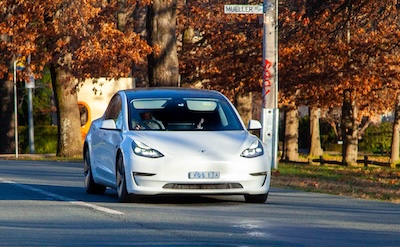
Between them Mojtaba Khamenei and Donald Trump are doing wonders for the electric car industry, and that’s only the start.