Housing
Hot houses
Most Australians live in poorly insulated houses: there are low-cost ways we can improve our comfort while reducing emissions and cutting our energy bills.
Houses built in the last 22 years have had to achieve at least 7 stars on the Home Energy Rating scheme, which assesses their capacity to provide comfort in winter and summer, while using energy efficiently. As such, it relates to the cost of providing year-round thermal comfort: the higher the rating, the lower is that cost.
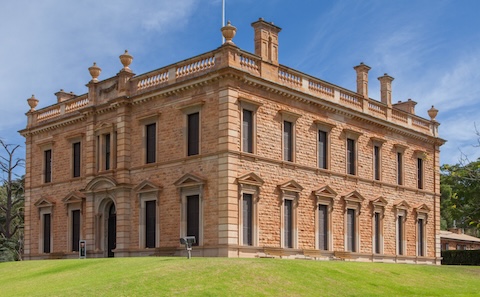
Old and elegant but drafty (Martindale Hall)
Writing in The Conversation – Living in a glorified tent: new research shows huge energy gaps between older and newer homes – Matthew Daly of Sydney’s University of Technology points out how few houses meet that 7-star standard. New South Wales homes built before 2004 achieve an average of only 2.1 on the star rating. Homes of renters were even worse – an average rating of 1.6, presumably reflecting the reluctance of those who own rental properties to bring them up to standard.
Those homes do a little better on hot weather ratings than on cold weather ratings. That simply reflects the fact that most people in that state live on a coastal strip with mild winters. But there are enough people living in the mountain regions, and in the far west of New South Wales, to ensure that his research is reasonably representative of the range of experiences of all Australians.
He describes the measures that can improve a house’s energy efficiency, starting with those that give the greatest return per dollar, such as ceiling insulation, moving up to those that are more expensive but still effective, such as retrofitted double glazing. These are all straightforward, even before we go into schemes such as solar-powered home batteries.
His article doesn’t go into the broader economics or politics of household energy efficiency. But it’s a reminder that many people have so little financial slack that they cannot outlay a few thousand dollars in order to enjoy significantly lower energy costs in the future. It’s a pity, because these are probably about the highest-yielding secure investments anyone could make. The ABS Making ends meet survey – a set of indicators of financial stress – shows that 27 percent of households would be unable to raise $2000 for something important within a week. It’s not a specific measure of people’s capacity to spend the same amount on insulation, but it’s a pretty good indicator of liquidity: if you don’t have $2000 for an emergency you don’t have it to buy R5 ceiling insulation. Our energy affordability problems are a manifestation of our inequitable distribution of wealth.
Most of us, however, can do something about our heating and cooling costs, but there will always be a certain percentage of people who will find more pleasure in blaming the government, particularly a Labor government, for their high energy bills, than in taking responsibility for their own conditions and spending a little on insulation.
The cooling housing market
House prices have probably peaked and may be on the way down. That’s good.
John Howard once said that no one had ever complained to him about the value of their houses increasing. He went on, with his 1999 tax changes, to reinforce the conditions for house prices to inflate even further.
Shane Wright, of the Sydney Morning Herald, reports on the results of a Resolve Political Monitor poll, which finds that A growing majority say house prices have to fall – even owners. Times have moved on perhaps, or, more probably, Howard hadn’t met anyone with a sensible understanding of house price inflation.
The poll was large enough (2252 people surveyed) to allow for classification by income, home-owner/mortgage-holder/investor/renter groups, location, age and voting intention.
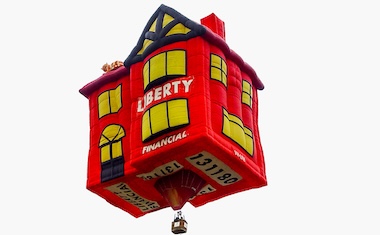
A balloon waiting to be pricked
There are predictable differences based on these classifications, but they are slight. The overall message is that a clear majority of Australians – 58 to 66 percent depending on age, income and home ownership – want house prices to fall. Only 5 to 14 percent oppose a fall in house prices.
The same poll assessed people’s support for key budget items. Unsurprisingly there is strong support for the government’s income-tax reforms – the $1000 deduction for all workers, the $250 Working Australia Tax Offset, and the drop in the rate of the lowest tax bracket.
Less expected is a reasonably positive response to the government’s changes in capital gains tax and negative gearing. On CGT changes there is 35 percent support, 24 percent opposition, and on negative gearing changes 37 percent support, 23 percent opposition.
Angus Taylor has been rather silly in promising to reverse these reforms. If, as is likely, those who have bought “investment” properties find that their value has not caught up with general inflation, they would find themselves paying more tax on realization under the Howard system than under the government’s restored indexation system. (The same goes for investors in shares who have chosen reliable slow-growth investments over speculative gambles.)
And in view of this public acceptance, it’s strange that government spokespeople come across as almost apologetic for the reforms. If Keating were prime minister he would surely be shouting about them from the rooftops.