Politics
Privatize (or abolish) the ABC?
Public broadcasting needs its defenders, because it is easy for those who would prosper from its absence to mount superficially plausible arguments for its abolition.
Pauline Hanson gave her opinion on public broadcasting in her Press Club address. After acknowledging the ABC’s role in “regional, rural, and remote areas where there is a lack of commercial media”, she went on to outline her vision, saying “but in the cities which are already saturated with media outlets across the political spectrum, the ABC will only be a subscription service. From its chairman down, the ABC has proven itself to be completely in denial about its profoundly transparent political bias and the activists in its ranks.” As for the SBS, “it will be gone”.
Advance was quick to come in behind Hanson with its Shut down the ABC campaign. Then Maurice Newman joined the bandwagon, supporting the idea that the ABC should become a subscription service. Newman, a passionate campaigner against renewable energy, and one who helped establish the Centre for Independent Studies, had been appointed Chairman of the ABC by John Howard in 2007. In anticipation of a possible change in government (which actually eventuated), Howard stacked a number of boards with Liberal Party sympathisers.
Their arguments are about public funding – $1.3 billion a year for the ABC, and $0.4 billion for the SBS. At first sight their criticism makes some sense: why should taxpayers fork out $1.7 billion for public broadcasting? It makes even more sense when one considers that the ABC audience is likely to be able to afford a subscription service.
That is, until one realizes that $1.7 billion is but a very small part of what Australians pay to subsidize all media. Australian companies spend about $31 billion a year on advertising, of which around $4 billion is for traditional commercial TV and radio and $18 billion is for internet advertising.[1]
To reframe that, while we spend $1.7 billion on public media broadcasting funded by taxation, we spend $22 billion on commercial media funded by what is in effect a sales tax imposed by the private sector. While government taxes have some level of progressivity, the money we spend on commercial media is collected by a regressive form of taxation. When we buy a packet of Tim Tams (Matt Canavan’s latest concern) or a Cirrus G7 airplane (Pauline’s), some of what we pay goes to advertising, and about two-thirds of that funds commercial media.
And so long as we buy stuff, we have no choice: we have to pay that sales tax, whether we use commercial media or not, whether we take any notice of advertisements on the Internet. That’s part of the bargain about collective goods – I fund the media you use, you fund the media I use.
In any event public broadcasters are different from commercial media. So long as commercial media are dependent on advertising, they have to be responsive to those who provide that funding. Similarly their programming is likely to be attuned to those who are responsive to advertising: young men who don’t understand the odds in sports betting provide a case in point. Older people who have established consumption patterns, and those who reasonably mistrust advertising, are not served well by advertising-funded media. There’s no revenue in providing content for those whose consumption patterns are set.
But the main function of public broadcasters goes well beyond filling a gap in the media landscape. Provided their funding is secure, and that their governance is at arm’s length from government, they are a vital institution of democracy. The ABC, for example, is bound by a set of strong and detailed rules on “objectivity and impartiality”. Some commercial media may also be bound by standards of professional journalism, but they will not have the same commitment as a public broadcaster to holding the government to account. They may cover stories of political scandals – sexual misbehaviour, bribery involving brown paper bags stuffed with $100 notes, jobs for mates – but less vivid instances of maladministration aren’t going to excite their audiences.
It’s therefore the task of the public broadcaster to engage in the tedious task of factchecking, summarising and commenting on difficult-to-read audit reports, and reporting on policy issues in their wide context. Unsurprisingly such work will not always be welcomed by people in power.
The most persistent accusation against public broadcasters is that they are politically biassed. To quote Advance on the ABC:
It lectures mainstream Australians, protects its own, gives platforms to activists, sneers at anyone outside the left-wing bubble.
In less emotive language that could be summarized as “It gives voice to those who challenge the status quo”.
Is that a bad thing?
A public broadcaster serves the public by making us examine the conventional wisdom, by challenging those “everyone knows” beliefs: everyone knows that government deficits are bad; everyone knows that immigrants from X don’t integrate; everyone knows that high minimum wages cause unemployment to rise; everyone knows that crime rates were lower in the past; everyone knows that we have to choose between protecting the environment and enjoying economic growth ….
Are those who accuse the ABC of bias saying it should not challenge our unquestioned beliefs, should not encourage us to examine our biases, should not pose counterintuitive frames of reference? Of course they have a right to put their case, but they should be honest about it – they want to bring society back to a pre-Enlightenment order.
Fortunately most Australians don’t think that way. Our public broadcasters remain the most trusted sources of news, as measured by the Australian Communications and Media Authority. The University of Canberra Digital News Report 2026reveals that people under 35 are increasingly turning to the ABC and SBS as trusted news sources. The most recent Essential Poll reveals that only 15 percent of respondents, predominately older supporters of One Nation and the Coalition, go along with Hanson’s idea that the ABC should be privatized. (The SBS is even more popular.) But as with other institutions of democracy, public broadcasting always needs its defenders, because it is so easy for those who would prosper from its absence to mount superficially plausible arguments for its abolition.
1. Data on the composition of advertising spending is hard to come by. These figures are pulled together from two of the advertising industry’s websites: B&T Australia ad spend to grow 7.4% led by retail media, and iab Australia reporting that internet advertising spend increases 11.5% to reach $18.4 billion ↩
A proliferation of polls
More frequent and detailed polling is allowing us to look at segments of the electorate in more detail, revealing an electorate that refuses to be classified on simple binary divisions.
BludgerTrack – more refinements
This year has seen a large expansion of political polling. More companies are involved, they are polling more often, and they are collecting more data about respondents.
William Bowe has used this extra data to add detail to his BludgerTrack, allowing the user to look at polls in more detail – by state, age, gender, income, religion, level of education, home ownership, language spoken, region, and vote cast at the 2025 election.
I gave it a run, choosing parties’ primary vote in outer metropolitan electorates. The result is shown below.
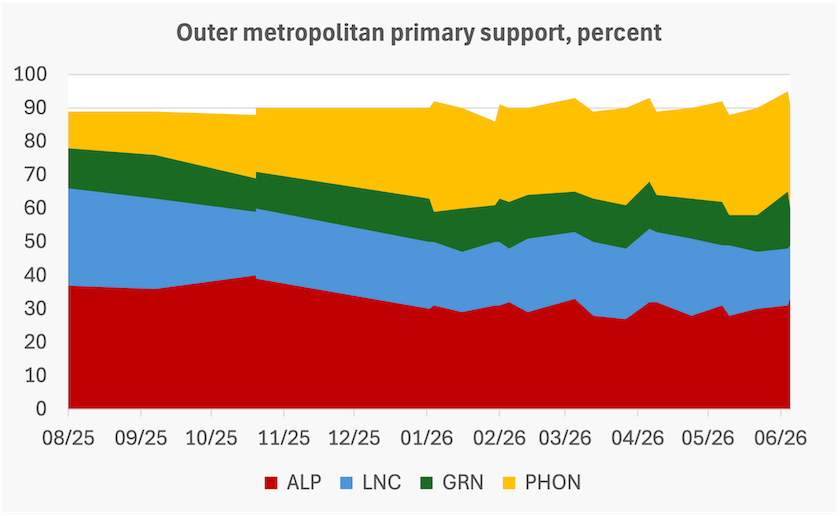
OK, it’s a bit rough. That’s because different companies have different polling intervals, different ways of framing their questions, and there is always sampling error. The smaller the classification you’re looking at, the bigger will be the error: if you’re looking at data by state expect less sampling error from New South Wales than from Tasmania, for example.
For these classifications you will find estimates not only of parties’ primary vote, but also of their TPP vote, where available. The general message, across almost all ways you cut the data, is that Labor has lost ground, but leads by a small margin after preferences and would be returned to office.
To interrogate the data, go to his BludgerTrack page, and click on “Poll data” in the top menu. You will be presented with tags, allowing you to interrogate the data by state, and gender, and a little tag that says “More”, which takes you to more options.

And don’t forget that William Bowe has a donation drive for his site.
BludgerTrack – Victorian election
William Bowe has a special BludgerTrack page for the Victorian election. The trends in primary vote and in TPP outcome are clear. In March 2024 Labor’s TPP lead over the Coalition was 60:40. The Coalition now leads 54:46, but the situation is volatile, because Labor is unloved and the Liberal Party is tearing itself apart. One Nation’s primary support is hovering around 25 percent.