Australia’s energy transformation
The transport sector — muddling through with policies from another era
Recent concerns about fuel tax credits expose the absence of a carbon price on transport fuels and haphazard policies on road funding.
Federal Parliament is a confusing place for a rookie MP, as One Nation’s new member David Farley found when he accidentally voted with the teals and Greens to cap diesel tax credit scheme rebates to miners.
The particular issue before Parliament was about the revenue forgone resulting from miners’ exemption from fuel excise under the Fuel Tax Credit Scheme. As the Climate Council describes the scheme, it refunds fuel excise (normally 52.6 cents per litre) for businesses that use diesel “off road”. Those uses include earthmoving machinery, irrigation pumps, backup electricity generators in hospitals, and vehicles in businesses such as mining and farming that use them on their own roads. The rebate is also available to businesses operating heavy trucks that are subject to separate road use charges.
The Australia Institute estimates that the Fuel Tax Credit Scheme cost public revenue $10.8 billion in 2025-26. That seems to be on the high side. A detailed breakdown of the cost of the scheme is in the 2023-24 Taxation Statistics, which shows that while the total cost of the scheme was $9.6 billion in that year, $1.8 billion of that was for rebates to the aviation and heavy transport sectors, subject to their own user charges, meaning the total rebate for private roads and non-transport use was about $7.8 billion.
The main issue, of concern to the Greens, independent MPs, the Climate Council and others keeping an eye on public revenue and greenhouse emissions, is that of that $7.8 billion, $4.5 billion went to the mining industry – a highly profitable industry that already enjoys many tax breaks. Lock the Gate has figures estimating how big coal-mining companies alone are projected to make huge claims on the scheme, with one company alone projected to claim $1.7 billion over the life of a mine.)
Greens and independents have therefore come together with a proposal to cap payment of the rebate to big miners, while preserving the scheme for farmers, small miners and others.
Independent MP Kate Chaney has spoken in support of the proposal on two grounds – the disincentive for miners to engage in decarbonization, and the unfairness of the scheme because of its concentration on mining companies, which have opportunities for electrification, such as use of electric dump trucks, that are not so easily available to other businesses.
Unsurprisingly, this proposal has met with a hysterical response from the Minerals Council of Australia, who have launched a “Hands off our fuel” campaign. To hear the Council’s spokesperson on Murdoch’s Sky News you might believe there is some conspiratorial campaign by “left” activists to shut down the mining industry and to inflict deliberate economic damage on “regional” (i.e. non-metropolitan) Australia.
The Minerals Council does make a valid point, however. Why should those who don’t use public roads pay a road tax? That argument is reasonable, particularly because eligibility for the rebate is specifically based in non-road use.
In fact from 1929 to 1992 fuel excise was specifically hypothecated to road funding. Since then, however, there has been no effective link between fuel excise and road funding: fuel excise simply goes into that big purse called “consolidated revenue”.
The case Chaney, Greens and others are reasonably making is that the mining industry should pay its fair share of excise, as other Australians do, because excise has nothing to do with roads.
Policy neglect
Until 1992 hypothecation of excise had provided Australia with something that reasonably approximated a user charge.
The end of hypothecation was more to do with bureaucratic power in Canberra than with any deliberate government policy. Economists in Treasury claim to favour user charging, but in reality they hate user charging and hypothecation, because it deprives them of control of the budget. Lust for administrative power trumps any commitment to economic purity.
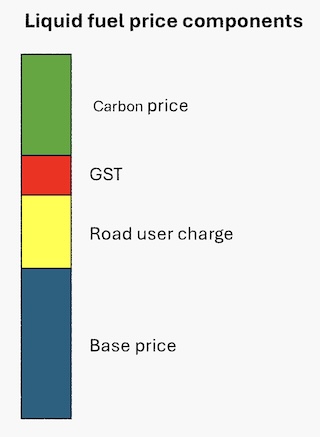
By 1997, when Australia became involved in the Kyoto processes, it would have been clear to the government’s policy advisers that there was a case for a carbon price on diesel, gasoline and related fuels. Ideally by now we should have a three-stage set of fees on those fuels, as shown alongside.
If such a scheme were in place today the miners, and others whose fuel use does not involve public roads, would be exempt from the road user charge. No one would be exempt from the carbon price, however.
But we never did apply a carbon price to transport fuels. In fact transport fuels were carved out of the short-lived Gillard government’s carbon pricing scheme. Our lack of explicit carbon pricing mechanisms is a story of the Coalition’s ever-hardening attitude to renewable energy and its drift towards hard-right populism.
It is understandable that people still think of fuel excise as a road user charge, and that bodies such as the Minerals Council argue against the rebate on that ground. There was never any announcement that hypothecation was to be dropped, and the clear implication from the description of the rebate scheme is that excise is still tied to road funding.
In fact there is still something of a loose link between road-related tax collected by Commonwealth and state governments and road funding, although the trend has been for those taxes to grow faster than spending on roads. This is illustrated in the graph below, compiled from the government’s Road-related Revenue and Expenditure data.
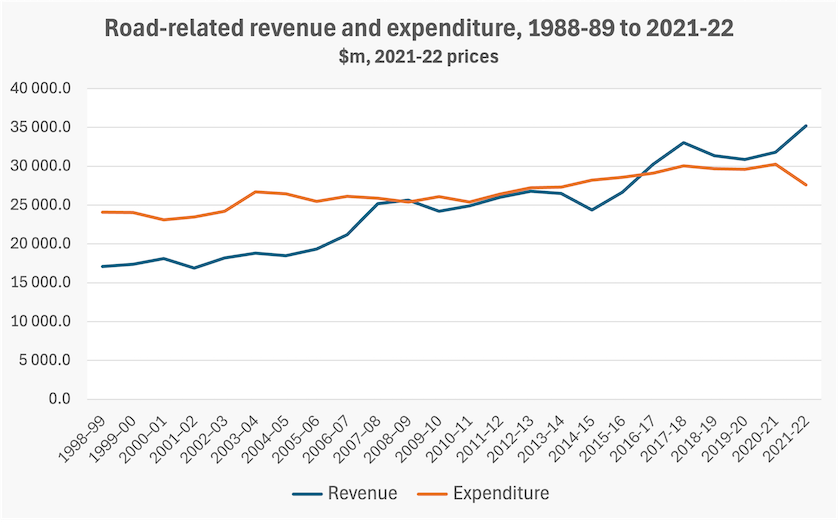
In the final year of that series, 2021-22, Commonwealth, state and local governments collected $35 billion in road-related revenue while spending only $28 billion on roads. The Howard government, in particular, was particularly hostile to public funding of roads, and from 2001 it actually froze indexation of fuel excise, which wasn’t restored until 2014. Since then excise has risen but government road expenditure hasn’t.
That graph covers a period over which population rose by 37 percent while road expenditure rose by only 14 percent (excluding the final turndown). Later figures compiled by the Australian Automobile Association suggest that the gap between excise and road expenditure is still widening.
The transport sector isn’t pulling its weight in our energy transition
In effect governments have left policy to drift. They abandoned a system designed to pay for roads, but they have retained its taxation mechanism. And they have left transport fuels out of our energy transition policies.
It’s a dismal story of policy neglect. One can rightly blame the succession of Coalition governments for the contempt it has shown to climate change policies and for its neglect of road funding. The 2015 comprehensive review of competition policy, the “Harper Review”, recommended fundamental review of road funding, which it regarded as “the least reformed of all transport sectors”, but the Abbott government ignored it. (The Coalition now blames immigrants for road congestion!) But Labor has been in office for four years, and has made only glacially slow progress on rectifying the economic damage it inherited from the Coalition.
On climate policy our current government has called on the electricity sector to do much of the heavy lifting, and that’s reasonable, but it has been slow to move on the transport sector.
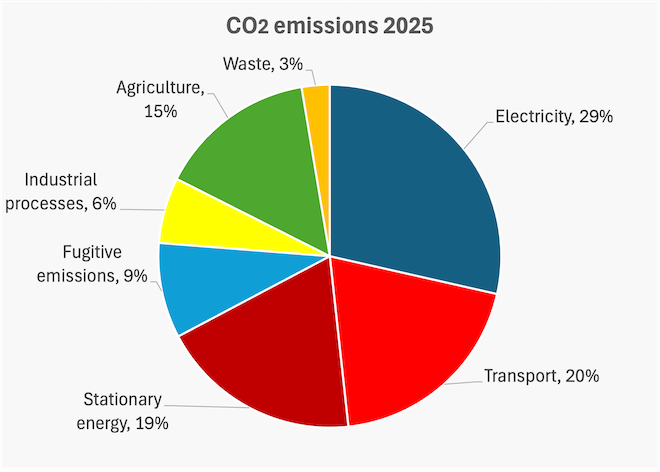
The transport sector accounts for 20 percent of CO2 emissions. In fact, if we are concerned with emissions from all users of diesel and gasoline, we should note that another 19 percent of emissions are from stationary uses, according to the National Greenhouse Gas Inventory.
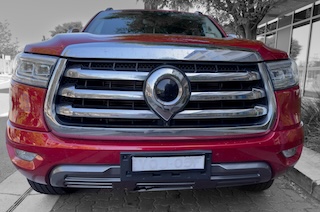
The government has some minor tax breaks for electric vehicles, but they are available only to companies providing cars as fringe benefits for employees – an economically indefensible market distortion, de-facto supporting a paternalistic model of employment. More recently it has introduced a New Vehicle Efficiency Standard, which requires each importer to meet fuel efficiency standards across the range of passenger vehicles they sell. They may sell vehicles with emissions that are higher than as set by the standards, but those sales must be offset by sales of vehicles that do better than the standard. It is a de-facto emissions trading scheme within individual companies, with an allowance for trading. This scheme has been in operation only since July 2025, and so far has made little dent on the sale of massive utes. The Ford Ranger was the best-selling passenger vehicle in 2025.
After a monumentally stupid attempt by the Victorian government to apply a road user charge to electric vehicles, road user charging has been kicked down the road. But the issue will be forced on to the Commonwealth, because at some time in the future it will have to deal with a fall in fuel excise.
At present the government is forecasting slow growth in gasoline excise (from $7.6 billion to $8.1 billion over four years), and a higher growth in diesel excise (from $18.6 billion to $21.4 billion over the same period). There is something reminiscent of the government’s over-estimation of tobacco taxes in these figures. Electric vehicle sales aren’t going to grow in some linear fashion. Rather they are likely to grow in a logistic function – an “S” shaped curve. Just this week the published data showing that last year, before there was any concern about Middle East oil supplies, electric vehicle sales were rising quickly.
More recent data from the Federal Chamber of Automotive Industries and the Australian Automobile Association shows that while new vehicle sales reached an all-time high in June this year, sales of internal combustion vehicles have been tumbling and even hybrid sales are falling.
At some time shortfalls in excise collection, and pressure from state governments, will force the Commonwealth to do something about road user charging, using a system that applies to all vehicles regardless of their power source. It is already technically possible to apply a comprehensive road user charge to all new vehicles, refined enough to account for the wear different vehicles impose on different roads, congestion, and urban planning priorities – such as discouraging drivers from using suburban streets when other options are available. In fact the 2015 Harper Review suggested that technologies then available could be used to develop cost-effective road pricing. The main problem for governments to confront will be associated privacy issues.
Comprehensive road user charging would serve the purpose excise served until 1992: it would provide a stream of revenue hypothecated to roads. (There is a case for some to be directed to public transport in certain circumstances.)
It would also expose the fact that diesel and gasoline are completely free of any carbon price, forcing the government to bring transport fuels into the loop of carbon pricing.
That means fuel prices need to be higher, and there lies a political problem, because low gasoline and diesel prices have become part of the Australian landscape – illustrated by the government’s huge concern about fuel prices in the context of the US-Iran war. That is in spite of the fact that we have almost the lowest gasoline prices of any “developed” country, as shown in the graph below.

The usual excuse is that we are a big country with big distances, but the reality is that we are also one of the world’s most urbanised countries.
In these figures there seems to be some room for a carbon tax on gasoline and diesel. It would give a boost to electrification, and for a time provide funds to support more positive movements towards de-carbonizing the transport sector.
Weaponized transport
Comprehensive road user charging could be the political sweetener that accompanies a carbon price, because it could result in a fairer way to charge for road use. Toll roads, one of the most loathed aspects of our transport system, could be abolished: in fact there would be more efficient resource allocation and more liveable suburbs if charging systems encouraged people to use these high-quality roads and discouraged them from rat running. Congestion charges could be structured so that shift workers who travel during quiet traffic times pay very little or nothing for road use. Vehicle registration fees could be reduced or abolished. And special consideration could be given for those who live in remote regions.
It may even have the public health bonus of seeing dangerous oversized utes disappearing from our streets.
Attitudes on climate change
Polling confirms that Australians’ approach to climate change is based more on political identity than on science.
The Essential polls have two time series relating to people’s beliefs about climate change.
The first, going back to 2010, is about people’s beliefs about climate change. According to that series, agreement with the statement “Climate change is happening and is caused by human activity” reached a peak of 64 percent in early 2018; by June this year it had fallen to 51 percent. There are predictable responses by age, but the most striking differences are by voting intention. Agreement with that statement is:
83 percent among Green voters;
64 percent among Labor voters;
45 percent among Coalition voters;
26 percent among One Nation voters.
The other time series, going back to 2014, is based on whether people believe Australia is doing enough to address climate change – “not doing enough”, “doing enough”, “doing too much”, “”don’t know”.
“Not doing enough” reached a peak of 62 percent in early 2020: it is now down to 30 percent. Younger people are most likely to seek more action on climate change.
Belief that we are not doing enough is:
64 percent among Green voters;
34 percent among Labor voters;
16 percent among Coalition voters;
18 percent among One Nation voters.
Anyone unfamiliar with Australia’s political history would find these figures hard to believe. Surely One Nation and Coalition supporters, disproportionately representative of rural Australia, would be most aware of the devastating effects of climate change. But those who travel in these regions would be familiar with the deeply entrenched prejudice against any policies associated with Labor governments.