Opinion polls
Are we passing peak One Nation – a chance for a Liberal Party resurrection perhaps?
One Nation’s support is starting to wane, but it seems to have completely wiped out the National Party. This should give the Liberal Party a chance to resurrect itself, but perhaps it has drifted too far to the right to think that way.
A series of Morgan Polls, conducted between mid-May and mid-June, showed One Nation’s primary support rising from 25.5 percent to 31.5 percent, eclipsing both Labor (27.0 percent) and the Coalition (17.5 percent).
But its latest poll shows a sharp drop in support for One Nation, falling down to 26.0 percent. Normally movements between successive polls can result from the interaction of margins of error, but a 5.5 percent fall is almost certainly indicative of a real fall.
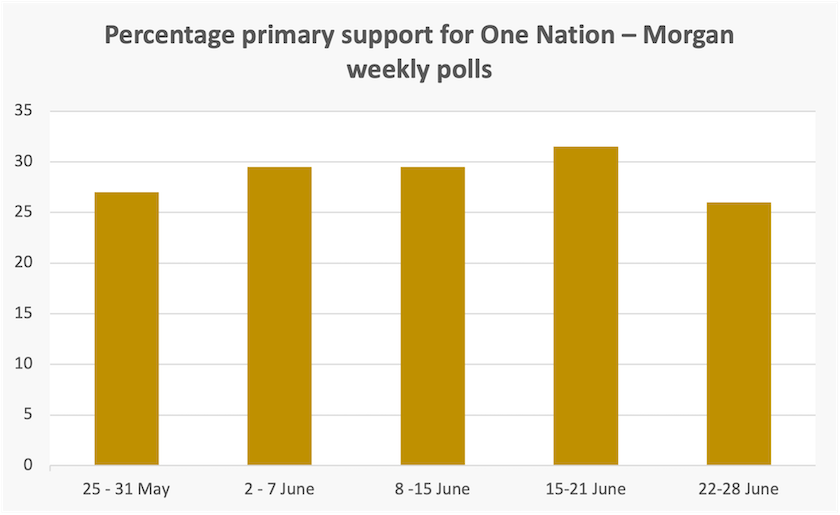
Further confirmation of a fall in support for One Nation is reported by Newspoll and Redbridge polls published last weekend and posted on Poll Bludger. The falls they reveal are less dramatic, because their polling intervals are much longer. Morgan’s weekly polls picked up the surge in One Nation’s support coinciding with Hanson’s Press Club appearance on 17 June.
The results of all three polls, compared with the outcome of last year’s election, are shown in the graph below.
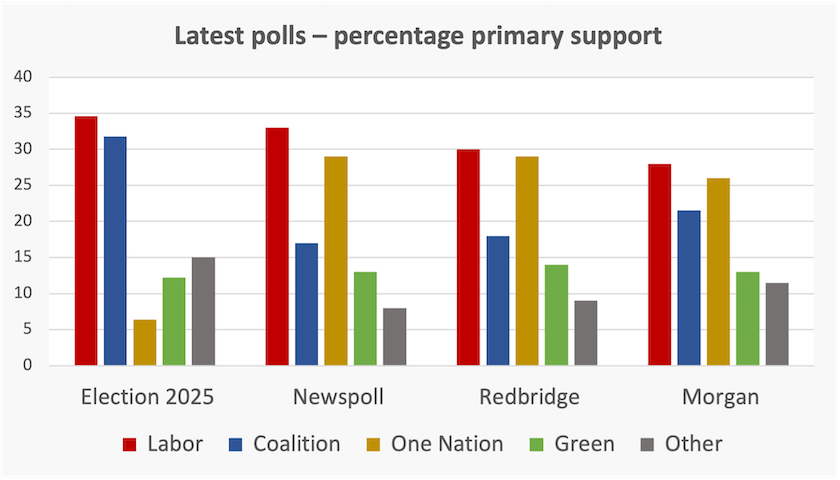
The Newspoll and Redbridge polls suggest that One Nation’s fall in support has been to the benefit of Labor and the Greens, but not to the Coalition. The Morgan poll shows a poorer result for Labor, and a more promising result for the Coalition.
The Redbridge and Morgan polls both show Labor in a TPP lead over both the Coalition and One Nation. (No TPP lead is given for Newspoll.) In terms of preferred prime minister ratings, the results are generally positive for Albanese, negative for Hanson, and very negative for Taylor.
On Late Night Live Anna Henderson of SBS goes into further details of the polls, and without identifying the specific source, she points out that one of these polls (in its unpublished data) shows that Labor easily leads the Coalition as the party better able to manage the economy, as well as in a number of other important attributes.
She seems surprised that Labor doesn’t seem to have suffered a strong backlash to the budget, suggesting that this is because the electorate’s interests are more around One Nation. An alternative explanation is that she, like so many journalists, mistook the shrill noise and disinformation coming from the partisan press and so-called business lobbies for opposition to the government’s reforms. The noise of the enraged and privileged should not be mistaken for general opposition.
Drawing on the results of the South Australian election, the Farrer by-election, and the latest Resolve Poll which had demographic data on One Nation support, it’s reasonable to conclude that One Nation’s strongest support is in the type of electorate once held by the National Party.
A detached observer of Australian politics might see the present situation as opening an opportunity for the Liberal Party, because it will no longer have to think of a coalition with the National Party. It could develop an economically responsible platform, including commitment to an energy transition driven by economics rather than an anti-renewable prejudice, a realistic migration policy without racist dog whistles, and tax and transfer policies that address the inequities still overlooked by Labor. It could even be so bold to acknowledge that our public revenue base needs boosting.
Bill Browne of the Australia Institute mounts a plausible argument that One Nation’s rise could give progressive voters more power in what were once “safe” Coalition electorates.
John Hewson, writing in The Saturday Paper – One Nation and the Trump-Farage phenomena – writes about the options for the Liberal Party presented by the recent surge in One Nation support. He acknowledges that Hanson has successfully tapped into the politics of grievance, and that there are many in what’s left of the Coalition who see a future in some form of cooperation with One Nation, ranging from preference deals through to a unification of the parties.
He warns his Liberal colleagues, however, that One Nation is nowhere near ready for the responsibilities of government, and that its weaknesses will become more apparent over the next two years. More basically he is critical of those in the Coalition who see the future only in the form of some coalition with the right, even if that means compromising with the far right. Hewson writes that:
…the Coalition is panicking and Abbott and Taylor have committed to preference deals with One Nation, hoping to stem the tide. It is sad that the Liberals prefer a government led by the far right than by Labor. I guess some are dreaming of a coalition with One Nation rather than the spent force of the Nationals. The Coalition’s standing will continue to erode, opening opportunities that Hanson will try to exploit. Increasingly, though, I feel Australia will recognise she is not ready for government nor capable of the kind of global representation that Australians will want.
He might have added the observation that demographics is not on the side of One Nation. Its base is aged, has missed opportunities for education, and has the ethnic mix of an earlier Australia. The cohorts who will replace it are entirely different.
In any case why should one think of politics only in a winner-take-all “left” or “right” coalition? In many European democracies, most notably Germany, there are centrist coalitions, making for stable and representative governments.
It is possible that the surge in One Nation is mainly a reaction to the collapse of the Coalition. That’s Richard Denniss’ interpretation of the polls and the Farrer by-election, presented in a 17-minute podcast What’s the point of One Nation?. By implication, if the Liberal Party can get its act together (let’s forget about the Nationals), and if Labor in government can switch from announcing to delivering, One Nation may fade back into the political never-never where it belongs.
The Lowy Poll – how we feel about the world in 2026
Such is our feeling toward the Trump administration that we’re on track to putting more faith in China’s foreign policy than in America’s foreign policy.
The most striking feature about the annual Lowy Institute poll about how Australians feel about the rest of the world is our deepening mistrust in America’s foreign policy.
Only 31 percent of Australians trust the United States to act responsibly in the world. That puts them just ahead of China, at 28 percent, even though 62 percent of those surveyed believe China will become a military threat to Australia in the next 20 years. And the trajectory of responses this question is revealing: at the present rate of our deterioration of trust in the United States, and our tentative growing trust of China, it’s a fair bet that China will overtake the United States by the time the next poll is published.
We’re not entirely negative about our trust in other countries: on the question of trust to act responsibly in the world Japan dominates (89 percent), followed by Germany (83 percent). (If you can find a WWII veteran try explaining that!)
In relation to the United States, the general tenor of the responses is that we value our military alliance, but we are deeply distrusting of this administration.

But ee still like their old peacekeeping machines
One surprising finding is that 54 percent of respondents believe our present government is doing a “quite poor” or “very poor” job in handling foreign policy, up from 41 percent in 2024.
Although the poll is mainly about our attitudes to foreign relations it covers a number of areas that mainly involve domestic policy.
Only 41 percent of respondents are optimistic about Australia’s economic performance in the world over the next five years. This has been on a downward trend since 2021 when it was 79 percent. Younger people are considerably less optimistic than older people.
Respondents’ views on climate change action are assessed with the statement “Global warming is a serious and pressing problem. We should begin taking steps now even if this involves significant costs”. Just on 50 percent agree, down from 60 percent 8 years ago. Respondents are also asked if they think achieving a net zero target by 2050 will leave the Australian economy better or worse off: 38 percent go for “better off”, 38 percent go for “worse off”. There is a strong correlation with respondents’ education level and a belief that we should take action on climate change.
Attitudes to immigration are hardening, particularly in the last couple of years. Earlier in this century we were split about evenly between immigration being “too high” and “about right”. The latest survey shows 55 percent believe immigration is “too high” and only 29 percent believe it is “just right”. There are strong partisan differences: 92 percent of One Nation supporters say immigration is “too high”, while at the other end of the spectrum only 23 percent of Greens supporters say that immigration is “too low”.
Most Australians – 73 percent – agree that our culturally diverse population has been positive for Australia. This is down from 90 percent in 2024. As with immigration there are significant and dismally predictable partisan differences in responses to cultural diversity.