Economics
A fair tax for startups – a problem in accounting maybe?
Some startup companies need a carve-out from the general CGT rules. This stems from ancient accounting conventions that don’t acknowledge the value of human capital.
A question that should be on the minds of journalists and policy wonks is why a system of taxing capital gains that operated without fuss from 1985 to1999 is resulting in howls of protest when it is being re-introduced. After all, the government is doing no more than removing a distortion that had resulted in a misallocation of resources in real estate and equity markets.
Those howls are discordant because they come from so many different groups. Partisans who object to anything a Labor government does. Mortgage brokers, real estate agents, financial advisers and others who benefit from commissions when assets are bought and sold, and who will miss the high turnover of “investment” properties. Investors, including many led astray by a partisan press, who do not realize that the changes actually lower the tax liability of many businesses and make the share market a more friendly place for small investors. Well-off businesspeople, unfettered by any moral consideration of their obligation to the community, who have been using family trusts to avoid paying their share of taxation.
Matthew Bowes of the Grattan Institute refutes some of these claims in his Conversation post Rising rents and “death taxes”’: why wild claims after the budget don’t actually make sense. He also warns that the voices of greed become so deafening, and lead to so much social division, that governments are put off the already difficult task of tax reform.
Also trying to make themselves heard, however, without being associated with the petulant whiners, are some with a genuine concern. Most notably they include a class of business investors for whom the move back to inflation-adjustment will have little benefit because they have so few tangible assets.
The image that most easily comes to mind is the business that starts in a garage or bedroom without a meaningful capital base. Having developed some new platform or app, or a large clientele for some service (for example a specialized travel agency), its founders sell it a few years later for a large consideration. Only then is it valued at sale price, entered in the books in a category known as “goodwill” or “intangible”, a vague term because accounting doesn’t really have rigorous way to deal with human capital. Because there is almost no recorded capital base, inflation indexation applied to the starting value is of hardly any benefit. Those founders would be far better off with the non-indexed 50 percent discount.
No doubt in consultation with people with close knowledge of small business, the government can work out something that doesn’t disadvantage such ventures. Some are saying the CGT changes should be confined to housing, but that is to overlook the need to correct the same distortions applying to the share market, and to private companies with substantial physical assets. To repeat the point, the problem applies only to companies with a small asset base, not to all non-housing assets, and not to small business in general.
The underlying problem, that gets little or no mention, lies in the way assets are valued.
Imagine two different scenarios. In one, someone has been saving and borrowing to buy an established business. That business will have a substantial starting value. In another, someone has spent four years in personal study, incurring HECS debt, forgoing employment opportunities, and has started a new business.
Both have made substantial investments, but only one of those two businesses has a balance sheet giving a substantial value to that investment.
The difference results from the way we value assets. As Barry Jones has often said, we are conditioned to think of an asset as something that hurts when you drop it on your toes. That was good enough in the days of Adam Smith and Karl Marx. But over the long haul, as the cost of physical capital has fallen, the contribution of human capital has become more important in generating real wealth. (In fact Marx understood this when he picked up the labour theory of value, but he was interested in matters other than accounting reform.)
If these valuation problems are difficult enough, we can think of trickier valuation issues as artificial intelligence comes to augment or displace human capital.
While there are almost certainly learned people in Treasury and maybe in the Tax Office who are on top of accounting concepts, the way businesses and governments value assets remains bound by conventions that don’t apply to certain assets. Those conventions do a reasonable job in valuing big stuff that really does hurt when you drop it on your toes – factories, trucks, airplanes, buildings – but they produce weird figures in human-capital intensive industries.
When Keating introduced indexation in 1985 it was much harder for people to launch the sort of businesses that some young people are starting today. Computers were still big and expensive. Steve Jobs and Steve Wozniak were seen as a pair of nerdy eccentrics.
But that doesn’t mean we should restrict the present reforms to housing. They should apply to the share market, where non-indexation is imposing high costs on patient investors who put their money into solid slow-growth industries. They should apply to businesses with a substantial capital base, large or small. High-tech startups can surely be accommodated with some tweaks to accounting, that recognize the considerable capital – human capital – people bring to these enterprises.
Don’t expect the Coalition to propose anything so practical, however. In promising to reverse the reforms if they win office they are making it clear that they are beholden to mortgage brokers, investment advisers, so-called “wealth managers”, stock brokers and others in the financial sector who do well out of a high turnover of assets, to the detriment of the real economy. In any event, observing their obsession with government gross debt, it’s doubtful if they even understand a balance sheet, let alone the basic concepts and conventions of accounting.
The death tax scare
No – the budget does not have a secret death tax. That’s a pity.

Buried in the budget papers lies Labor’s secret death tax, according to Coalition spokesperson on science, technology and innovation, Aaron Violi. His claim is echoed by many others in the Coalition.
That must surely be a good thing for longevity, because if you tax something you get less of it, according to Angus Taylor.
Nothing so wondrous, however. They seem to be suggesting that the government is introducing some form of inheritance tax, and when the ABC’s political correspondent Jake Evans tracks down the claim he finds that it refers to the government’s plans to bring Australia’s 10 000 discretionary testamentary trusts into the same tax arrangements as other family trusts.
Crispin Hull, in a post on his website Death to News Ltd’s propaganda, has a clear explanation, with examples, of the ways trusts of all kinds are to be treated, ensuring that the income from trusts is to be taxed at least at a rate of 30 percent, the marginal rate that kicks in at an income of $45 000. That is to shut off the rort that up to now has allowed trust income to be distributed to dependents with low incomes. He shows that even after the government’s reforms come into place the income from trusts will still be treated in generous ways not available to those who earn their income as employees.
And he illustrates how discretionary testamentary trusts work. They go beyond a tax rort. They’re also a vehicle used by patriarchs who cannot bear to lose control over their dynasties. Perhaps that explains why the Murdoch press has come out so strongly in their defence.
And what a pity we don’t have inheritance taxes, which would go some way to supporting the principle of equality of opportunity.
The CPI – stop calling it “inflation”
The CPI is on the way up, but what’s the value of this indicator when it’s pushed around by subsidies and taxes, and when it’s based on shonky statistical methods?
The CPI showed another rise in April, as illustrated in the graph below. Media attention is on the 12-month rise in the index, from 98.68 in April last year to 102.80 in April this year, a rise of 4.2 percent. That’s reported as the “headline” inflation, and is down on the previous month’s headline figure.
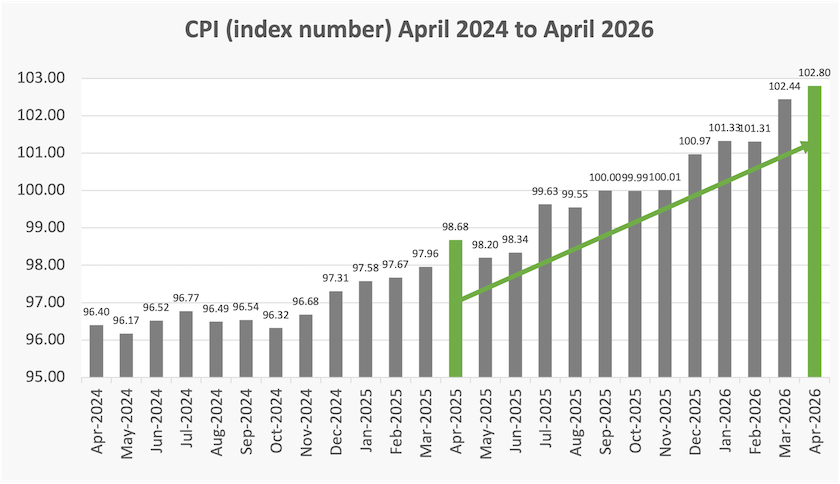
The main driver of that year-on-year rise was automotive fuel. Another was electricity prices, reflecting the withdrawal of government subsidies as wholesale prices eased. The “trimmed mean” CPI, which excludes such volatile items, was a more modest 3.3 percent.
Between March and April the CPI rose from 102.44 to 102.80, a rate, if annualised, would come to 4.3 percent. The April figure would have been higher but for the government’s decision to temporarily cut fuel excise. Most observers are predicting that even if the Strait of Hormuz is opened, oil prices will rise, because countries are depleting their stocks, holiday season is coming in the northern hemisphere, and it will still take many months for supplies to be re-established.
Also, it appears that so far many businesses are absorbing the cost of higher transport. This is normal behaviour when businesses expect input price rises to be temporary, but the longer oil prices stay high the more likely it is that companies will raise prices. In other words prices are rising and are expected to go on rising.
Gareth Hutchens explains recent rises in the CPI, with an emphasis on gasoline and diesel prices, which have had a once-off fall: Headline inflation eases to 4.2 per cent in April as fuel prices fall.
All of the above suggests that next month will see a more significant rise in the CPI. But that can pretty well be guaranteed just by looking at the graph, because the May figure will be coming off a low base. Even if there is no rise in the May index number, the annual rise, using a year-on-year calculation, would be 4.7 percent (102.8/98.2). This is yet another illustration of the absurdity of using year-on-year index numbers – a historical lagging estimate – as an indicator of CPI inflation, rather than something like a seasonally-adjusted trailing average, giving more weight to recent movements.
In any event the CPI is an indicator of households’ cost of living, which, as we have seen with gasoline prices and electricity prices, is influenced by changes in government taxes and subsidies. At best the CPI is an indicator with a distant link to inflationary pressures in the economy. It is not a measure of inflation.
Electricity prices
Electricity prices are on the way down. That’s good news.
Electricity prices are on the way down at last, but expect the Coalition to go on lying about what’s happening in the electricity market, as it attempts to discredit the government’s policy of moving electricity supply to renewables.
The Electricity Regulator’s decision on the default market offer – the ceiling on prices – is in its press release, showing the percentage price reductions by state and differentiating between households and businesses. Writing in Renew Economy Sophie Vorrath provides further details – Solar, wind and batteries push down electricity bills for homes and business, despite global fuel crisis – and Clare Savage, Chair of the Regulator, in a short (4 minute) session on Radio National explains how the reductions have come about.

Peak shifter
For the most part this price reduction is due to the expansion of renewable energy, particularly solar power. It is helped by mechanisms to shift demand from evening peaks to times when renewable sources are more available and by the uptake of batteries which reduce peak demand on the grid. And the regulator seems to have been somewhat tougher on “retailers” who have been charging dearly for the simple task of buying electricity from the wholesale market and selling it to households, while smoothing the price to consumers. (We should be coming close to the point where households can bypass retailers, using price-monitoring software and batteries.)
Tony Wood of the Grattan Institute, in his Conversation post Why are retail power prices finally falling? summarises those drivers of lower prices, reminding us that wholesale power prices are only 30 to 40 percent of the retail price. There are still igh-cost elements in our power supply network:
Solar, wind and batteries can provide power more cheaply than fossil fuels, and renewables have reached as high as 50% in Australia’s main grid. They could have driven retail prices down further if not offset by the rising costs of new transmission lines.
We’re paying dearly for governments’ decisions to privatize or corporatize the electricity transmission and distribution networks.
We can expect the Coalition, and its pro-coal allies in One Nation, to go on discrediting renewable energy. Even though he would have had plenty of advance information of the Energy Regulator’s decision (it issued its draft determination in March) Taylor has been sticking doggedly to his line that wind and solar power are driving up electricity prices, and that sustaining coal-powered generators is the path to bringing electricity prices down.
On the same day the Energy Regulator announced the reductions, Nationals Senator Susan McDonald was trying to tell the Radio National listeners that the default market offer determination by the Australian Energy Regulator was meaningless: all that counted was Labor’s failure to see electricity bills reduced by $275. She went on to say that since Labor came to office “prices are up $1000”!
What is she talking about? The retail price of electricity is about 30 cents per kWh. To what is she referring with that $1000 figure?
Perhaps she somehow confused people’s electricity bills with the price of electricity: she wouldn’t be the first Coalition spokesperson to get muddled about the difference between bills and prices.
If so does that $1000 figure make any sense? The average annual household electricity bill is about $2000. If that includes a rise of $1000 since Labor came to office in 2022, it means electricity bills have doubled. Really? Even if so, it cannot be because of higher electricity prices, which have risen in nominal terms by 37 percent (20 percent in real terms). Mathematically that means consumption must have risen by 46 percent. It surely hasn’t risen by that amount, and even if it has it shouldn’t matter: governments have some influence on the price of electricity, but the amount of electricity people use is up to the individual.
In that interview she goes on making other assertions, but if the first number she uses is found to be meaningless, how can we believe anything else she or other Coalition spokespeople are saying, assuming they all use the same brief?
I get no pleasure in calling out her behaviour. The government is not beyond reproach: it could do much better in decarbonising the economy, but it is not being held to account. If the Liberal and National parties rely on made-up figures, rather than considered criticism of the government, how can they go on claiming to constitute the “opposition” in the Westminster tradition?