Other economics
Wages are not moving
Real wages are barely above their level when the Albanese government came to office.
The ABS Wage Price Index for the March quarter, a publication that came and went almost unnoticed in the din of the budget, revealed that there was no real wage growth in the March quarter. It reveals that wages fell sharply during the Morrison government’s time in office, made an anaemic recovery in 2023 and 2024, and have since fallen back.
The graph below is derived from that index, using the CPI to convert it from nominal to real figures.
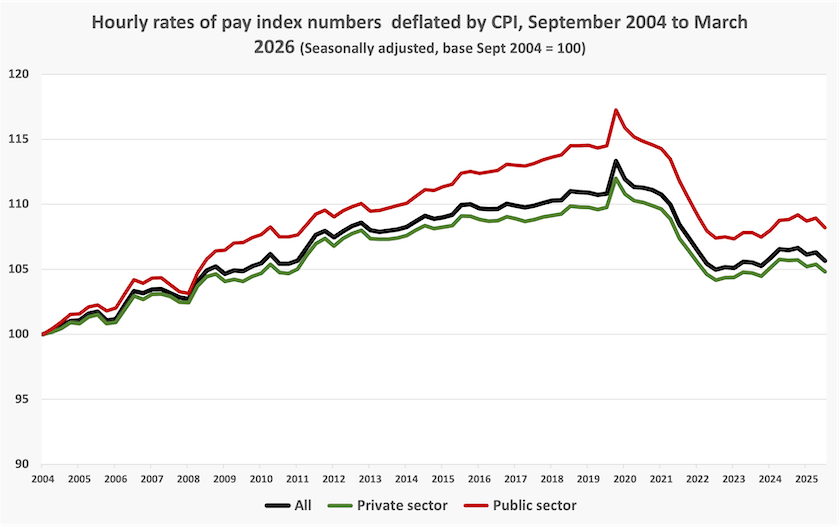
There was a strong rise in wages up to the temporary boost during Covid when “JobKeeper” subsidies (payments to firms to retain workers) made a mess of the figures, and there was a rapid fall in the post-Covid period. The Albanese government came to office at a time when wages had just been through that sharp fall. Hourly pay is back to around where it was in 2010.
If, as projected in the budget papers, there is a 3 percent real wage growth over the next three years, that would see the black line move closer to the 110 level – about where it was before Covid.
Note that this series relates to hourly pay. Because labour force participation has risen, the number of hours worked per worker has risen, which means the index probably understates changes in actual wages.
Some observers may believe that the widening gap between public and private sector pay is about overpaid Canberra bureaucrats. But it’s mostly at a state level, and is in the health care and education sectors – almost certainly due in part to belated rises in pay for nurses and teachers.
The World Bank gives an OK to industrial policy
That’s a huge ideological conversion.
One of our readers has drawn attention to an article in Global Currents by Jostein Hauge of Cambridge University, UK: Why the World Bank changed its mind on industrial policy.
It’s a review of a report from the World Bank, admitting that its long-held criticism of industrial policy (in Australia we use the term “industry policy”) was wrong. The World Bank stuck to its neoliberal line, more-or-less oblivious to the fact that the governments of successful economies, particularly the high-growth Asian “tigers” in our region, had active and carefully-designed interventions shaping their economic structures. Industrial policy worked.
According to Hauge, it’s not that the World Bank has suddenly had a mea culpa. It’s more that as countries have walked away from neoliberalism it is hard for the Bank to keep pushing the same anti-industrial policy line.
The evidence for industrial policy was always there. What has changed is the geopolitical context. Western nations now actively need industrial policy to compete, especially with China. Semiconductor supply chains, electric vehicle manufacturing, critical minerals processing — these are the battlegrounds of great power competition. It is simply no longer coherent for the West to condemn industrial policy as a relic of misguided statism when it is simultaneously practising it on a large scale.
It’s an important statement for our times, when governments of the world’s largest countries are conducting real-time experiments in variants of industrial policy. China and the USA present two of these experiments, one through subsidies, the other through tariffs.
Here in Australia we have a government directing an energy transformation and setting policies to develop valued-added products based on abundant energy and mineral resources, particularly for critical minerals. It differs from the industry policies of last century – indeed from the time of Federation – which were about industrialising behind a tariff barrier as a means of developing a well-paid working class. Industry policies of our time are about developing specialized industries based on our comparative and natural advantages, and securing supply chains. It’s hard for those with an old-school mindset based on a mercantilist idea of promoting exports to realize that securing imports may be just as important.