The budget and the hysterical reaction
Australia is still struggling with low taxes
As with previous budgets, the government tries to reconcile economically justifiable demands for public expenditure with an ideologically-constrained tax base.
No serving or aspiring politician is allowed to say what most detached economists point out: Australia is a country of low taxes, and we are trying to fit requirements for public expenditure within a small and unnecessarily constrained flow of public revenue.
The chart below, essentially an update of similar charts occasionally run on this website, reminds us that our revenue base – mainly our taxes – is small in comparison with other high-income countries. This chart displays taxes at all levels of government, and non-tax revenue, such as from sovereign wealth funds, which is why Norway stands out: that’s a reminder of our repeated failure to capture more value from exported gas and other natural resources.
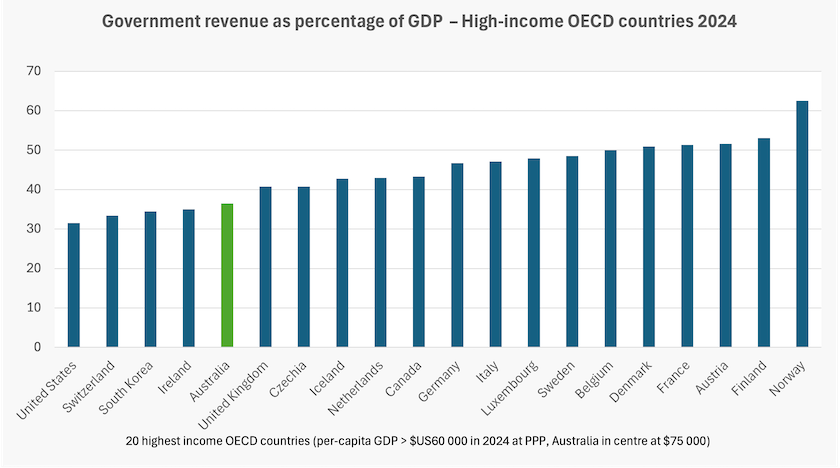
There are countries with lower taxes, the standard example often cited by “small government” ideologues being the USA. But when you add back its 7 percent fiscal deficit – which is really a tax liability – and add back our 1 percent tax liability to make a fair comparison, we’re actually paying less tax than the USA.
I raise this once more, in the context of the budget, because the Coalition is promising to link the cut-in points of income-tax brackets to inflation. Most economists, including Saul Eslake, believe that indexing tax brackets is a good idea, in that it removes what most call “bracket creep” and the “small government” mob calls “taxation by stealth”. The main argument against bracket creep is that Australia already relies on income taxes more than most other prosperous countries, and we should not raise that dependence.
We should apply a grain of scepticism to that argument. First, because our overall taxes are so low, it is a mathematical reality that our income taxes are high in relation to other taxes. And second, through trusts and other rorts, some of which the government is trying to close, many Australians pay far less tax than they would without those rorts. Our income tax is far less progressive than it appears by simply considering the brackets, because so many very well-off people enjoy unjustified breaks that reduce their reported incomes.
The government and opposition are locked in an argument about the cost to public revenue that would result from indexation of tax brackets. It’s almost amusing to see the precision of these estimates, attempting to cost a policy at least three years off, in a period of volatile inflation and economic growth. (You can roll your own estimates using the Parliamentary Budget Office’s SMART program.)
But the main point is that indexation would deprive the government of a source to increase revenue, in an environment when it is facing higher demands for public spending for an ageing population (which would age much faster if we lowered immigration), when public services in the care economy are intrinsically labour intensive, when there are demands for increased spending, when the task of re-building public sector capability is far from complete, when there are demands for increased defence spending, and when there could be a wave of unemployment resulting from the uptake of AI. Treasurer Chalmers is not entertaining the idea of indexing tax brackets, claiming that there are better ways to return extra tax collected through bracket creep – specifically through measures such as the Working Australians Tax Offset (WATO), which have the same effect as removing bracket creep for workers, but not for idle investors.
Indexing tax brackets is the only economically sound idea in Angus Taylor’s response to the budget, but to be capable of implementation it would have to be accompanied by some other tax. We have plenty of unused tax capacity – wealth taxes, higher resource-rent taxes, inheritance taxes, taxes on pensions paid from high-balance superannuation accounts, a higher GST – but no-one in the political classes wants to talk about it.
A budget for aspirational Australians
Like Howard and Costello before them, Albanese and Chalmers have crafted a budget for “aspirational” Australians, but these are in a different cohort.
The noise around specific measures has distracted us from the government’s economic strategy, manifest in the budget.
The ABC’s Gareth Hutchens sees the budget in terms of an appeal to aspirational voters, but these aren’t the same “aspirationals” John Howard was referring to in his day. Howard’s “aspirationals” were people in their middle age and older, seeking to build up their personal wealth. Howard served them well with generous superannuation concessions, and a tax system that encouraged them to invest in housing. So well did he succeed that he overshot. To quote Hutchens:
The wealth those measures helped to create for the baby boomers and gen Xs who took full advantage of them has come at the expense of opportunities for their children and grandchildren to do the same.
Those children and grandchildren are the “aspirationals” at whom this budget is directed, and their main aspiration is to have the security of housing.
Hutchens, in his well-researched article, emphasises housing. Others may say that the government’s main objective has been to correct distortions that taxed income from idle investment more lightly than income from work and effort, but there is no contradiction because the two overlap. Which one the government emphasizes is a matter of political choice.
One clear objective in the government’s tax changes is to clear “investors” (i.e. speculators) out of the housing market, so that first home buyers have a better chance. Those well-off Australians who want somewhere to put their savings are being encouraged to do something useful with their money – to invest it in new housing, or in shares. That’s why removing the investment disincentives (yes “disincentives”) applying to long-term investors in Howard’s capital gains package is a necessary complement to the housing measures.
The budget is only ten days old, and tax changes are yet to be legislated, but there are already signs that “investors” are withdrawing from the housing market. Maybe some have done careful calculations based on cash flow projections, maybe their banks have already set tighter lending limits on “investors” in anticipation of changes in the market, or maybe they are just reacting to hysterical scare campaigns. Either way the effect is the same.
In fact the real (CPI inflation-adjusted) price of houses in Sydney and Melbourne is already falling, and will probably start to fall in other regions. If this happens it will confirm that the tax measures announced in the budget are working, but don’t expect the government to crow about it, because so many people irrationally believe that the market value of their house is a measure of wealth.
If real prices of houses do fall, one consequence will be that “investors”, when they sell, will find that their capital gains are assessed on the nominal gains in their property prices. Many will realize that they would have been better off had the indexation method of capital gains not been abolished. They will have learned, 27 years too late, that the Howard changes meant that taxes were imposed on illusory gains. There is an element of retributive justice in the government’s policies.
Changes to capital gains taxes should benefit investors in shares
Contrary to the scare campaign mounted by “influencers” and the Coalition, reversion of CGT provisions to inflation-adjustment should make shares a more attractive vehicle for small investors.
Sneaky way Albo is now killing your savings is how the headline on realestate.com.au reads. The headline on a session of ABC Business is: Could CGT discount changes see mass exodus of businesses from Australia?
“Influencers” – people who have never done the hard slog of learning about finance, economics, or anything else for that matter – are warning young people that the share market has become less friendly for small investors, because they will be taxed at 47 percent on their capital gains. (The ABC’s Michael Janda explains the convoluted way they get to a 47 percent tax rate, which has no connection to reality or logic.)
There is a torrent of misinformation about capital gains taxes, because the common story, circulating since Howard changed capital gains tax provisions in 1999, is that he “halved the rate of CGT”.
That is wrong, terribly wrong, because it ignores the other way he messed with the system: he abolished indexation, which meant that a large class of investors would finish up paying more CGT.
“Halved the rate of CGT” has 27 years of traction, because journalists and spokespeople in welfare agencies – even some academics – didn’t bother to look into the profoundly distortionary effects of abolishing indexation. Perhaps they found the mathematics too hard, even though it’s only at a mid high school level.
Having created the idea that Howard “halved the rate of CGT”, they are now responsible for the idea that the Albanese government is doubling it. (Oh for the days when mathematical ignorance wasn’t a mark of pride for the “left”!)
The government’s changes in capital gains taxes are well-explained in a budget document Negative Gearing and Capital Gains Tax Reform, in plain language and with worked examples. On the way the changes apply to shares, government Minister Andrew Charlton provides an even simpler description on ABC Radio National – Assistant Minister says online claims about CGT changes “factually incorrect”. As he puts it the Howard changes provide a discount on reported capital gains: the indexation method also provides a discount in a fairer and less distortionary way.
The realestate.com.au article referred to above, in common with many other statements, points out that many young people invest in the share market as a way to save for a house deposit. The share market is certainly a wise vehicle for small investors, and their chosen instrument is often an Exchange Traded Fund (ETF) –a well-diversified fund that essentially tracks the share market, which, over a reasonable time, should give the investor about the average dividends and capital gains as the Australian stock exchange.
The ABC has run a story about Vanessa, living with her partner in a motorhome, while she accumulates savings by investing in ETFs. According to the article, Vanessa is worried that the CGT changes may result in her having to pay more tax.
So to run an example I had a look to see how an investor like Vanessa would fare under the Howard system, and under a restored inflation-adjusted system, if she had invested $10 000 in an ETF in March 2021, and sold it five years later in March 2026.[1] I chose Vanguard’s Australian Shares Index because it is one of the most popular ETFs.
Here is the comparison, first using the Howard method:
ETF price March 2021: $87.92, buys 114 shares, outlays $10 023
ETF price March 2026: $107.68, sells 114 shares, receives $12 276
Capital gain = $12 276 – $10 023 = $2 253
Tax base after 50 percent discount - $1 127
Now the neutral inflation-adjusted method:
ETF price March 2021: $87.92, buys 114 shares, outlays $10 023
CPI index March 2021; 81.9
CPI index March 2026: 101.7
Inflation adjustment factor = 101.7/81.9 = 1.242
Inflation-adjusted purchase outlay = $10 023 * 1.242 = $12 449
ETF price March 2026: $107.68, sells 114 shares, receives $12 276
Capital gain = 12 276 – 12 449 = – $173
No capital gain therefore no tax payable.
That is simply one example. If you run the same comparison on BHP you find almost the same result: her tax base on the Howard method is $1 246, and only $74 on the inflation-adjusted method. If you run it on Australian Financial Investment Corporation – a listed investment company used by conservative investors seeking a strong dividend stream – no tax is payable under either method. But if you run it on Wesfarmers, the tax base on the Howard method is much lower than the tax base under the inflation-adjusted method.
The general pattern, baked into the mathematics of the two methods, is that the Howard method is most advantageous for assets held over a short term (provided it’s more than a year) with high gains in asset prices. The inflation-adjusted method is most tax advantageous for assets held over a long time, particularly if their price accumulation is more modest. The more an asset price outruns inflation, the more advantageous for investors is the Howard method, but that has to be a high return – as a rule of thumb at least twice the inflation rate – for the Howard method to offer a better return.
A more comprehensive analysis of the difference between the methods, and a spreadsheet model you can download, is in the roundup of April 4.
One could argue, as funds manager Geoff Wilson does, that the Howard method encourages people to invest in high-growth assets, and therefore it nudges investment into successful firms. But as anyone who has followed financial markets over the years knows, share prices can have a life of their own almost unconnected from corporate performance, particularly if the firms are carrying a high level of debt. And the whole stock market itself is volatile – indeed it has become more volatile in recent years. The Vanguard example above illustrates this: if you look at their historical price chart on Yahoo Finance you will see that small differences in the dates of buying and selling can have a large effect on reported capital gain.
The inflation-adjusted method cushions some of the variability in asset prices. Compared with the Howard method it taxes more of the windfall profit while not unfairly taxing those whose investments have had lower capital gains. This cushioning should make the share market more attractive to small investors, particularly those saving for a house deposit who may want to make a sudden sale on the day when they have made a successful bid on their first house – which may also be a bad day for the share market.
If you tune into the wailing about CGT changes you might believe that the government has made some massive interference in financial markets. But in fact it has simply removed a distortion that’s been misdirecting investment flows for 27 years. The government has brought financial markets back towards neutrality.
That distortion was sold to the Howard government by the finance sector, which always profits when there is a high turnover of assets. That is why people in the share and real-estate markets have benefited from speculators who buy and sell in a short period, rather than long-term patient investors more intent on building up real wealth over an extended period.
It’s hardly surprising that in the two days after the budget, shares in the Commonwealth Bank fell from $173 to $153 – the sort of fall banks usually experience only in the rare event of a financial panic. But this was no panic: rather it was a realization that a distortion in tax settings is to be removed, allowing more finance to be directed into the real economy, rather than to be continually churned through the banking and real estate sectors.
Chalmers gets it right when he says shares have been “under compensated” for two decades. If, as he hopes, removal of the Howard distortions bring small investors back to the share market – as in the days when small parcels of BHP shareholdings were as common as Holden cars – they will have lessened the cost of corporate finance, and removed one source of housing price inflation.
And as for “influencers”, those with public voice – preferably a voice respected by the young – need to call out these people as charlatans in the service of the Coalition and big business, who see young people as resources to be exploited. In fact one of the instigators of the “47 percent partner” campaign, Frank Greef, has admitted that the campaign favoured attention-grabbing over accuracy. In the world of many “influencers” the only currency is attention-grabbing, the only ideology is greed, and ideas like truth, analysis, rigour, and social justice are affectations of “woke” left-wingers.
1. I chose those dates, rather than April or May, because we have ABS CPI data up to March. Vanguard’s share price can be tracked on Yahoo Finance. ↩
Small business complaints
Mostly a scare campaign reinforced by uninformed journalists, but there are resolvable issues relating to startups.
Capital gains tax changes
Imagine that you bought a small business 40 years ago. A business with substantial assets – buildings, motor vehicles, machinery, and merchandise or raw materials. A small ready-mix concrete business, perhaps, all originally valued at $2 million. You have managed it well, maintaining buildings, replacing depreciating assets. You have expanded your business a little, but you have not wanted it to grow beyond your capacity to manage it. On retirement you sell it for $10 million.
If you were permitted to use the inflation-adjusted method to assess the capital gain tax base, that original $2 million would be revalued in line with inflation – by a factor of 3.5 to use the rise in the CPI over the last 40 years as an example. That brings its capital base up to $7 million (2.0 *3.5). The base for CGT would be only the other $3 million of real gain.
But under the system introduced by the Howard government in 1999, capital gains tax would be levied on the entire nominal capital gain – $8 million – discounted by 50 percent. That is $4 million.
In this instance such businesses would be far better off under the inflation-adjusted system than under the Howard system.
A business that just holds its own in real terms – a shop in an established country town, a small market garden, a small manufacturing firm – would show little if any capital gain and therefore little or no CGT payable on sale. That’s surely reasonable – one should not be taxed on the illusory gain of inflation, because in real terms the owner is selling the business at much the same price he or she paid for it. And that’s the idea behind the government’s plan to revert to the pre – 1999 inflation-adjustment method of assessing a base for CGT.
I mention a ready-mix concrete business as an example, because the ABC’s PM last Tuesday featured the owner of a ready-mix concrete business, enraged by what he understood the government was planning for capital gains taxes. He talked about the Albanese government “taking 50 percent of our profit” when he would sell his business some time in the future.
It’s clear from his comments that he and his similarly aggrieved small business colleagues believe that the government’s policy is simply to scrap that 50 percent tax break. On that same ABC program journalists Samantha Donovan and Oliver Gordon made no mention of indexation as part of the package: they simply referred to the 50 percent break.
They, like so many journalists over the 27 years since the government changed the way CGT is assessed, have been contributing to the simple but erroneous idea that the Howard government “cut CGT by 50 percent”. No wonder small business people are getting it wrong and are being sucked into the opposition’s campaign of lies about the CGT changes.
Startups
One may note that a ready-mix concrete firm is probably a comparatively stable business. There are also businesses that start up with very little in the way of physical assets – a few desks and computers perhaps – and they never accrue many. But they grow strongly and many manage to sell the business at a high price. These are the textbook high-tech startups and their sale price is nearly all real capital gain, because they don’t really have a substantial base to be adjusted for inflation.
Their anxieties are the subject of a letter to the Prime Minister expressing concern about the impact of the CGT proposals on their businesses. Not all are high-tech startups, but the others also seem to be businesses without many physical assets.
An accounting purist would say that they should not be given any special treatment. The increased value of their business is all due to their personal effort: it is ordinary labour income. But it can also be seen as accumulation of an asset – an intangible asset but still an asset – and should similarly be allowed some adjustment for inflation. Also because that asset has been built up over many years, there may be a good case for allowing the capital gain to be assessed over an extended period, provided it is taxed at least at a minimum rate – 30 percent perhaps.
Such consideration for startups can be included in the CGT system, and the government has acknowledged that some special provision could be made for businesses with a small physical asset base.
While much discussion is about the rate of CGT on successful businesses, policymakers and business lobbies should not forget about less successful businesses – including those that never expand. They should not be taxed on illusory capital gains.
Some people object to the reintroduction of the indexation method on the basis that compared with the Howard method, it applies a higher CGT liability for high-growth firms – those whose returns have easily exceeded inflation. That is so, but the next part of their argument is that the prospect of having to pay a higher CGT is a disincentive to investment. That is questionable. What owner or responsible manager would hold back a firm’s growth because it may incur a slightly higher tax liability when it is sold? Growth has its immediate rewards in terms of higher salaries and dividends, which should easily have a higher net present value than a tax benefit some years into the future when the business is sold.
Trusts
Trusts are much easier to explain, because they simply involve the ability for people with business income to allocate some of the earnings to family members whose income – or lack of income – puts them in a lower tax bracket. That’s a break not available to wage and salary earners.
The ABC’s Michael Janda has a worked example of how the well-off use trusts to minimize their tax in his article Should the tax system reward those who can afford to take risks?. Or for the official explanation you can turn to the Treasury paper Minimum tax on discretionary trusts.
The changes are modest – generous in fact. They apply only to discretionary trusts, and they still allow for income splitting. The main change is that the income from such trusts must be taxed at a minimum of 30 percent. That’s the marginal tax rate that cuts in at an income of $45 000. This provision eliminates the incentive to allocate earnings to a spouse with no other assessable income. Trustees allocating incomes above $135 000 where the 37 percent marginal tax rate cuts in, and above $190 000 where the 45 percent marginal tax rate cuts in, can still use trusts to save on taxation.
The government’s intention relating to trusts goes some way to achieving its aim of reducing the disparity between personal and business income, and it should collect a little more public revenue. It’s also an aspect of the government’s general objective of encouraging businesses to re-invest their profits rather than distributing them. It’s pro-business, rather than pro the immediate financial benefits of business owners – a distinction conveniently overlooked by those who lobby for the tax-privileged.
Treasury points out that there are only 840 000 discretionary trusts in Australia. Most of Australia’s small businesses (around 92 percent of our 2.7 million businesses have a turnover under $2 million) are operated ethically. It’s only a minority of businesspeople who treat an Australian Business Number as a licence to minimise their contribution to the collective good.
Taxing tobacco
There have to be better ways than caving in to criminals.
We’re missing up to $13 billion a year in public revenue, because there is a flourishing black-market trade in cigarette products, whose operators avoid tobacco excise.
That $13 bn estimate is based on the difference between $17.4 billion tobacco excise collected in 2018-19 (Budget Paper 1, 2019-20) and $4.1 billion expected to be collected this year (Budget Paper 1, 2026-27). That’s rather a lot of money – about $450 a head, or more than enough to finance a $1000 cut in income tax or to revamp some deteriorated transport infrastructure.
OK – it may be an overstatement because fewer people are now smoking than in 2019, but it excludes about $1 billion in lost GST. A comprehensive set of calculations of the cost to revenue is in a 2025 paper by Fei Gao and Andrew Terry of the University of Sydney Tobacco excise revenue has tanked amid a booming black market.
One response to this loss is to suggest that the government should cut its excise down to a level that makes the black market unprofitable. That’s gaining increasing support, even among some public health lobbies.
Simon Chapman, whose work as an anti-tobacco campaigner won him world-wide recognition, disagrees. Writing on his website Why the “lower tobacco tax” emperor has no clothes he does the fairly simple mathematics of the tobacco market as faced by the average cigarette smoker. His argument boils down to a recognition that the black market is so low-cost that it would thrive even if excise were eliminated.
He rejects the idea that law- enforcement agencies trying to close the black market trade are fighting a losing battle. The battle is winnable he argues, citing successful action by Border Force and some state governments.
Tobacco excise is also the subject of a discussion on the ABC’s The economy stupid, where Peter Martin discusses the policy issues with Chris Richardson of Rich Insight and Edward Jegasothy of The University of Sydney. Their consensus view is that once a black market has been established, and has become a normal place for smokers to buy cigarettes, it is very hard to shut down, even if excise is lowered to a level that prevailed before the black market was established. They discuss the broader system-wide effects when a market becomes controlled by criminals: once criminals have the structures to run one market they are likely to diversify into other markets.
Chapman, however, has faith in working through existing legal outlets. Perhaps the next move should be closure of all tobacconists, and revocation of licenses for pubs, servos and supermarkets. Why should it be permissible for anyone to sell a lethally dangerous product? It’s a trade the government could run itself in plain unadorned outlets – the way most Canadian provinces sell alcohol. After all up to half the price of a pack of cigarettes is excise and GST: tobacco is already a government business.