A modest Labor budget
The politics of the budget
Treasury in autumn
It’s modest in its measures, and is fiscally conservative, but it’s politically convenient for the government to be seen as reformist and transformational.
It’s the work of a Labor government expecting to be in office long enough to see its policies on distribution and productivity take noticeable effect. These are to be achieved largely through tax reform, but slowly. This is the budget we’ve been waiting for write Aruna Sathanapally and Matthew Bowes of the Grattan Institute, because it has “tax reform worth writing about”.
The government’s path to reform is through undoing the damage inflicted on the tax system by the Howard government. In its 11 years in office that government achieved one major reform, the GST. Otherwise it re-shaped the tax system in ways that defied established norms of equity and principles of economic efficiency.
The Albanese government, on coming to office, found a tax system that applied higher taxes on income earned through effort than on income gained by idle investment, that rewarded short-term speculation over long-term patient investment, that made housing into an asset for speculators rather than a basic asset accessible to all, and that transferred income from young workers to idle retirees.
That is why it is quite off the mark for anyone to suggest that the Albanese government is guided by some socialist agenda to soak the rich (if only it were!), and it’s certainly not a tax grab: taxation as a percentage of GDP is forecast to fall over the forward estimates period.
Rather, it is trying to restore some neutrality in tax and transfers – between earned income and passive income, and between young and older Australians. And it’s doing it slowly – too slowly according to some of the government’s critics, including those who fear that One Nation will portray the government’s risk-averse approach as a lack of concern for those who are struggling.
In true Labor tradition it is a budget for workers, but it isn’t a budget for the unemployed. There’s no boost to the unemployment benefit (cruelly called “JobSeeker”). It helps young people get into housing, but it doesn’t do much to improve their access to tertiary education.
It leaves untouched many of the Coalition’s distortions. Retirees with up to $3 million in their superannuation accounts will still pay no tax on the earnings from that capital. The government is abolishing a special private health insurance rebate for people over 65, but is retaining “lifetime community rating” which forces the young and healthy to subsidize health insurance for the old.
One interpretation of the government’s capital gains tax reforms is that it is belatedly implementing the reforms the Labor Party took to the electorate in 2019 – reforms that were sunk by Morrison’s scare campaign and vicious misrepresentation by the Murdoch media. That’s a gross simplification. Those reforms were fine in principle, but were poorly designed. For example, reducing the capital gains tax discount from 50 percent to 25 percent would have worsened distortions in the system, and abolishing franking credits would have diverted investment funds away from productive investment and into even worse house price inflation.
That’s the burden of designing policies from opposition, guided by partisan zealots rather than the resources of the Treasury. The government’s reforms announced in the budget, relating to indexation of capital gains, taxation of start-up enterprises, and taxation of trusts, have been carefully designed to encourage productive, patient investment, to discourage housing speculation, and to encourage small businesses to reinvest rather than to withdraw earnings.
The thoroughness of the government’s tax reforms is covered in Budget Statement 4: Tax reform for workers, businesses and future generations, which is an extract of Pages 129 to 189 of the main budget paper Budget Strategy and Outlook. Labor must be enjoying the Schadenfreude of watching the Coalition, pushed by its own zealots, struggling to come up with some sort of coherent economic policies.
There have been scare campaigns, and there will be more. One consequence of these reforms will be to reduce the turnover of real-estate as speculators vacate the market in favour of house buyers. That doesn’t go down well with real estate agents – or with state governments collecting property transfer taxes.
Indexation of capital gains taxes should bring small investors back to the stock market, including patient investors who know that they will not be taxed on the illusory gains of inflation. The budget (Page 147 of the main paper) shows how the Howard changes effectively scared small investors out of the share market, which means they have been pouring their savings into housing price inflation rather than sharing in the growth of the nation’s real wealth. Some in the property industry are warning that this will have the unintended consequence of diverting funds from housing, but the best outcome would be that even if it reduces total funding for housing, it could release more funds for new builds.
Another superficially plausible claim is that the government’s income tax cuts are too small to compensate for bracket creep. On Page 164 is a chart showing how the average tax rate for a worker on average earnings has been moving, revealing the effect of the government’s income tax changes, compared with the outcome if they had not been implemented. That average rate has been kept at about twenty percent for the last ten years. But the key word is “worker”: those living off the income of passive investment will experience bracket creep, and that is surely in line with the government’s intention to collect more tax from those living off idle investment and redirect it to workers. In his budget reply speech Taylor accused the government of relying on bracket creep, without mentioning the way the government has largely eliminated its effects on workers.
One scare campaign which seems to have influenced the government is the Reserve Bank Governor’s warning about avoiding any fiscal stimulus. That seems to have resulted in the $250 “Working Australians Tax Offset”, which was rumoured to apply from next financial year, being pushed back a year. Perhaps, in the absence of an opposition with any coherent economic plan, the Reserve Bank is becoming the lobby for economic austerity.
It is notable that the government’s tax changes, including the $1000 claim for working expenses announced in last year’s budget, have to be legislated. Unless the Coalition undergoes a Pauline conversion and adopts principles of sound economic management, the government’s reforms will pass only with support from the Greens in the Senate. If the government has been clever enough it may have left some room for the Greens to toughen up its proposals and claim a win.
The budget’s economic outlook
The government believes that Australia can do well in a turbulent world.
Although the media tend to focus on measures announced in the Treasurer’s speech, the main indicator of the government’s thinking is in Budget Paper 1; Budget Strategy and Outlook, where near the beginning it presents its economic projections and forecasts.
Below is a presentation of that table (blue figures), with the figures in last December’s Mid Year Economic and Fiscal Outlook (red figures) inserted as a basis for comparison.
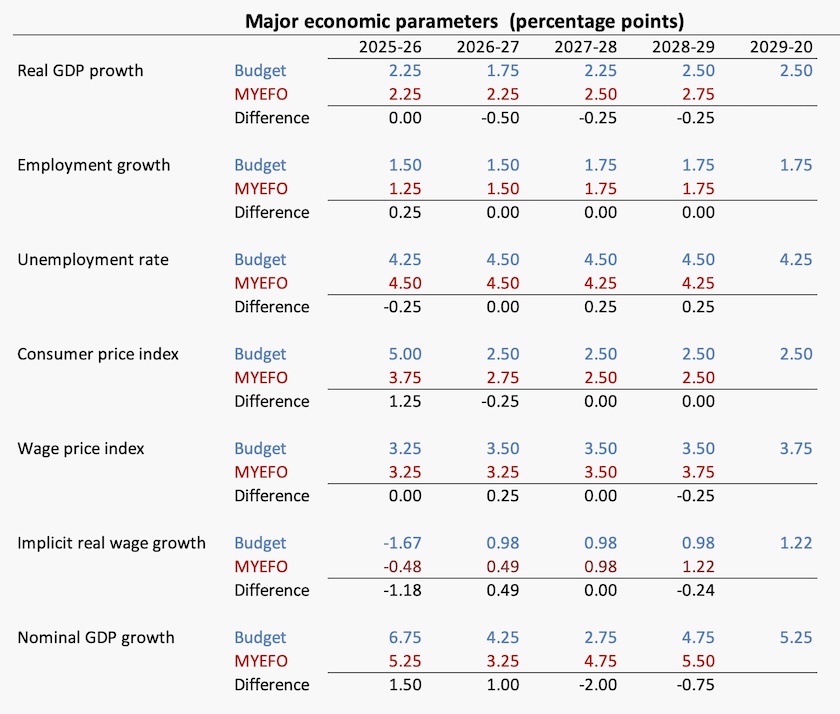
What is striking about those forecasts is how little they have changed since December, even though the world economy has been rocked by the Trump-Netanyahu war against Iran.
Note that from next year real wages are expected to be growing at about one percent a year: presumably that reflects the government’s confidence in its productivity agenda. The only significant variation is in the CPI: it is impossible to ignore the effects of the closure of the Strait of Hormuz.
The subsequent reversion of the CPI to the middle of the 2 to 3 percent comfort range is probably based on the reasonable idea that the oil price rise is temporary and that at some time oil prices will fall, bringing CPI down. (Further on in Budget Paper 1 are some less optimistic scenarios, based on a long-term stalemate in the Gulf.)
This rise in the CPI is manifest in high nominal wage growth. That assumes wages will rise at least in line with inflation, and a little higher if productivity gains are achieved.
Although no government would dare mention it, nominal wage growth is a convenient way to lower the real burden of housing debt. Baby boomers who lived through years of high inflation and rising nominal wages know all about that.
The budget’s fiscal outlook
Fiscally conservative and cautious.
Talk about “irresponsible spending”, “budget repair”, “skyrocketing taxes” have dominated political reporting for years, particularly in right-wing media.
The reality is rather boring. This conservative government is running a small fiscal deficit of around one percent of GDP. You can see that in the graph below, or if you’re unconvinced, you can refer to Table 1.2 in Budget Paper 1; Budget Strategy and Outlook.
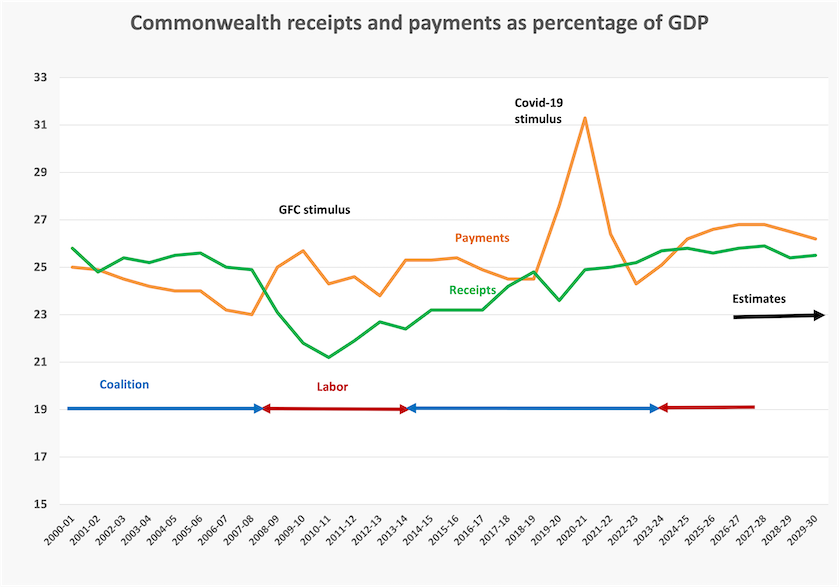
Compare that with fiscal deficits in other “developed” countries – 6.6 percent in the USA, 5.1 percent in Britain, 3.1 percent in the Euro area. Even Germany, once the model of fiscal rectitude, is running a deficit of 3.8 percent of GDP.
As for government debt, alarmists are warning that the budget shows gross debt reaching $1 trillion next year, or around 34 percent of GDP. That’s a scary-looking number, and Taylor couldn’t resist bring it up in hi budget reply speech, but it’s informative to look at the budget’s Debt Statement to see how conservatively the government presents its balance sheet. Net debt, after some conservatively-priced assets are subtracted, is around $0.6 trillion, or 20 percent of GDP. Any established company reporting debt of only 20 percent of turnover would be considered to be undercapitalized. That is, it would be missing out on profitable opportunities for investment. Many comparable countries are carrying much higher levels of government debt: the USA and the UK report gross debt in excess of 100 percent of GDP, and Germany’s gross debt is around 54 percent of GDP.
The reality is that Australia remains a country with low taxes – probably too low. Behind those smooth projections of receipts and payments lie some minor reallocations of taxes, and some more significant reallocations of expenditure, most notably from NDIS to health and aged care.
The budget’s housing measures
No-one is sure of their effects, but the squeals from parts of the property and finance industry confirm that they are in the right direction.
It was silly for Albanese ever to have promised that there would be no change to capital gains tax and negative gearing provisions. But surely the continued inflation in house prices, and the ongoing way “investors” (i.e. speculators) have displaced home buyers, have given the government permission to break that promise. ABS data on lending released just this week confirms that loans to property “investors” continue on a strong upwards trend, while loans to first home buyers remain stuck in a slow lane.
In fact Albanese might even be able to frame his willingness to break a promise as a sign of his responsiveness, as he did with the tax cuts in 2024.
The graph below shows how real house prices have risen more than fourfold since 1970. Note particularly how prices took off on a new trajectory from 1999, which is when the Howard government replaced the inflation-adjusted capital gains tax assessment with the non-indexed 50 percent assessment.
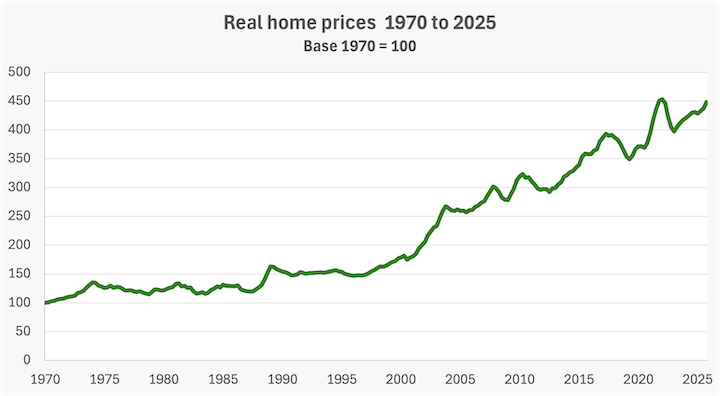
That was bad policy, adopted by an economically naïve government, urged on by a banker who wanted to see more asset turnover.
Those who designed it claimed it carried much the same incentives as the inflation-adjusted method, without its complications, but it came across then, as many still see it today, as a 50 percent cut in the rate of capital gains tax. The absence of inflation-adjustment was hardly mentioned, and naïve investors didn’t understand it. It came in just as real incomes were rising and interest rates were falling. These were just the conditions to set off a speculative boom, and as housing prices did indeed rise, the positive feedback cycle of FOMO gave the housing boom its own energy.
Described above are the financial incentives for a boom. There was also a shift in the way people came to think about housing as a financial instrument rather than a place of shelter and community. Economists noticed what they called the “wealth effect” taking hold: as the market value of people’s houses rose, they felt better off, and became more willing to go out and spend.

A depreciating asset
Of course the “wealth effect” is illusionary because it’s simply a manifestation of inflation in an area not captured by the CPI. Houses are normal depreciating assets, and the phenomenon is better called a “wealth illusion”. But it served its political purpose. Howard claimed that no one ever stopped him in the street to complain about the value of their house going up, and just this week we heard Albanese on the ABC’s 730 program desperately avoiding any suggestion that the government would like to see lower house prices. The closest the government can come to saying that is to rely on Treasury modelling that suggests property price growth will slow by about two percent over three years.
That’s a forecast made by well-educated public servants, who live in a world of ordered rationality. But the world of so-called housing “investors” is different, and it has a wide range of actors – the “mum and dad aspirational investors” through to the vastly over-leveraged 30 year-old about to buy his twentieth investment property. It’s a financial market with many naïve investors, subject to the bias of believing that past appreciation in the price of financial assets is a guide to future price growth.
As we well know, the big scale financial markets move in ways that defy rationality (think of the interaction between Trump’s hollow announcements and share market prices), and they’re driven by people with impressive Harvard and Wharton MBAs. The “investor” housing market is subject to even more irrationality and emotion.
In fact no-one has much idea about where the housing market is going. There is a deafening din of horror stories about these changes, which simply take capital gains taxes back to pre-1999 neutrality, and abolish the perverse incentives of negative gearing applied to personal investments. They will supposedly cause hardship among worthy “aspirational investors”, force rents to skyrocket, and reduce the supply of housing. And horror of horrors, they could see more cool-headed small investors go back to the share market, where they can invest in real wealth, bypassing the property industry.
Even hard-nosed independent economists are taken aback by the shamelessness of investment advisers and partisan journalists when they try to justify what has been a disgraceful exploitation of an unjustified loophole.
The government would be well advised to let that noise pass. Stories about the distress of housing “investors”, and the pain of real-estate agents who find that renters have become buyers, depriving them of commissions, don’t go down well with young first-home buyers. Nor do they go down well with their Gen X parents trying to help their children build up a deposit.
Old Labor hands have always considered that the voices of greed work in the party’s favour. Those strident voices send to the community the message these reforms are a big deal, which is just the political message the government wants to convey, when its reforms are simply a rectification of a distortion in taxation provisions.
There is more reasoned criticism by those who point out that in grandfathering the Howard provisions the government has not addressed a now-established intergenerational inequity. Maybe, but that’s based on the assumption that the Howard changes were unduly generous to those whose investments made capital gains.
In fact the Howard system is generous only when the rate at which the value of an asset increases is greater than the rate of CPI inflation. But in Australia’s most historically overpriced house markets, Sydney and Melbourne, over the last year house prices have not kept up with CPI inflation: they may even been falling a little. Shane Wright and Natassia Chrysanthos writing in the Sydney Morning Herald suggest that spooked investors could see house prices sink.
If expectations of higher interest rates, lender caution, general economic uncertainty, and irrational over-reaction to the government’s changes cause “investors” to offload their properties and suppress prices, the Howard changes may come back to bite them. As for negative gearing, it is not an indefinite benefit: as loans are paid off, and as rents rise with inflation, negative gearing becomes positive gearing. It is possible that the government, rather than stirring up established “investors”, is letting time, and possibly falling real house prices, work their way through.
Perhaps the ideal outcome for government would be a controlled real fall in house prices. That would take the form of an ongoing rise in nominal house prices (reducing the real burden of mortgages) that is less than the rate of inflation. Even better would be a change in thinking so that housing is no longer seen as some financial asset.
For a discussion covering the budget’s influence on housing, you can listen to a 33-minute podcast by two ABC journalists, Pater Martin and Anthony Burke: The budget and housing – a fix. They have their views – they’re both well informed – but the discussion is entirely non-partisan and independent.
Taylor’s budget reply
Pathetic and predictable
Angus Taylor based his budget reply speech on two impressions he is trying to convey to voters. One is that taxation is theft. Taxation is something the government “takes” from you, rather than payment for public goods and transfers. The other is about immigrants. Immigrants are parasites drawing on welfare programs, worsening the scarcity of housing, and those from certain countries (unnamed but we are all supposed to know what they are) are hostile to Australian values and present a terrorist threat to our country.
All three portrayals of immigrants, taken from the propaganda of international extreme-right movements intent on undermining democracy and endorsed by One Nation in Australia, are wrong.
His speech is essentially a promise to roll back everything the government – “this bad government” has achieved. A liberal government would restore the Howard tax distortions, bring an end to renewable energy programs, and somehow magically cut tax and spending without reducing the scope or quality of government services.
His speech is a torrent of sophistry, misinformation, misrepresentations of government policies, numbers quoted out of context and some straight-out deceitful statements on renewable energy. No, Angus, wholesale electricity prices are actually falling and they would be falling faster if previous Coalition governments had not been so dismissive of renew renewable energy. How can he justify a policy that deliberately keeps high cost coal in electricity supply chain?
When it comes to specifics, Taylor’s muddled ideas on immigration are all over the place. Pauline Hanson and Barnaby Joyce say it all when they accuse him of stealing their policies. But Taylor might be right when he talks about reducing the number of immigrants, because if this mob ever get into office who on earth would want to come to such a badly governed country?
On indexing income-tax brackets to the CPI, he fails to recognize that fixed brackets act as a fiscal stabiliser in times of inflation. Economists acknowledge that bracket creep has been a way of raising taxes incrementally, and that makes sense in a country that’s facing demands for higher defence expenditure, that needs to restore public sector capability, and that is committed to providing services to an ageing population – a population that would age much faster under the Coalition’s immigration policies. But where is the tax he would apply to replace bracket creep? All he is proposing is to restore the rorts that have enriched idle investors, which means that he is proposing savage cuts to government services.
Maybe I’m politically naive, but I don’t understand why a politician from a movement on the ideological fringe should be given the opportunity to address Parliament for half an hour, broadcast to the nation.
Among non-government parliamentarians with comments on the budget is David Pocock who has a detailed description of budget measures and a press release drawing attention to areas where the budget missed opportunities to address economic inequities. Allegra Spender, a strong advocate of tax reform, has some positive comments and some criticisms: she is disappointed that there has been no move to tax gas exports, for example.