Public ideas
How safe is Australian democracy?
Reasonably safe – for now.
When the country was hit with a pandemic in 2020 many Australians were surprised by the way governments could move so quickly to restrict people’s physical liberty.
Since then we have observed the behaviour of the Trump administration with some apprehension. The USA has an apparently strong constitution guaranteeing the separation of executive, parliamentary and legal powers, and strong protection of civil rights, but these protections have not been able to halt the administration’s move to executive authoritarianism.
More generally there has been a resurgence of the populist far right in European countries and a global democratic backsliding, revealed in surveys such as the EIU Democracy Index.
The more subtle threat to democracy is the demonstration effect of authoritarian governments in countries such as China and Vietnam, who have made tremendous and commendable strides in lifting their people out of poverty, while democracies are bogged down by interest groups who use the institutions of democracy to protect their privilege and to thwart economic progress.
At home we have witnessed a slow purge of centrists from the Liberal Party and more recently the political resurrection of One Nation. A referendum was defeated not on its merits or otherwise, but on the ability of opportunistic politicians to exploit people’s ignorance of their own constitution. Our Labor government has proven itself no less ruthless than its right-wing predecessors in its tendency to shroud its decisions in secrecy.
It is not surprising therefore that many are wondering about the safety of Australian democracy.
Gabrielle Appelby in a Conversation post asks Is Australian democracy eroding? She is particularly concerned by the way executive government uses whatever means it can to limit the power and authority of Parliament. She mentions stratagems used to bypass parliamentary scrutiny, and makes passing reference to so-called “bipartisan” deals designed to exclude small parties and independents from involvement in lawmaking. In fact she could have gone further, drawing attention to the way public servants are beholden to executive government, even though their pay is appropriated by Parliament. Robodebt provides a clear example of that perverted loyalty.
From a different angle constitutional expert Anne Twomey has a 10-minute YouTube clip What would it take for Australian democracy to collapse? She explains the difference between our democratic safeguards, which rely heavily on legislation, convention and the High Court, and those in the US, which rely more on their written constitution. Both can serve their purpose, she argues, and she suggests that long-standing established practices, such as compulsory voting, even though they are based on legislation, carry high authority approaching that bestowed by provisions in a written constitution.
On despots and despotism
Democracies slide into despotisms, without many people noticing the transition.
We have many words for political systems that don’t match our ideals, and often use them with little regard for their specific meanings.
John Keane of the University of Sydney, in his Conversation Friday essay Demagogues, despots and the rise of “phantom democracies” takes us through these different meanings, with examples, in an edited extract from his book: Demagogues and despots: democracies on the brink.
His emphasis is on despotism, based on his observation that democracies seem to be heading towards despotism in a process that’s meeting with very little resistance.
He assumes that we know the word’s precise meaning. As a reminder, the Webster Dictionary’s pithy definition is “a system of government in which the ruler has unlimited power”. Macquarie is even more pithy, defining a despot as an absolute ruler, and therefore a despotism is a system ruled by a despot.
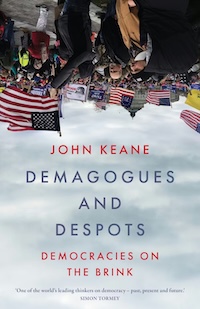
Keane’s essay is more than an exercise in semantics. He is pushing us to think beyond the idea that the despot is necessarily a tyrant as portrayed in mythology and in children’s stories. He dispels that image:
Despotism feeds upon the voluntary servitude of its subjects. Those who think despotism is a synonym for repression, fear and raw force are profoundly mistaken.
In words that surely resonate with what we hear from far-right populists, without naming names, he writes:
In practice, despots are masters of seduction, deception and control. They calibrate their use of violence and manage, using a combination of slick means, including rigged election victories, to win the submission and loyalty of the ruled. Oiled by government largesse, rampant patronage, bags of money, job creation programs, legal trickery and endless talk of defending “the people” against its foes, despotism nurtures the docile subservience of its subjects, including important sections of the middle classes, skilled and unskilled workers, and the poor.
Despots are skilled in the art of fostering political loyalty:
In this sense, the despotisms of our age are state-of-the-art forms of tutelary power, a type of media-saturated political rule that achieves something many previous observers thought impossible: they dominate their subjects by winning their calculated support and affection by means of top-down, people-friendly techniques of government, elections, happiness forums, online Q&A portals, public opinion sampling and anti-corruption agencies.
Drawing on the work of political philosophers – Laureano Vallenilla Lanz and the better-known Max Weber – Keane describes two possible ways democracies develop into despotisms – one benign, one brutal.