How we live together
How migration has shaped Australia
Australia’s native-immigrant population mix is reverting to its pattern in the energetic pre-federation period. That’s not how the right portrays it.
A routine ABS publication – Australia’s population by country of birth – became newsworthy last week. Maybe that’s because journalists could cut and paste the ABS’s summary: 8 things of interest about Australia’s overseas born population.
It’s all in the bland style of official statisticians. But there is enough data in these statistics to provide tropes for explicit racists and their dog-whistling supporters in the Coalition, particularly related to the ethnic mix of 7 million Australians.
One significant revelation not listed in those 8 points is the sex ratio of our migrant population. The sex ratio of our overseas-born population – the number of males per 100 females, is 96. That’s lower than the balanced 100 sex ratio for the native-born population. The sex ratio is particularly low among migrants from China, the Philippines and Vietnam, while it’s comparatively high (115 but falling) among migrants from India. It’s an important indicator, because in some countries the migrant population tends to be disproportionately male, which means that migration becomes politically associated with the problems that arise when there are concentrations of unattached young men. That may be a problem in some countries, but the numbers suggest it is not a pressing problem here.
The ABS presents a table comparing the percentage of our population born overseas with the percentages in other countries. At 32 percent our proportion is high, but it is much higher in many other countries, including some Middle East countries. But the countries with very high overseas-born populations are those with refugee populations (such as Jordan), and large expatriate populations (such as the United Arab Emirates).
In the USA, Germany and the UK, where right-wing extremists have made migration a strong issue, the percentages of overseas-born are 15 percent, 17 percent and 20 percent respectively. (In separate research I found that the Vatican stood out at 100 percent non-native population: the figures relate to births, not conceptions.)
The ABS’s most revealing data is a chart of the number and proportion of Australians born overseas, going back to the late nineteenth century. This is shown below in a graph compiled from the ABS data.
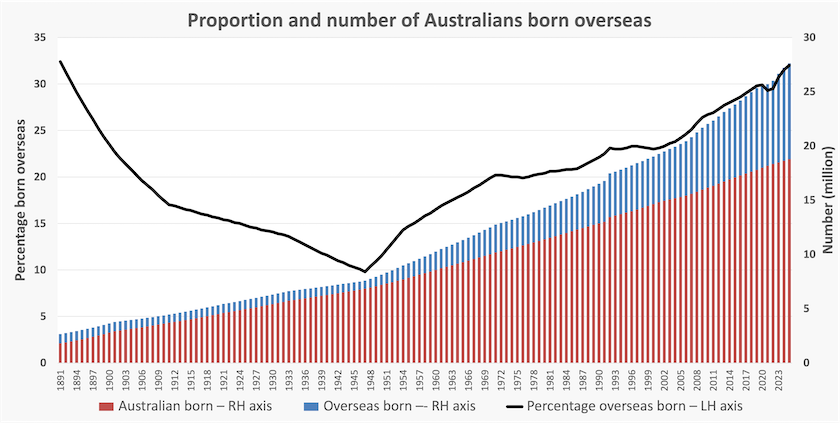
It is understandable that baby-boomers, born into a country where 90 percent were native- born, might find Australia of 2026 to be a different place, but someone of Henry Lawson’s generation (born in 1867) would be quite at home.
Cities as dangerous hothouses
Cities are hot and are getting hotter. This is a health hazard.
Hothouse
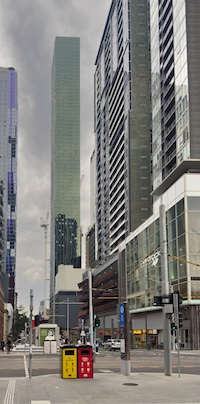
Cities are hot. The energy that comes into cities through power lines, gas pipes, and vehicles burning gasoline and diesel has to go into heat. That’s the main reason why cities are hotter than the surrounding countryside. And it’s why, as the planet heats up, the temperature of cities is rising from an already high base.
Writing in The Conversation – Cities are getting hotter – and bigger – Hamish Lewis and Luke Harrington of the University of Waikato remind us that high temperatures are killers, but unlike deaths resulting from other climate change events, such as floods, they do not show up so dramatically. “What we don’t see is the human cost that is often only counted long after the event is over”.
But we know those deaths are happening: Europe’s heatwave in 2022, for example, was responsible for more than 60 000 excess deaths.
That’s a worldwide analysis. Closer to home the New South Wales Net Zero Commission has published its Heat Stress Spotlight Report, which points out that “Extreme heat has killed more Australians than all other natural disasters combined”.
They explain how extreme heat kills, and therefore the reason it commands too little policy attention:
Deaths are typically recorded as cardiac, renal or respiratory events rather than heat-related causes. Increasing humidity amplifies the impact of extreme heat. Overall the true health burden of heat stress is significantly underestimated, limiting the policy attention and resourcing directed toward preventing it.
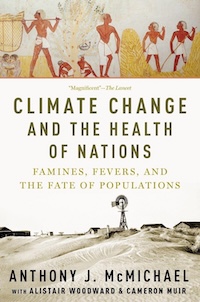
Tracing the health-related effects of climate change, and bringing them to public attention, has always been a difficult task. The person who brought it most strongly to our attention was Tony McMichael in his 2019 work Climate Change and the health of nations: famines, fevers and the fate of populations.
The Net Zero Commission’s data-rich report covers only New South Wales, but its analysis of the increasing frequency of heatwaves, for example, would surely be applicable to all of Australia – New South Wales is a big state with many representative rural and urban climate zones.
Declan Bowring of ABC Sydney summarises its findings: Extreme heat the most deadly yet preventable natural disaster. While some people can literally insulate themselves from the hazard of excess heat, others are more vulnerable, including the old, the very young, outdoor workers, those who live in poor quality housing, and people living in the hotter regions of our cities – the western plains of Sydney, the northern expanses of Adelaide and Melbourne, distant from the coast and concentrated enough to generate their own high temperatures.
The Net Zero Commission report recommends more rigorous building standards. Bringing these perspectives together, we should be aware that there is pressure to weaken building standards in order to make housing more affordable. Such a trade-off would put a very low figure on the value of a life saved, and would be a lousy deal for home buyers, who, for the sake of a few thousand dollars in the purchase price of a house, would have the ongoing cost of heat stress.
An early assessment of our social media ban
In ignoring social media bans, kids are behaving like sensible grown-ups.
Australia was the first cab off the rank with social media restrictions for children, that came into effect last December.
Tony Ward has drawn to our attention what may be the first independent analysis of that ban, a National Bureau of Economic Research paper Why Bans Fail: Tipping Points and Australia's Social Media Ban, reporting on research by prominent behavioural economists.
The researchers found that only about one in four 14-15 year-olds were complying with the ban. That seems to be consistent with theories of networks. Just as we feel pressured to join a network when people with whom we associate are in a network, we don’t abandon a network when we believe our peers are still using it.
Think of our use of fixed-line phones – once most people had one they became a “must have”. We confidently abandoned them when we found others were abandoning them, but importantly, that was when we had a reliable alternative.
Based on network theory, and on Thomas Schelling’s “tipping” model, the researchers believe that compliance is more likely to diminish rather than to rise.
The politics of sex and reproduction
Debates on contraception and abortion now have an immigration dimension.
A reader has brought to our attention a new round in the politics of contraception and abortion, so far confined to the United States.
Mary Ziegler’s article in Politico – Trump is going after birth control. Here’s why – describes how under direction from the Trump administration the Department of Health and Human Services is now discouraging Americans from practisng birth control.
She takes readers through the political history of US laws on abortion and contraception, which have involved major struggles between liberals and political conservatives, particularly conservatives associated with Catholic and other faiths with strong dogmas on sexual behaviour.
Although the US stands out for the strength of organized Christian religions, the religious lobbies haven’t had much success in convincing their followers about the evils of contraception: only 8 percent of Americans say that using contraception is morally wrong.
This latest move, however, while it has the support from religious movements, is attributable mainly to the anti-immigration movement.
Are we likely to see a similar push in Australia? Our religious lobbies have a weaker voice than their American counterparts, and we have witnessed the failure of Peter Costello’s “have one for mum, one for dad, and one for the country”. Also any successful push to see Australians have more babies would see a replication of our already established ethnic mix. Those who want to re-establish “white Australia” are much more likely to direct their attention to migration, as we are already witnessing among the extreme right.