Economics
The budget – tune in if you like comic opera
On Tuesday night enjoy a recording of Die Fledermaus or Die Zauberflöte because it will make more sense than the budget speech.
From next Tuesday we will be treated to a week of publicly-financed opera, mostly carefully scripted, with only a little space for improvisation.
We have been treated to rehearsals, particularly about taxation changes. Technically the budget is concerned only with expenditure, but in practice spending and taxation have to be considered together.
The highlight solo parts will be the Treasurer’s speech, and the opposition’s reply. The other parts are played by a largely anonymous chorus of Treasury officials. Their scores are in hundreds of pages of budget documentation, released at the same time as the Treasurer’s speech.
Minor roles are played by journalists and spokespeople for selected lobbies, who are treated to budget lockups giving the invited a headstart to prepare their parts – usually around 6 hours.
These lockups are carefully managed propaganda sessions: outside communications are blocked, but the selected guests have all the budget papers, in hard copy, a USB or a limited intranet. They also have access to helpful officials who have been responsible for parts of the budget, and may be treated to an explanatory session with a minister or even the treasurer. Otherwise they have to rely on what they have brought with them. They may have preloaded their laptops with certain ABS or IMF data to allow comparison of the government’s data with data from a wider context, but that requires guesswork. There’s no looking up abs.gov.au, last year’s budget, or googling to find other countries’ data. You have to make your story out of what the government has given you.
The atmosphere is that of an overactive, adrenaline-loaded newsroom. Within nanoseconds of the embargo being lifted newspaper articles and press releases are on their way, with pretty-well predictable content. Generally it’s just the message the government is after: the Kremlin could not do it better. There will be some dissent: look for the usual Murdoch headline about the worst government since 1788. But considered critical analysis will be missing: policy analysis takes more than six hours.
Immediate reactions
Based on the rumours we have heard about taxes, we can expect to hear howls of protest from so-called property “investors” (speculators taking advantage of unjustified tax breaks), and from those who believe that an Australian Business Number is an entitlement to avoid tax by using a family trust. As a preview one of Australia’s richest men, Geoff Wilson, is already making hysterical claims about how changes in capital gains taxation will impoverish Australians. (If, as is likely, they succeed in redirecting investment from short-term speculation into long-term investment, the only people likely to be hurt are so-called “asset” managers.)
Budget Paper I – usually titled Budget Strategy and Outlook – is the most authoritative budget document. It will not be free of political spin, but it will present basic macroeconomic data.
Beware of misunderstandings that lead many to rush to judgement about debt and deficits – the idea that debt is bad, and a budget surplus is good. There is nothing intrinsically good or bad about debt. Our primary assessment of government debt should be about its purpose. Is that debt funding useful infrastructure, investment in human capital, repossession of unwisely privatized entities? Or has it accumulated because transfer payments have been underfunded? That’s the basic distinction between “good debt” and “bad debt”.
Take the same approach as you would to a corporation’s financial statements: that is, look at both sides of the balance sheet – assets and liabilities, not just the liabilities.
Similarly there is nothing virtuous about a budget surplus. A fiscal surplus simply means that the government is collecting more money than it is spending to provide services. If supermarkets or gas companies do that we call it profiteering or price gouging. Governments have a few more responsibilities than businesses, which is why there are times when governments should run a surplus or deficit, but ignore the “surplus good, deficit bad” assumption, and realize that Australian governments stand out for running very tight fiscal policy.
It will be a week or two before the more serious analysts – experienced journalists, research staff in organizations such as ACOSS, academics and others – have been able to do some careful analysis. The government will hope that by then something else will be dominating the news – Trump’s invasion of the Falklands, Pauline Hanson’s plan to deport foreign-born health workers.
The Reserve Bank’s rather silly decision
In chasing the CPI, the Reserve Bank fails to distinguish the difference between self-reinforcing inflation and necessary structural change, revealing the destructive dysfunction of monetary policy.
To quote from the Reserve Bank’s press release accompanying its decision to lift the cash rate last Tuesday:
We acknowledge that the Australian economy is being battered by America’s erratic administration. Our concern however is not with the health of the economy but with the reading of an indicator we don’t really understand. If that indicator cannot be brought within a small green band, something horrible will happen to the economy, but please don’t ask us to explain why a high reading is so bad because we don’t know ourselves.
We are told that because demand is running ahead of the economy’s productive capacity we have to raise interest rates, which will make it more difficult for firms or government to invest to expand our productive capacity. We know that’s stupid, but to admit as much would be economic heresy.
Just kidding. That’s the statement the Reserve Bank should have made to accompany its decision to raise the cash rate to 4.35 percent.
Its actual statement asserts that inflation as indicated by the CPI (which is only a distant relative of inflation) was rising beyond the 3.0 percent cap, even before Trump and Netanyahu decided to start a war. That’s doubtful: there were strong signs that by March the CPI had stopped rising, but the RBA places more reliance on data that’s 14 months old than it does on current data.
The RBA’s full statement of monetary policy is even more confusing. It starts with the statement that “spending by Australian households and businesses has shown some signs of slowing this year”, and acknowledges that higher fuel prices are likely to dampen household and business spending further, and to weigh on output growth. As shown in the chart below, it significantly downgrades expectations of economic growth.
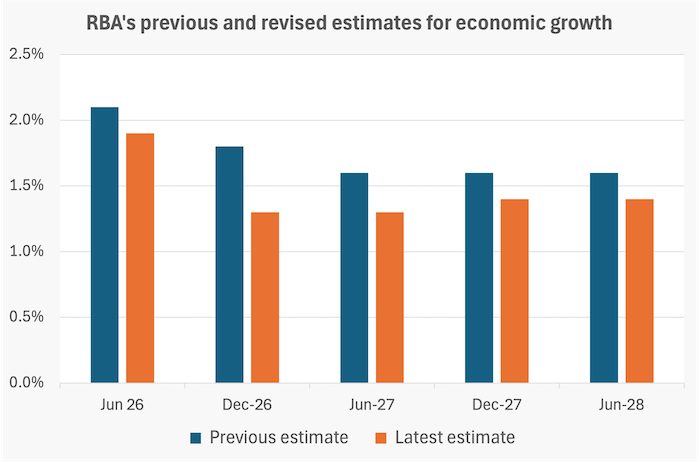
Absurd. We know economic growth will slow, therefore slow it further by raising interest rates. Go figure.
This forecast doesn’t deflect the bank from its obsession with CPI inflation, which it sees as staying above 4 percent for the rest of the year: this is the menace that must be addressed with higher interest rates. Not that it ever states why moderate inflation is bad.
The chart below has every sign that the RBA has been over-reactive in its monetary policy decisions, probably too obsessed with the CPI which, because of the way it is constructed, the paucity of seasonal adjustment series, its dependence on policy decisions, normal sampling error, and the weird way the RBA interprets it, is a fairly bumpy series.
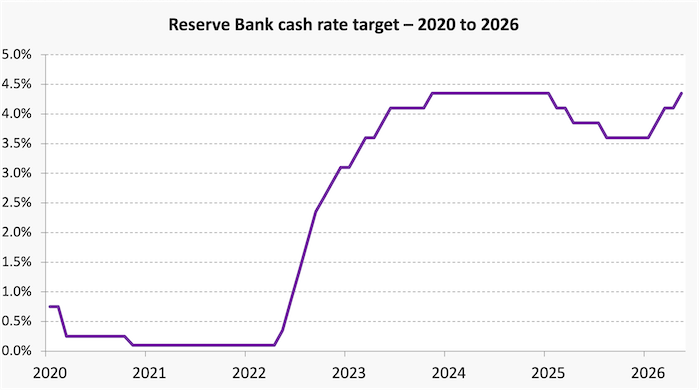
That over-reactiveness is serious, because businesses and consumers alike seek some assurance of stability before they buy a house or invest in a business. They may accept that nominal interest rates will move in some relation to the business cycle, but they don’t like the shocks of sudden reversals.
Besides CPI inflation, the RBA is also concerned by indicators of what it calls “labour market tightness”. In other words the unemployment rate is still lower than the RBA would like it to be. The RBA won’t be happy until workers knuckle down and accept whatever pay their worthy masters offer them. A confident, mobile workforce ready to change jobs may be important for resource reallocation, but it plays hell with that sacred number, the CPI.
These forecasts about the CPI and unemployment are in what it calls its “baseline” assumption about world conditions. That is based on no further damage being inflicted on energy infrastructure in the middle east, and a return to pre-conflict oil flows by the end of the year. In its outlook it has two more-pessimistic scenarios which would result in higher and more enduring CPI inflation, which would presumably result in the need for even more restrictive monetary policy. Shane Wright, writing in the Sydney Morning Herald, presents them in clearer language than you will find them in the RBA statement, with the heading: Grim, worse and dire: the three ways Donald Trump is playing havoc with Reserve Bank forecasts.
As the textbooks say, and as Governor Bullock often reminds us, monetary policy is a “blunt instrument”. In treating “the economy” as one single entity, monetary policy cannot deal with complex problems that call for the reallocation of resources between sectors. Just this week Bronwyn Kelly on her Substack added to writings on that subject in her article the failure of Reserve Bank independence – how it happens, how it hurts, and how to fix it. She doesn’t call for a return to the bad old days of politicization of monetary policy, but she does call for policies that respond to capacity shortfalls that stimulate rather than impede investment.
One of the shortcomings of monetary policy, evident in our Reserve Bank’s decision relating to the disruption to energy markets, is that it relies on one idea and one indicator of “inflation” – the CPI in this case. Any price rise, whatever its origin, shows up in the CPI – which in itself is simply an indicator of the movements in the cost of selected consumer items. Economists have a genuine concern with positive feedback cycles of price rises that reinforce one another through commodity and labour markets. That’s why they are concerned with “the non-accelerating inflation rate of unemployment, as well as inflation indicators.
But in a dynamic economy some the prices of some products rise relative to one another. We don’t worry when productivity improvements, such as we have seen in information and communication technologies, result in real price falls. Fossil fuel, however, is a commodity that has been underpriced for more than a century, because its contribution to greenhouse gases has not been included in its price. In a perverse way, war has done what flawed markets have failed to do, and has raised the price of fossil fuels closer to their true economic cost. We don’t know if this is adequate to cope with the environmental externalities of fossil fuels, but it is certainly giving a strong nudge to renewable technologies.
Most economists would argue that it has been a mistake by governments, including our own, to compensate for higher fossil fuel prices with measures such as a cut in excise. Rises in the price of fossil fuel, and in items with a high transport cost component, should be allowed to flow through the economy, resulting in a more efficient allocation of resources. That will certainly show up in “inflation” indicators, but it should not evoke the same policy response as inflation that arises from imbalances between supply and demand.
Such resource reallocation certainly involves hardship for those in industries dependent on fossil fuels. Truckers and farmers are most strongly affected in the first instance. But if the government has a role, it should be in helping stakeholders adjust to changed conditions rather than using handouts that convey the impression that the disruption is temporary and that there will be no structural change. That’s a path to economic stagnation.
Some time in the future, if universities still have schools of economics, the recent decisions of our Reserve Bank will serve as case studies in the failure of the short-lived fashion of monetary policy.