Public ideas
Anzac Day
Anzac Day has been changing for 110 years.
On Late Night Live David Marr talks with military historian Peter Stanley, discussing whether Australia’s culture of remembrance needs updating. They discuss many aspects of the way the meaning of Anzac Day has been changing: the Australia of 2026 is very different from Australia of 2016, when the day was officially proclaimed on the first anniversary of the Gallipoli landings. (By 1927 April 25 was proclaimed as a public holiday.)
Also, and perhaps less obviously, they point out that the nature of our military engagements has changed.
Because radio isn’t the best medium for numerical data, I decided to present some numbers on our participation in major military conflicts, and on our casualties in these wars. These numbers, converted to rates per million population, are shown in the table below.
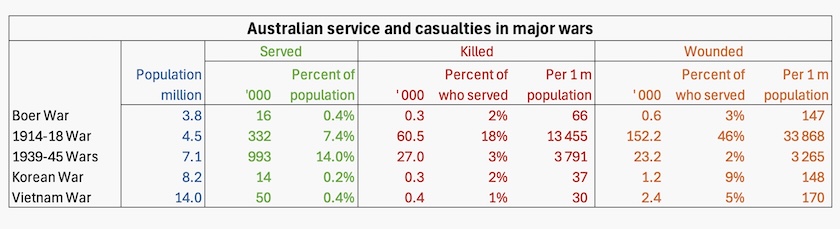
What stands out immediately is the huge number of killed and wounded in the 1914-18 War. Just on two thirds of those who served were killed or wounded, and those figures on the wounded are understated because at the time psychological scarring was not well recorded.
The number of killed and wounded as a proportion of the population is also high. It’s a fair bet that everyone would have lost friends, and would have known grieving widows and lovers. Because almost all the casualties were men, those 213 000 killed or wounded would have accounted for almost 10 percent of our male population, or probably about 20 percent of our productive young and middle-aged population.
If these numbers are too hard to envisage, you can scale them up five times to bring them in line with our existing population: imagine a war in which we lose 300 000 dead, and 750 000 wounded. It would present a body blow to our nation, as it did 110 years ago. The 1914-18 war left the young nation shattered. It emerged from the war as something quite different from the Australia that had come through Federation with energy, optimism and confidence.
Stanley’s main point is that Anzac Day in the first half of the twentieth century was a sombre occasion – a day about honouring sacrifice, and remembering the dead.
The ranks of those who had been through the horrors of trench warfare thinned out only slowly in the subsequent years. (Claude Choules, the last veteran of the 1914-18 War, died in 2011.)
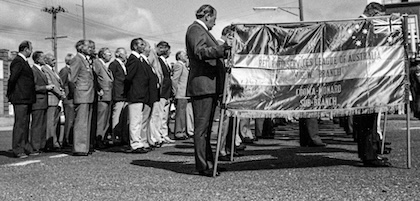
Anzac Day Cooma 1970s
The ranks of veteran marchers were replenished after our participation in the European war of 1939-45 and the Pacific war of 1941-45. Many more Australians served in these wars, but casualties were lighter. Anzac Day was becoming more about returned soldiers and comparatively less about grieving for the dead. For the population at large it was mainly about commemorating and honouring national service.
Over the following years the ranks of those who served in the 1939-45 wars have become vanishingly thin: the youngest survivors would now be 98 years old.
Almost all of the fighting in the wars listed in the table above has been in foreign lands, but Stanley reminds us of the frontier wars between settlers and the land’s original owners. He also reminds us that when we opened up our country to immigrants after 1945 we brought in hundreds of thousands of former soldiers and civilians who had experienced the horrors of war in other countries. To many such immigrants there wasn’t much distinction between the war experience of civilians and service people.
Stanley has gentle hints about the politicization of Anzac Day and the function of the War Memorial. It has obviously been a struggle to get floorspace for the frontier wars, but that quest has succeeded to some extent. There has been an artful use of Christian imagery and commemorative texts which has worked in our multicultural and secular society.
He doesn’t mention the wider partisan conflicts about commemoration of war service. For a long time conservative Australians, loyal to Britain and its monarch, sought to emphasize service in the 1914-18 War in defence of the British Empire. By contrast those with a realistic appreciation of our history and geography, have sought to emphasize our service in the Pacific War. Prime Minister Keating made a strong point of that history when he visited Ela Beach at the southern end of the Kokoda Track on Anzac Day 1992.
We now witness the same partisan politicization of military service in relation to the trial of Ben Roberts-Smith, as if those who believe in the spirit of Gallipoli have a duty to line up in his defence, disregarding the processes of the law. This is the subject of a Saturday Paper editorial The alleged crimes of Ben Roberts-Smith.
The Pope and the President
Trump’s attacks on Pope Leo reveal worrying things about his moral and political judgement.
Pope Leo is probably as politically perceptive as the world’s most able politicians and diplomats, but he is not a politician. That’s why Trump’s attacks on Pope Leo are like missiles fired into a remote sea. Contrary to some media misinterpretations, they did not evoke a response from Pope Leo to President Trump.
Antonio Spadaro SJ, undersecretary of the Dicastery for Culture and Education of the Holy See, clarifies the Pope’s and the President’s statements in an article published in Pearls and Irritations: Trump has turned the Pope into an adversary – and exposed himself.
Adversaries are rivals, competing for the same territory. But the Pope, as a spiritual leader, is not in the same territory as Trump. To quote Spadaro:
Leo is not aiming at a person but at a structure – the mental, spiritual and political machinery that makes war thinkable, acceptable and, in the end, inevitable. Trump activates that machinery with particular intensity; he does not own it.
What we are witnessing, then, is not a clash of personalities but the friction between two operating systems. On one side, a grammar of force: deterrence, national exceptionalism, the “providential” use of power, a re-theologisation of politics in which God is enlisted to bless the strong.
On the other hand, a grammar of the Gospel: dialogue, moral limits, international law, the inviolable dignity of the innocent, the refusal to drag the name of God into the language of death.
Drawing on the Catholic Church’s moral teaching on war – always tricky territory for theologians – on the ABC’s Religion and Ethics Report Darius von Guttner of Australian Catholic University describes the difference between a “just war” and a “holy war”, a discussion prompted by the suggestion from Vice President Vance that America is pursuing a “just war” in the Middle East. In the Church’s moral teaching a just war is one aimed at containing and suppressing violence, while a holy war is one in which one of the combatants claims to have God on their side, to use Bob Dylan’s terms to describe Vance’s interpretation of moral theology.
This idea is also the subject of a 14-minute discussion on The Atlantic’s “Washington Week”: How will Trump get out of his fight with Pope Leo? The headline misinterprets the situation, but the discussion is on cue, and quotes from Pope Leo:
The things that I say are certainly not meant as attacks on anyone, and the message of the Gospel is very clear: “Blessed are the peacemakers.”
Some Americans have jokingly suggested that the statements by Pope Leo and Trump are about a conflict between two strongmen – Pope Joe from Chicago versus President Donald from New York. It’s a clever analogy, but it implicitly conflates the bases of the two men’s authority, and overlooks the fact that Pope Leo has never personally attacked Trump or responded to his personal attacks.
But the analogy has some relevance, because as Spadaro explains Trump seems to be particularly upset that an Americanpope has come out with statements about the morality of war:
He [Pope Leo] embodies an America already inhabited by the world, not an America walled against it. His pontificate is becoming, almost against its will, a counter-narrative about what the United States could be: a country of genuine religious freedom, of the rule of law, of generosity toward refugees, of leadership grounded in legitimacy rather than coercion. …
The attack on the pope has the shape of an outburst, not of a considered gesture: the outburst of an executive that cannot dominate a moral voice.
Spadaro has no doubt that Trump’s ill-considered attack on the Pope, and the Pope’s statements on armed conflict, are going to force American Catholics to turn their minds to the moral behaviour of the Trump administration and their own political orientations. This is covered in detail in an ABC Saturday Extra segment, in which Nick Bryant discusses with author and journalist Katherine Stewart the domestic political consequences of Trump’s aggression towards the Pope, and his gauche presentation of himself in an AI-generated image as Jesus Christ: As Trump spars with the Pope is MAGA fraying?
It’s partly a discussion about Trump’s and Hegseth’s weird moral frameworks. Trump hurls at Pope Leo what may be the MAGA movement’s strongest curse, accusing him of being a “liberal”. Hegseth recites a prayer of vengeance that he implies is attributed to scripture. In fact it seems to have been a film-maker’s lines.
It’s also a discussion of the moral challenge for those American Catholics who have tended to align with the Republican Party, because of self-identification as “conservatives”, and the elevation of abortion as a defining issue. Trump’s behaviour is surely going to force them to reconsider their political loyalties.
In fact, it’s not only Catholics who are reacting to Trump’s behaviour. On most moral issues, particularly issues of social morality, Christians of all mainstream denominations – Anglicans and most Protestants – tend to respect the Pope’s moral standing, as do Jews, Muslims and people of other faiths and of no religious faith.
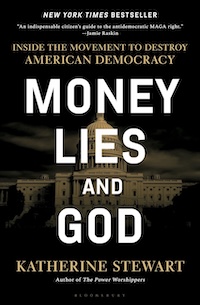
Katherine Stewart is author of Money, Lies and God: Inside the movement to destroy American democracy.