Social surveys
How Australia is travelling
A survey of Australians’ attitudes about the country’s direction of travel reveals many negative attitudes, but young people and migrants from our diverse sources are more positive than older people and native Australians.
“Almost three-in-five Australians (59.1 per cent) believe life has worsened over the last 50 years, while only 15.3 per cent believe it has improved”.
That’s a quote from Holding together, just: wellbeing, economic strain, and democratic resilience in Australia, March 2026. It’s a report on a survey conducted by Nicholas Biddle and Professor Matthew Gray of ANU. The survey period was March 11 to 26, when US operations and Iranian retaliations were already underway and crude oil prices had just risen.
When one considers what life was like in 1976 the perception comes as a surprise. Fifty years ago crime rates were much higher, life expectancies were significantly shorter, motor vehicles were much more deadly, clothes, appliances and cars were much more expensive (these were the days of tariff protection), foreign travel was too expensive for most Australians to contemplate, and real (inflation-adjusted) incomes were at about half their present level. Life was much tougher if you were female, aboriginal, homosexual, or one of the pioneer immigrants from Asia (the Whitlam and Fraser governments had just demolished the White Australia policy).
Perhaps our view of the past is constrained by sentimental blinkers. Or perhaps we place high value on the few things that were indeed better by most people’s standards. We were still served by competent and capable government enterprises providing banking, airlines, water, electricity, and employment services: the economic orgy of privatization was still ahead of us. Whether to rent or buy, housing was more affordable. And while there were disparities in wealth and income, they were much more contained than they are today.
As with most attitudinal surveys, we should be cautious in interpreting people’s reported feelings, and only 17 percent of those surveyed would have been adults in 1976. The survey is really about changes in people’s feelings about their personal situations and the direction of the country over the last few years, and whether they expect conditions to improve.
The most striking finding is that people’s “life satisfaction” is at a low ebb. That’s hardly surprising in the current circumstances.
But this is not just about the current oil supply problems. It is notable that the survey’s life satisfaction score has been on a downward trend since the series started in 2019. Similarly there has been a steady deterioration in people’s satisfaction with “the direction of the country”. (Those who survey public opinion are very good at picking up dissatisfaction with the country’s direction of travel, but they never ask respondents what direction they think the country should be travelling.)
Just over a third of respondents find it hard to cope on their current income, and there is heightened anxiety about job security, particularly related to advances in automation. Indicators of financial stress, however, show some improvement in the last two years, as shown in the graph below, drawn from the survey’s data.
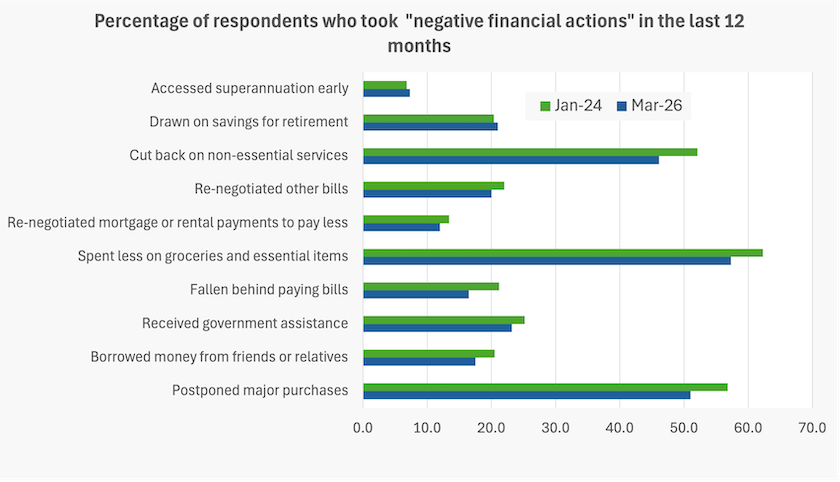
I don’t know what these absolute percentages mean – for example I have been postponing purchase of a Ferrari since I got my driver’s licence – but the direction of easing financial stress is clear. This does not align with the narrative that ever since we unwisely voted against the Coalition in 2022 we have been experiencing an ever-worsening “cost of living crisis”. Some people, including many older Australians, seem to be spending quite freely. If we have a “crisis” it’s a crisis in the distribution of income, wealth and opportunity.
Another general finding from the survey is that the old are more likely to be gripped by pessimism and nostalgia than the young:
Contrary to widely-held narratives, the results do not support the view that younger Australians are disengaged from democracy, intolerant of opposing views, or more anti-feminist than their elders. Those aged 18 to 24 are among the most satisfied with democracy, and are more likely than older Australians to support the right of those with extreme views to speak in public.
Unsurprisingly the survey reveals that education is the “most consistent predictor of positive outcomes”. The researchers suggest that “education appears to function not only as a source of economic security but as a buffer against the civic disengagement that often accompanies sustained economic strain”.
Their most striking findings are on immigration. Australians born in non-English speaking countries report a substantially more positive orientation to Australia and more faith in our institutions than migrants from other countries. On most indicators their attitude to Australia is similar to that of native Australians, while on their sense of the country’s direction of travel, they are significantly more positive than native Australians. Their most significant finding relates to negative attitudes among migrants from English-speaking countries.
Notably, those born in English-speaking countries overseas report lower levels of closeness to Australia than either of these groups [native Australians and immigrants from non-English-speaking countries]. On democratic attitudes, assumptions that migrants from non-English speaking backgrounds hold less favourable views of Australian democratic norms are not supported: across four separate models of democratic attitudes, country of birth was not a statistically significant predictor in a single instance.
This is not how politicians on the far right, unmoved by evidence, want us to see immigration.
A charitable interpretation of Andrew Hastie’s statement about migrants making us feel like strangers in our own land is that he is referring to those English migrants who never come to understand fully that they have come to a foreign country with different traditions and customs. Perhaps when Angus Taylor states a preference for migrants from English-speaking democracies he is signalling that a Coalition government wishes to see an increase in the number of migrants from India.
Or maybe Hastie and Taylor are trying to outdo One Nation on racism.
Last week’s roundup covered Taylor’s immigration proposals, pointing out that the Coalition has moved from dog-whistling to explicit racism. The ABC’s Gareth Hutchens has looked at the Coalition’s statements in terms of their political inconsistency: Why Angus Taylor's criticism of high immigration is raising eyebrows. It’s hard for anyone in the Coalition to claim, as Taylor does, that Labor has allowed immigration to be out of control, because it was a deliberate policy of the Coalition when in government to allow temporary immigration to be demand-driven, and to implement around 40 working holiday arrangements with specific countries. Also, in a deliberate policy, the Coalition cut funding to universities, envisaging that they would compensate by enrolling far more full-fee paying international students.
There is a trap for those who try to embrace populists’ political strategies. As vague ideas, populist tropes such as “cut immigration” can work, but when a party aspiring to government tries to use the same messages, they have to provide some details, and that’s when the contradictions and impracticalities become evident.
A survey spotlight on young people
Surveys by e61 reveal that life is getting tougher for young people not engaged in work or study and it’s not only young people who engage in problematic use of social media.
The ANU survey on social attitudes (linked elsewhere in this roundup) reveals positive aspects of young Australians’ lives. A different but not contradictory picture is in a short report by Lu Huang and Theo Gibbons of e61: It’s not just video games. What we know about the growth in young people not working or studying.
They look for evidence that may confirm or negate the idea that young men are generally more disengaged from work and study than women. After adjusting for changing female workforce participation rates, they find no strong evidence of a gender difference. The rising trend of youth disengagement is observed among both men and women.
They find that disengagement is most likely explained by economic circumstances, rather than by motivation. They conclude:
Finally the conversation around youth disengagement often focuses on motivation. But our work suggests that at least some of the story is about capacity and opportunity. Rising care needs are associated with nearly a third of the increase in youth disengagement, and the jobs available to young people have fundamentally changed. There will always be complex interactions between capacity, opportunity and motivation. But perhaps the main question is not why young people don’t want to work, but why they can’t.
So much for the right-wing narrative about young “dole bludgers”.
Another e61 survey on behaviour is about social media, dispelling the idea that “problematic” use of social media is confined to young people. While excessive use is mostly found in people aged under 25, there is considerable excess use among older people.
Tiya Banerjee’s paper Doom scroll: How problematic social media use impacts everyone is an account of her research on people’s use of social media by age. She draws on six self-reported behavioural patterns revealed in the most recent HILDA survey. These include responses to statements “feeling restless when cannot use social media”, “using social media to forget own problems” and four others.
This focus on problematic use of social media overcomes the problems in using indicators such as hours of social media engagement, which fails to distinguish between the ways people are using the apps.
Her strongest findings are about the relation between problematic use of social media and mental health, loneliness and gender attitudes. Unsurprisingly there is a correlation between “problematic” use of social media and negative outcomes on mental health and loneliness (indicated by agreement with the statement “I often feel very lonely”).
But she also finds that those who report a small amount of social media use, even if that use is problematic, has positive effects. That seems to confirm the idea that if social media is used in the way it was originally envisaged, as a means of sustaining relationships with friends, it can be a positive force.
Her observations on gender are revealing. The more men engage in social media, the more likely they are to hold traditional views on gender roles. No such relationship holds for women, she finds.