Other economics
The IMF’s economic outlook
The IMF re-calculates projections for the world economy as the Trump-Netanyahu war threatens to disrupt growth and governments’ inflation-busting programs.
In its latest World Economic Outlook – Global Economy in the Shadow of War – the IMF has revised downward its projections for world growth. Growth in 2026 is projected to be 3.1 percent, down from 3.3 percent in its January projections. Inflation is expected to rise, before resuming its decline next year.
This headline projection is based on a reasonably fast resolution of the conflict. The ABC’s Michael Janda and Gareth Hutchens have done the hard work of condensing the IMF’s forecasts into a short summary, drawing attention to less optimistic scenarios the IMF has modelled if there is a prolonged conflict. The “adverse” scenario is based on an oil price of $US100 a barrel, and the “severe” scenario is based on an oil price of $110. (The oil price last year was about $US80.) Both result in significantly constrained economic growth and higher inflation. Under the “severe” scenario inflation would be above 6 percent next year.
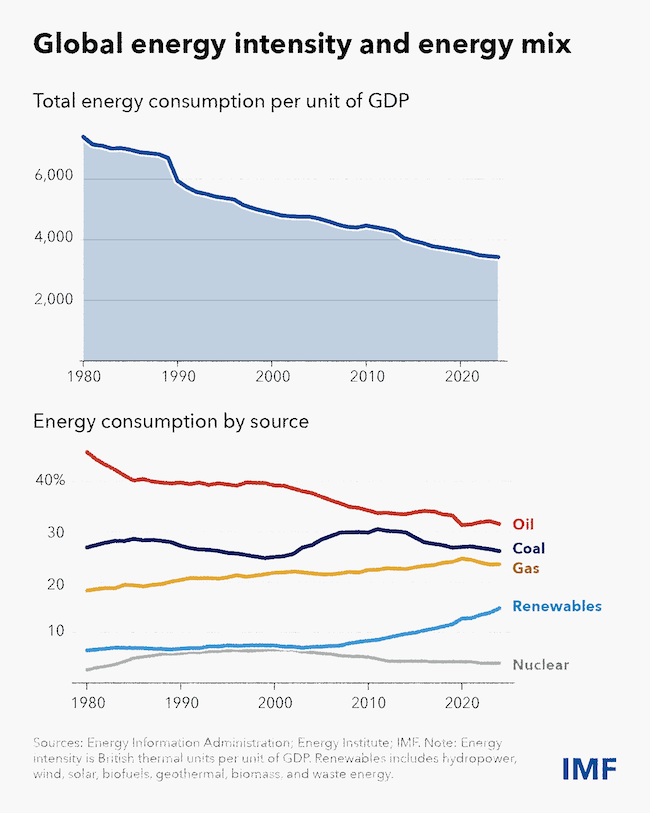
For an easily-read summary of the effects of the war you can turn to a speech by IMF Managing Director Kristalina Georgieva, Cushioning the Middle East war shock. She presents graphs on before-after situations, relating to commodity prices (fuel and fertilizer), inflation, oil and gas trade and other economic indicators, as well as a summary of policy responses by national governments. It is notable from her figures that the situation would be far worse if the world had not become less energy intensive since 1980 (much lower energy consumption per unit of GDP) and had not seen a significant displacement of oil by renewable sources. Those developments are shown on her graph, reproduced below.
Flavio Macau of Edith Cowan University has a Conversation contribution Will oil prices ever truly go back to ‘normal’?. The short answer is “probably not”.
Regarding the very short term we should note that there are many political actors on the right who would like to see a fuel panic set in, on the eve of a by-election in Farrer where the Liberal, National and One Nation parties are lined up against a community independent.
Capital gains, negative gearing and the budget
There is a strong case, in political and economic terms, for reform of tax provisions that have privileged housing speculators over first-home buyers. Does the Albanese government have the gumption to go ahead with reforms?
“Never let a crisis go to waste” is how Peter Martin introduces his Economy Stupid session What could be in the budget? in which he interviews tax expert Bob Breunig of the ANU and the ABC’s own economics editor Tom Crowley, about what the government may be planning for the budget next month (May 12). Most of the discussion is about possible changes to the taxation of capital gains and leveraged investments, particularly as they relate to the behaviour of so-called housing “investors” – speculators who hope to profit from housing shortages.
These roundups have often covered the way the Howard government’s 1999 changes to capital gains tax, including its decision to abandon inflation indexation, have favoured housing speculation over long-term investment: the latest iteration was in last week’s roundup.
The discussion on The Economy Stupid goes one step further, when the group considers a suggestion by the e61 Institute that the same inflation-adjusted principles should be applied to interest as should be applied to capital gains. If we revert to the pre-Howard model, in which capital gains are taxed at 100 percent with an inflation adjustment, there should be a similar inflation adjustment for claims of interest tax deductibility for leveraged investments. The e61 model is on its website – Housing leverage and the capital gains tax discount.
It’s a long-held practice for businesses, including individual investors, to claim interest on a business-related loan as a tax-deductible business expense. It’s also orthodox economics to point out that this gives an unfair tax advantage to borrowers, and encourages investors to become more heavily indebted – excessively “leveraged” or excessively “geared” in economists’ terms.
The e61 authors Nicholas Garvin and Matt Nolan do a good job explaining why only the real (after inflation) component of interest should be countered as an expense. (In 20 years of teaching public finance I found this to be one of the hardest concepts for students to grasp.) As an example, if you are paying 7 percent interest on a $500 000 loan, and inflation is 3 percent, then of your $35 000 interest you would be permitted to count only $20 000 as a tax-deductible expense. That is ((0.07 – 0.03)*500 000) in arithmetical terms.
Breunig and Crowley discuss this and other possibilities for housing tax reform. Breunig’s approach is closer to the models of best practice taxation theory, while Crowley is more aware of political sensitivities. Tax reform is ripe for opportunists like Angus Taylor to make stupid but superficially appealing statements such as his favourite “if you tax something more you get less of it”.
Because the Coalition (at least the Liberal Party) has already signalled its opposition to any reform that would disadvantage housing speculators, the government would have to convince the Greens to get reform through the Senate.
Will the Greens be willing to engage with the complexities of the issue, as the e61 researchers do, or will they insist on some simple solution such as cutting the CGT discount down to 33 or 25 percent – solutions laden with consequences that can make our capital gains tax system even more unfair and more economically damaging.
Breunig and Crowley also discuss the possibilities of an excess profits tax on gas exports. That makes good economic sense, particularly in light of the windfall profits likely to result from higher gas prices because of the Gulf War. But it’s politically delicate territory, when we are using our strong position as a gas exporter to bargain for deals in liquid fuel imports, and we want to keep gas prices down before the next round of electricity price default market offers.
Labor’s caution – the over-learned lessons of 2019
Overshadowing this discussion is Labor’s experience in the 2019 election, when it took proposals for tax reforms to the electorate and lost the election. In my view this is a lesson overlearned. It was a narrow loss, and unlike the proposals they are now considering, their offerings on imputation and capital gains taxes appear to have been knocked together by economic amateurs. The party ignored warnings from tax experts about unintended consequences of its proposals.
The question of the Albanese government’s risk aversion is covered in a Conversation article by Intifar Chowdhury: Risk‑averse voters want caution and visible reform. Can Albanese deliver both?
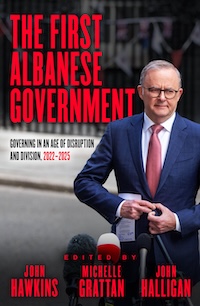
It’s a review of a book The First Albanese Government: Governing in an Age of Disruption and Division, 2022-2025, edited by John Hawkins, Michelle Grattan and John Halligan. Drawing on the book’s contributions Chowdhury sees the tension between risk aversion and electors’ demand for visible impact as unresolved. Looking forward to Labor’s short- and long-term prospects, she describes the tension between:
… whether it can build a durable constituency in a low-loyalty electorate – and whether it can articulate distinctly Labor ideas in an era where risk aversion pushes it toward caution, and grievance punishes it for just that.
The tax measures in the coming budget will go some way in answering that question.