Australia’s energy transition
A short political history of energy policy
In spite of political headwinds, our energy transition has proceeded. The war in the Middle East reminds us of the insecurity of relying on fossil fuels in our transport sector.

With huge reserves of easily extracted coal and gas, Australia got through the twentieth century without having to think much about energy security.
But as concern with climate change mounted there was pressure on governments to respond. In 2001 the Howard government set the first renewable energy target at two percent of total energy consumed, with a focus on the electricity sector, with accompanying subsidies. It was a political move, designed to counter the belief that the Coalition was indifferent to environmental matters, rather than any commitment to addressing climate change.
Nevertheless over subsequent years renewable energy came to play an increasing role in the electricity generating sector. By now, every substantial increment in electricity, catering for demand expansion or replacement of aged coal-fired stations, is met by renewable energy.
Anyone who has followed the transition knows that it has been slow and tough, with disappointments and reversals. Even as it became obvious that renewables, backed up with storage, provide electricity at much lower cost than fossil fuels or nuclear reactors, campaigns of lies and misinformation have overstated the cost of renewable energy. The right in Australia has consistently portrayed renewable energy as a concession to those concerned with left-wing woke issues, rather than as good business and a means to preserve long-term economic competitiveness.
Now that the war in the Middle East has reminded us of our energy insecurity, the battles that have been waged in the electricity sector look like being repeated in the transport sector. As an opening salvo the Coalition’s unhelpful response to the problem is to repeat Trump’s “drill, baby, drill”.
In a session on the ABC’s Rear Vision – Australia’s energy security and resilience –Annabelle Quince enlists the help of three energy experts who take us through the history of our energy policy. Tony Wood of the Grattan Institute, Andrew Blakers of ANU, and Penelope Crossley of the University of Sydney, describe the politics, economics and engineering of our energy transition.
It is notable that Tony Abbott keeps re-appearing in this history, as one who has had a powerful influence in thwarting our energy transition.
Trucking
Even before diesel prices rose in response to closure of the Strait of Hormuz, electric trucks have been looking more economic than diesel trucks.
Although there will always be real men who feel inadequate unless they are surrounded by two tonnes of steel in a Ford Ranger or a Toyota HiLux, the transition to electric cars is well on its way, having been boosted by high prices and fears of fuel shortages as a result of Trump’s war in the Middle East.
But what about trucks and buses?
Trucks next
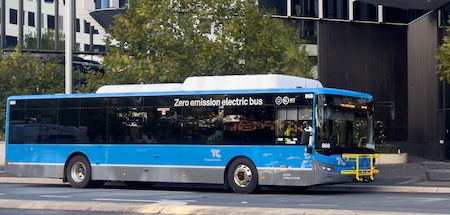
Even though we now have a growing fleet of electric buses, the dominant story is that the diesel-powered truck is here to stay, particularly because of range considerations and charging time limitations. Also because the battery pack on an electric truck is much heavier than the fuel tank on a diesel truck, there are problems with axle load limits.
Writing in The Saturday Paper – B-doubling down on electric trucks – Mike Seccombe debunks these negative attitudes, providing examples where transport companies, having considered the cost of buying and operating electric trucks, find them to be economically attractive.
They are more expensive than diesel trucks, and firms making a transition to electric will have to invest in charging stations and in facilities for battery-swapping along their routes. But the operating costs are much lower than the operating costs of diesel-powered trucks, even at the diesel prices prevailing before the war.
Those savings are substantial: Seccombe provided an example of an actual truck journey, from Picton south of Sydney to Beresfield in the Hunter Valley, that cost $50 in electricity that would have cost $300 in fuel for a similarly laden diesel truck. That differential leaves plenty of room for a higher Heavy Vehicle Road User Charge to pay for electric trucks’ heavier axle loads that contribute to road damage. Also it would be surprising if the price of electric trucks doesn’t fall, in the same way as they have fallen for electric cars, as manufacturing processes are standardized and as scale economies are realized.
Seccombe mentions some other benefits of electric trucks over diesel trucks. They should be able to maintain their speed on undulating roads, making for faster point-to-point delivery times and reducing the risk of other vehicles engaging in dangerous overtaking. And it should be possible to lift night curfews, because their engines are almost silent and they can use regenerative braking. (But would truckies feel impotent if they were deprived of the opportunity to use compression braking?)
A paper prepared by the Electric Vehicle Council and the Australian Trucking Association – Electric trucks: keeping shelves stocked in a net zero world – goes through some of the other benefits of electric trucks. For example, with our concern for GHG emissions we tend to forget about the local environmental costs of diesel fuel.
Electric trucks’ rapid acceleration and regenerative braking may have safety benefits all around. If drivers know that they can accelerate quickly from a stop, they will be less inclined to run red lights. And regenerative braking reduces the risk of inexperienced drivers burning out their brakes on long descents.
Perhaps the main safety benefits lie in the way electric trucks will transform the industry’s operating practices. The requirement to establish charging systems and to plan trips more carefully will force the industry to take on more capital-intensive and orderly business models, driving out fly-by-night operators. An interim Productivity Commission report presented this week – Impacts of heavy vehicle reform – notes that productivity improvement in the trucking industry has stalled, and suggests that the change to zero-emission vehicles opens up opportunities for widespread reform of the industry, including the productivity benefits of reviewing restrictive reforms designed around the negative externalities of diesel-powered vehicles.
Sectors of the transport industry seem to be enthusiastic about the opportunities presented by electric trucks. But as Seccombe points out, the Coalition has no interest. Its spokesperson on transport Bridget McKenzie did not bother to look at an electric truck demonstration at Parliament House, and Angus Taylor’s approach is Donald Trump’s “drill, baby, drill”.