Political parties
A tough analysis of the Liberal Party
A former Liberal Member of Parliament presents a brutally frank analysis of the reasons urban voters have turned away from the Liberal Party.
It takes courage for someone who has devoted their life to public service as a politician to make a dispassionate and objective analysis of their party’s failures, but that is what former Liberal Party MP Keith Wolahan, who lost the Melbourne seat of Menzies to Labor last year, has done in his Inflection Points article Liberal Foundations.
The first part is a brutally frank analysis of the party’s losses in urban Australia. He presents the hard data on swings and outcomes – the same data that has featured in these roundups over the years – and reminds his colleagues, once again, that because Australia is highly urbanized “a party that cannot win in the cities cannot govern Australia”.
“Australia has changed faster than the party” he writes. Howard’s “aspirational” suburban battlers have given way to new generations of urban voters, more likely to have been born overseas or to be children of immigrants, and more likely to have a university degree.
Drawing on Australian Electoral Study data he notes that in past times the party could count on voters shifting to the right as they aged and joined the ranks of the bourgeoisie. But that is not happening anymore: “millennials” (aged 30 to 45) are not turning to the Liberal Party: many are staying with Labor, and if they switch it is to Greens or independents.
A graph in his article shows this movement vividly, but is he interpreting the trend correctly? It is possible that millennials are turning more conservative as they age, and that they correctly identify Labor and independents as the true conservatives, while parties on the right are off in a right-wing fantasyland.
The second part of Wolahan’s article is an attempt to re-affirm the party’s basic principles, going back to Menzies’ statements of beliefs. Those principles should be uncontentious to anyone who can claim to believe in liberal democracy.
He goes on to paraphrase Menzies’ economic beliefs – “In private enterprise, fair reward for effort, and the dignity of work. In equality of opportunity, not equality of outcome. In a nation united, secure, and worth defending”. Again, these would be uncontentious to the vast majority of Australians.
It’s in his suggestion that these are distinguishing principles of the Liberal Party that Wolahan seems to be hindered by a blind spot – in contrast to the detached rigor of his analysis of the party’s electoral failures. These are surely general Australian values, and people’s experiences of the Howard government, of the Abbott and Morrison governments, and of Dutton’s unsuccessful platform, confirm that the party’s policies do not align with these values.
Rather than rewarding hard work these Coalition governments have rewarded idle investment and housing speculation. Rather than encouraging private “enterprise” they have encouraged rent-seeking and crony capitalism, privileging bankers, health insurers, and the new owners of power lines, toll roads, child care, labour placement and other businesses that should have been retained in the public sector.
Wolahan’s prescription for the party is to engage with urban voters in ways it hasn’t been doing. It needs candidates selected for their administrative and political competence rather than party loyalty. It needs the research capability to develop evidence-based policy, and to be able to describe its policies in an authentic tone.
He’s probably right on authenticity. Authenticity is something the independents have that party stalwarts don’t have. Well-trained actors may be able to fake it, but not the lesser mortals who stand for Parliament. In successive campaigns Liberal candidates, following directions from their pollsters and political researchers, have tried to fake it, but it fails. That’s why Wolahan’s soft hints about candidate selection are really about choosing candidates who can present themselves with the authority of their own conviction, rather than the authority of the party’s speaking notes.
Wolahan presents sound advice, but he puts one constraint around it. That is, adherence to the party’s “small government” obsession. To Wolahan, constraining government spending is a self-evident objective of good economic policy. But he fails to recognize that Australia is close to having the smallest public sector of all “developed” countries, and that the capability of our governments to provide services has been eroded. Population ageing, demands for higher defence spending, and the “Baumol” effect (the intrinsically labour-intensive nature of health care, aged care, education and policing), will drive up demand for public services. There is unmet demand for transport infrastructure, public housing and other capital works. People want capable and efficient government, not small government. They don’t understand why the quality of a service should be degraded, or its price increased, just to satisfy some ideology about the supposed benefit of “small government”.
Fortunately for reformers like Wolahan there is scope for raising revenue from those who have been allowed to free-ride on the tax contributions of others. But unless they acknowledge this they will not be able to promote a realistic policy agenda to the electorate.
As he says “no political party has a right to survive”.
National Party echoes of a Labor Party we once knew
Matt Canavan’s National Press Club address reminds us how absurd it is for the Liberal and National parties to try to work together in a coalition.
Canavan as disruptor
If you tuned in to listen to Matt Canavan’s speech at the Press Club last week, without knowing that he was the leader of the National Party, you might have had the feeling that you were listening to a Labor politician from another era. You could have placed his speech in the 1950s, when Labor was supporting an expansion of manufacturing behind a tariff barrier. Or perhaps in the early 1970s when Whitlam was pushing a strong urban and regional development agenda.
Canavan would say, however, that he doesn’t want to go back to Australia of the postwar era. The “Australian settlement” (to borrow Paul Kelly’s term) served its purpose during that era. We had to change, and we did well by opening up the economy to the world.
The world has changed again, however. The Covid shock and the current oil shock, in exposing our vulnerabilities, are prompting us to re-build our resilience, particularly in terms of our manufacturing capacity. We also need to re-build our infrastructure – our roads, railroads, ports, water and electricity supplies.
The media has picked up on specific aspects of his speech, such as his enthusiasm for working from home, a work pattern that favours settlement in new growth centres. But more important is the general spirit of his ideas, which are about governments doing things to make our lives better. To Canavan economic revival goes beyond the utilitarianism of everyday political promises (one more hour of free child care, another $1000 tax break and so on), because it also involves a sense of pride in Australian progress. Make Australia Great Again but without Trump’s baseball caps and silly hand gestures.
Canavan would have been right at home in Australia of the postwar years, the years of physical nation-building, when the Snowy River Scheme was under construction, when new standard gauge rail lines were being built, when every few years another Australian-made car model would appear in the showrooms, when new universities were being established. He admits to his admiration of Essington Lewis, who supervised the establishment of Australia’s wartime manufacturing capacity and who went on to guide postwar reconstruction.
He also understands something about manufacturing that most economists just don’t get. That is the importance of workers’ and consumers’ identification with the product. It’s why we pay more attention to jobs lost when an automobile maker closes than when a bank sheds the same number of workers. It’s why we look for the “made in Australia” label when we shop.
It’s easy to criticize aspects of his address. He opposes our renewable energy transition, even though it is quite in line with his general idea of greater self-reliance and expansion of manufacturing. His experience with the Productivity Commission should have taught him the folly of tariff protection, but organizational memories are frail. The failure of tariffs isn’t just about abstract macroeconomic models: rather it’s about the way tariffs froze Australia into a high-cost-low-volume-low-productivity industrial structure, providing poor quality jobs and expensive and unreliable consumer products.
There are better ways to support industrial development – through well-designed tax systems, through providing low-cost renewable energy, through training and education, through support of government research bodies, and through provision of transport infrastructure. And his negative ideas on immigration conveniently overlook the fact that our postwar boom was built on immigration, at a rate (as a proportion of the population) that was much higher than it is at present. Canavan wants to see our high population growth sustained, but with higher birth rates rather than immigration. (If he knows how, the governments of Japan, Korea and Italy would really like to hear from him.)
But politically his message that the government should get on and re-build Australia –an “economic revival” – should resonate well with those who hoped that election of a Labor government four years ago would see some action to make up for a long period when economic reform stagnated.
Instead we have had summits, announcements, tiny incremental taxation reforms, and glacially slow progress on housing and infrastructure. A 4 km freeway extension in Sydney, approved 9 years ago, has been under construction for six years, and probably won’t be open until 2030. The case for an east coast high speed rail line was established almost 50 years ago: we now learn that it will be two years before there is a final decision on a start to the short Sydney-Newcastle extension. The Melbourne-Adelaide highway is still a dangerous two-lane road passing through towns. The Great Western Highway connecting Sydney to the Bathurst-Orange Growth Centre is closed for several months because the convicts who built it didn’t have the foresight to plan for B-Double trucks.
Politicians who ignore Canavan’s message, and who hope the public can be placated with plans posted on the Internet and token physical projects, do so at their political peril.
Canavan ducks questions about the economic and fiscal costs of re-building Australia. If, as he suggests, our universities are to become less dependent on foreign students, if we are to allow for couples to share their reported incomes for tax purposes, if we are to catch up with our delayed infrastructure provision, we need to raise more public revenue and to become more accepting of public debt.
That’s simply to acknowledge that national reconstruction requires investment in human capital and physical infrastructure – investment we have failed to make because we have been trying to support our growing population with some of the developed world’s lowest taxes and lowest levels of public debt. Canavan understands the Zeitgeist, but he doesn’t face up to the economics of attending to the community’s demands.
It’s a fair guess that Canavan’s ideas have not gone down well among fiscal reactionaries in the Liberal Party, such as Tim Wilson who is called the “shadow treasurer” (whatever that means in a multi-party Parliament). Canavan distances himself from the ideas that have been dominant in the Coalition ever since the election of John Howard in 1996.
He explicitly rejects the neoliberal ideas of Milton Friedman and the policies of Thatcher and Reagan, suggesting that their policies may have worked in their time but that they don’t work now. With some exaggeration he asserts that our living standards have not advanced in 15 years: some may disagree with the exact dates, but the main point is that he is referring to a period that includes 9 years of Coalition government. He’s arguing against the ideas embraced by our policymakers, rather than against the policies of any particular party.
The hard right of the Liberal Party are probably thankful that Canavan’s speech was on the same day as Trump and Hegseth were reaching peak military madness, commanding almost all media attention. Some others will simply see his ideas in terms of traditional National Party ambit bids, noting his emphasis on dams and decentralization.
A broader interpretation – reshuffling the left-right spectrum
The other way to see his speech is in terms of reaching to those who feel that life has been unfair and have turned to One Nation. Based on the way we construct a political spectrum, this would put him well to the left of the Liberal Party, and perhaps to the left of the governing Labor Party, because many of his ideas resonate with what would have been standard Labor Party lines in past times when it was more adventurous. Although the National Party has been in thrall to the fossil fuel lobby (who have pushed its anti-renewable stance), the party owes its electoral success to Australia’s least privileged. That should give the party some basis of common ideology with Labor’s traditional base.
If the political commentariat could free itself from thinking that the Liberal-National Coalition is a permanent political fixture, they might recall that between 1935 and 1950 Victoria was governed by Labor-Country parties in forms of cooperation. In South Australia between 2002 and 2010 a National Party MP served as a minister in a Labor government, even though Labor had a majority. And if they tuned into Canavan’s entire session, they might note what the chairperson, the ABC’s Andrew Probyn, had to say about Canavan’s political background: it’s well to the left of Albanese’s.
Some may enjoy the Schadenfreude of witnessing an ideological split in the Coalition. Others, however, would see that Canavan is opening up the possibility of the Liberal Party and the National Party going their own ways without the burden of having to work around irreconcilable differences. The Liberal Party, freed from National Party demands for rural boondoggles and concessions to the fossil fuel industry, could develop its own policies.
It’s doubtful, however, that its present economic spokespeople, Angus Taylor and Tim Wilson, recognize that opportunity. They will probably keep the party on a Thatcherite path – degrading state capacity and defending the interests of the idle rich – until it learns from one or two election losses to abandon its “small government” obsession.
What we know about One Nation and its supporters
One Nation is a politically savvy party, adept at drawing support from those who missed out on education opportunities.
Even though it is a party centred on one person, One Nation’s success in South Australia has shocked the political establishment into taking it seriously. In fact it is now spooking the establishment with attempts to establish itself as the “opposition” in South Australia.
The Conversation Digital Storytelling Team has a post Pauline Explained, presenting a political biography of Pauline Hanson, drawing on the insights of Anna Broinowski of the University of Sydney.
From the outset Hanson has had three defining political traits – the politics of grievance (“it’s not fair”), the politics of the outsider, and the politics of standing up and saying what she feels her supporters are thinking.
That is not all: she has honed her political skills. Over 30 years of political experience she has transformed from “the politically clueless, firebrand xenophobe” to “a serious, strategic, experienced, battle-hardened political operator”.
The South Australian election provides some idea of her support among various demographic groups. One Nation did very well in the wheatbelt and the riverland, and reasonably well in Adelaide’s industrialized northern suburbs, but comparatively poorly in Adelaide’s older urban regions.
No doubt researchers will be poring over the South Australian outcomes to find evidence linking electorate characteristics with One Nation support, and will probably be doing some follow-up interviews with voters. Already some correlations can be generated from election data and from census data which is available at a state electorate level.
I therefore ran a few correlations to see if there were any general characteristics of electorates in which One Nation did well on primary vote. My first attempted correlation was on average income by electorate. There is some correlation: the lower the electorate’s average income the higher is One Nation’s primary vote. But the relationship is weak. In two low-income non-metropolitan electorates, Stuart and Finniss, the One Nation vote is comparatively low: this may be because both have been successfully held by independents.
But when I ran the correlation against education, I found that the relationship is strong. Census data is collected for several levels of education. For example in electorates where the average level of education was Year 9 or earlier there is a significant correlation with the One Nation vote. The strongest negative correlation however, is related to tertiary education – an advanced diploma, degree or higher.
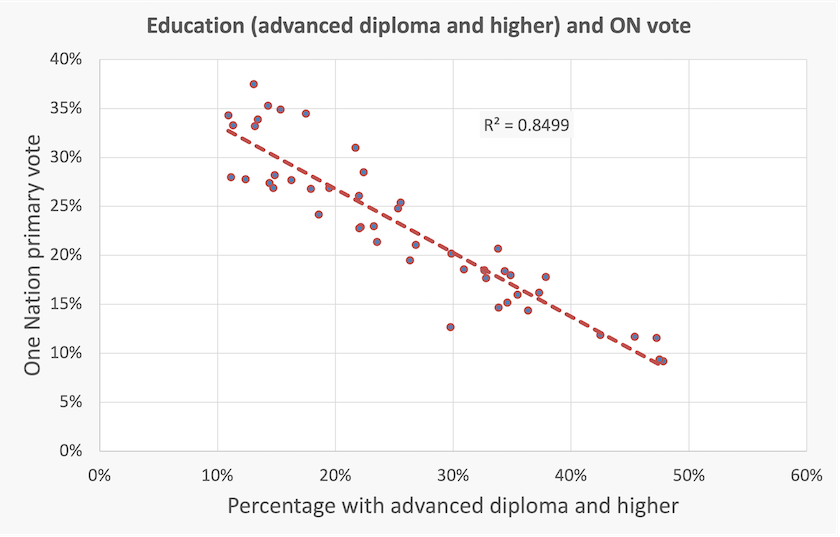
It is tempting to over-interpret such a correlation. People’s level of education is correlated with many other variables that may influence voting behaviour, such as early childhood experience, and life chances generally. A degree or diploma may not be the path to material riches, but it may be a path to a more satisfying and secure job where people enjoy autonomy and professional respect. And maybe our education institutions are doing a reasonable task in helping students develop their capacity for independent critical thinking, which provides some inoculation against the spin, lies, bullshit, sophistry, misinformation and disinformation spouted by populist politicians.
There is a risk in pointing out this correlation, in that it can lead to inferences that One Nation voters are stupid. But all such data means is that those without certain forms of education accreditation are more likely to vote for One Nation. It says nothing about people’s skills, intelligence or morality. but it may say something about shortcomings in early education: education experts point out that skills in critical thinking can be taught at a very early stage.
What’s Next?
Expect to see a proliferation of political movements. One or two may emerge as serious parties, displacing the Liberal Party.
Periods of discontent spawn political movements, most of which have short half-lives.
A reader has asked about an outfit known as Next. Their simply-named website (https://next.org.au) presents a political gathering concerned with fairness, integrity, a strong economy, evidence-based policy, and an independent Australia. Pretty well what any political movement would say.
They go a little further with a “core platform” of policies, which could be described as anti-establishment populism: for example it would “declare war on Crony Capitalism and rent-seeking from the Big End of Town”. Many progressives would endorse its ideas of establishing a sovereign wealth fund and setting a 25 percent minimum corporate tax raate on foreign companies.
That core platform includes “a moratorium on immigration until infrastructure, training, housing and integration have caught up with our population” – a statement that hints at either naivety, or identification with the xenophobia and racism of far-right movements. A deeper dig into their platform suggests it has been put together by people with good intention but with little understanding of public administration.
A movement aiming to establish itself as a new party would surely include a few prominent names on its website, but there is nothing in this regard on Next’s site. It has a call for candidates for the next Victorian election (November 28), suggesting that it aims to pick up seats in the state Legislative Council. That may be the limit of its ambition.
It is too easy for progressives to dismiss such movements, suggesting that exposure to the hard world of political and economic realities will wipe them out. The re-election of Trump, and closer to home the success of One Nation in South Australia, should force the political class to recognize the genuine concerns these movements are addressing. Some of their specific suggestions may be wacky, but good ideas often emerge as refinements of far-out ideas.
As is pointed out elsewhere in this roundup, there is no rule guaranteeing the immortality of political parties. In times of accelerated change the political landscape can resemble what Joseph Schumpeter called “creative destruction” to describe the dynamics of competitive capitalism: old parties die, new parties emerge from the ruins. Indeed that was more or less the pattern for the first 44 years of our Federation.
There are two reasons why we might see new political parties emerge on the centre-right to fill the space left vacant by the dying Liberal Party.
The first is a possible gathering of “teal” and some other independents into a “party”, as a convenient way to compensate for rigged donation laws that discriminate against independents. This would probably be a coherence around one or two principles, such as political integrity, and maybe a sharing of some research resources. Otherwise independents will go on being independents: many are refugees from political parties who aren’t going to give up their strongest asset.
The second and more substantial possibility is a party to replace the Liberals. Writing in the Financial Review Phil Coorey has an article Talk grows about new movement to replace “irretrievable” Liberals.
Coorey acknowledges the possibility that the Liberal Party can resurrect itself, particularly if it manages to do well in the Victorian election.
But if that “success”, which it is likely to define in terms of defeating Labor, is achieved in a coalition with One Nation it would be a pyrrhic victory. When a centre-right party forms a coalition with parties further on the right, it’s the party on the furthest right that holds most policy power, even if their numbers are small. That’s the mathematics of coalition-building. The wider reaction to a Liberal-National-One Nation coalition in government would be huge, hastening the downfall of the Liberal Party. But so fixated are the Liberals on defeating Labor rather than pursuing a coherent policy that they are blind to their own self-destructive behaviour.
Another big problem for the Liberals is the party’s relationship with the Nationals. They have had two chances since May last year to go their own way, but Ley was too timid to take it. Not that she should take all the blame. The two-party system has huge inertia, like a B-double truck whose driver has died at the wheel with a heart attack. The truck keeps paralleling down the highway, no one noticing that the driver is dead, until it hits a tree or runs out of momentum. The political establishment — media, academics, public servants, pollsters — have so much invested in the two-party system and the idea of a Coalition that they cannot envisage a different reality.
The other big problem with the Liberal party is its lack of talent. The parliamentary party, a hard core of true believer survivors, is seriously short of people who could take the Australian community with them. Angus Taylor is not known for his political skills. Tim Wilson, in his hard line on superannuation reforms, has identified himself with wannabe oligarchs rorting the tax system. Andrew Hastie’s White Australia dog whistles might resonate in his Canning electorate where there are disproportionate numbers of South African and English migrants, but they probably don’t resonate in the other 87 urban electorates.