Economics
Our trade agreement with Europe
The Australia-European Free Trade Agreement, finalized this week, is about more than tariffs, quotas and wine names: it sends an important message to Trump and the rest of the world.
If you’re contemplating buying a BMW M8, maybe you should hold off for a few weeks, because under the newly negotiated Australia-European Free Trade Agreement the 5 percent tariff on European cars is to be removed. If this saving is passed on the base price of the BMW M8 will fall from $353 000 to a more affordable $335 000.
Writing in The Conversation -- Prosecco makers lose out as Australia seals EU free‑trade deal after 8 long years of talks – Hazel Moir of ANU summarizes the main points of the agreement.
In fact Australian Prosecco makers don’t lose out. They can keep that brand name in Australia but will have to call it something else when they export it. The same holds for our beloved Australian cheeses.
There will be some reduction in our luxury car tax – the 33 percent tax levy that cuts in at a price of around $80 000 to $90 000 – but unfortunately it won’t apply to your BMW M8, because the reduction applies only to highly priced European electric vehicles.
The Business Council of Australia sees it as a major win for business, jobs and investment. The only grizzles, so far, are coming from the beef industry. Australian exporters will still face quotas on red meat exports. (These agreements are never about complete trade freedom.) The negotiated annual quota of 35 000 tonnes represents only about 80 grams per European – a degustation portion rather than a satisfying meal. But as Moir points out, that’s well above the 6 000 to 8 000 tonnes of red meat Australia is presently exporting to the EU.

Trade agreements involve a large amount of bureaucratic work, with only small incremental improvements for exporters and consumers. The benefits of abolition of those 5 percent tariffs have been more than negated by rises in the $A:€ exchange rate since January. So there will be no saving on your BMW, but as consolation your holiday in Tuscany should still be affordable – if you can afford to get there.
But accumulated over many years trade agreements do yield benefits, particularly in a world that has turned its back on multilateral trade institutions such as the WTO. And importantly in this era when mercantilist sentiments are re-emerging, when the US is engaged in a tariff war, and populist politicians in One Nation and the Liberal Party are calling for a return to protectionism, the political message of a new trade agreement is important.
It is notable that European Commission President Ursula von der Leyen came to Australia to announce it, and that it has become a major item on European news. Von der Leyen’s statement “We are sending a strong signal to the rest of the world, a signal that in times of turbulence friendship and cooperation are what matter most.” is the opening sentence in Deutsche Welle’s news item, headed by a photograph of Albanese and von der Leyen joined in celebration.
The symbolic importance of the agreement, rather than brands of wines or the price of BMWs, is Trade Minister Don Farrell’s main message in a 9-minute interview on Radio National. He also has some creative explanations around the theme of multiculturalism about why Italian and French food and wine names have become native to Australia.
The agreement still has to be ratified by the European Parliament. Von der Leyen’s support will certainly help it along. Although our beef producers are grizzling, our negotiators have had to consider the sensitivities of Europe’s beef producers who are grizzling about the deal’s generosity to Australia. Likewise it has to get through our Senate, and the Coalition has already expressed its misgivings about the deal. Maybe that’s because the National Party feels pressure from beef farmers. Or more likely the Coalition doesn’t want to be showing support for free trade, which would put itself at a distance from One Nation’s strong support for protectionism. New romances must be handled delicately.
Pressure to hurry up our energy transition
Prominent world energy and security spokespeople warn that the US-Israel-Iran war exposes our dependence on fossil fuels. Coalition parties would have us extend that dependence.
It is notable that in these times the International Energy Agency Executive Director Fatih Birol has chosen to come to Australia. That is because he sees this part of the world – Asia – at the forefront of dealing with the challenges of climate change and energy policy.
The urgency in dealing with these problems is heightened by the war. Closure of the Strait of Hormuz presents short-term challenges, and severe damage to gas and oil facilities bring forward long term challenges.
In his address and Q&A session at the Press Club on Tuesday he covered these challenges, stressing the seriousness of the present situation, which most countries are underestimating or ignoring.
Birol’s address, covering the consequences of the war, is summarized in Mark Foley’s article in the Sydney Morning Herald, Economic carnage “worse than ’70s” as PM admits “stable, predictable world” is gone. Even if you can’t get past the firewall that headline is a good summary.
Absence of a sense of the serious economic consequences of the war was reflected in many of the media questions in the Q&A session, which were about immediate measures such as fuel rationing and working from home (the latter having received political prominence following another bout of silly comments from Liberal MP Jane Hume).
But Birol did get on to longer-term issues about the world’s energy transition away from fossil fuels. “We are entering the age of electricity” he said, and that growing demand for electricity will be generated from renewable energy and nuclear power. He admits to being “bullish” about nuclear power, but not for Australia. He said “in my view if somebody asked me does Australia need today to build a nuclear plant I would say no”, referring to our plentiful solar, and wind resources, and progress in battery storage. He also referred to our opportunities to provide the world with critical minerals.
That same emphasis on an energy transformation through electrification came through in Ursula von der Leyen’s speech to Parliament. Most of her speech was about the Free Trade Agreement, security issues, and a general restoration of good relations with the countries of the EU (badly damaged by Morrison’s cancellation of the French submarine contact). It was in the context of national security that she saw our energy transformation:
With geopolitics at a boiling point we know firsthand that the more you build homegrown energy, the sooner you get independent and thus can shield yourself from energy price shocks. We are in a race to electrify our economies. This is what future generations will judge us on.
She warned that “malicious actors are able to reach into our borders without ever leaving their own”.
Such a statement can lead people to think of attacks on computer networks, and that is indeed a problem. But it’s also about attacks in plain sight, through lies and disinformation, as we are warned by the Australian Security Leaders Climate Group in their publication The climate disinformation war: how to fight back for Australia’s democracy and Security. To quote:
Anti-climate-action propaganda and disinformation networks have grown into multi-billion-dollar permanent campaigns, largely funded by fossil-fuel interests and their allies. These campaigns may be best understood through a lens of information warfare, combining traditional media influence, coordinated online activity and algorithmic amplification to shape narratives and perceptions at scale.
They warn particularly of “anti-climate-action coalitions”. Writing in Renew Economy How climate and renewables “disinformation networks” are fuelling a major national security threat Rachel Williamson echoes the warnings from Admiral Chris Barrie and others on the Security Leaders Climate Group, reminding us that:
… fossil fuel interests spent $7 million backing conservative politicians in the 2025 federal election, and links have been made between conservative think tanks espousing anti-renewable energy ideas with local and US-based fossil fuel donors.
Russia and Iran are two countries that have a clear interest in thwarting the transition to renewable energy. So too would many other countries benefit competitively if Australia remains burdened with high-cost fossil fuel, or an unaffordable nuclear power system.
In this regard Williamson calls out the Coalition parties:
Sadly, one of the culprits is Australia’s own Liberal and National parties, whose energy policies for two decades and claims of what renewable energy could, or would do despite evidence to the contrary, allowed disinformation and misinformation to flourish.
In most countries there are names such as “traitor” for those who use their public voice to promote the interests of foreigners over the nation’s interests. In Australia we politely call them the “opposition”.
Re-thinking Australia’s geography
The Australia most of us live in has a high population density: our transport policy should be built around this reality.
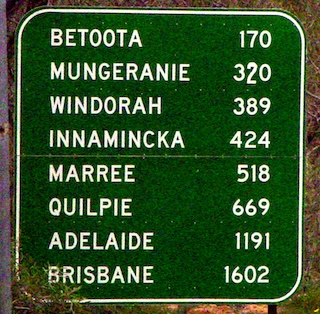
False imression of density
Australia is a big country, isn’t it? Our 7.8 million square kilometres is just short of the 8.0 million square kilometres of the USA’s contiguous 48 states.
When we consider our population of 27 million, a simple division reveals that our population density is 3.5 persons per square kilometer. That compares with densities of 339 people per square kilometer in Japan, 242 in Germany, 151 in China, 122 in France.
You might want to remember these numbers: they could be handy in a Trivial Pursuits game, or they may earn you a dead chook in a Friday evening quiz in a pub. But what relevance do they have in public policy?
In policy advocacy they can be weaponized, as they have been with high-speed rail. The four countries mentioned above all have networks of high-speed rail. Australian opponents of high-speed rail argue that with their population densities high-speed rail might make sense in those countries, but there is no way we, with our population two orders of magnitude lower than China and Japan, could possibly afford it.
So the arithmetic goes, according to the men and women who sit in state and Commonwealth treasuries, and Coalition politicians whose idea of nation-building is confined to white picket fences and coal-burning power stations.
As the ABC’s Bruce MacKenzie points out in a post Australia has been waiting more than 40 years for a high-speed train, fiscal misers have been knocking back high-speed rail proposals since the CSIRO first put forward the idea in the 1900s.
In a Conversation contribution about the proposed Sydney-Newcastle high-speed line, Phil Laird challenges the idea of a national population density that’s too low to support high-speed rail. He points out that 60 percent of Australians live within the Brisbane-Melbourne corridor, a comparatively small part of this huge continent, with a population density of 104 people per square killometer. On the bit of land where most of us live, we’re about as crowded as France. He asks why are we looking only at Sydney-Newcastle, and not the whole east coast corridor. (Others would add Melbourne-Adelaide for consideration.)
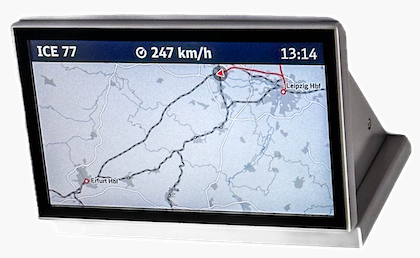
Not seen here
Part of the answer to Laird’s rhetorical question is in his article, which points out that the capital cost estimates for the Sydney-Newcastle leg come to $61 billion, or $93 billion if it is extended to the Western Sydney Airport. Considering the fact that the line would serve about 7 million people in the Sydney-Newcastle region, that comes to rather a lot of money – about $13 000 per person, or about $16 000 per adult.
That framing makes high-speed rail look like a rather expensive venture, until we consider it in a wider frame, the capital cost of transport. A car costs from $25 000 upwards, lasts only about ten years and is costly to run. (Railroads last a lot longer.) The consumer group Choice(using a slightly inflated methodology), estimates the annualized costs of running a car at $22 000. I include these figures not to provide a rigorous comparison, but to put the cost of building high-speed rail in perspective and to show that its cost can be compared with other items in our transport budget.
The other point about cost is that the Newcastle-Sydney leg is probably the most expensive of the whole Brisbane-Melbourne-Adelaide corridor. More than half of that leg will have to be in tunnels. Much of the rest of the line could probably be along existing easements.
Laird points out that a Sydney-Melbourne high-speed rail would provide capacity relief, and some real competition, on one of the world’s busiest aviation routes. Our airlines need to be shaken out of their arrogant contempt for passengers. It’s not just about their high prices. It’s also about their assumed right to cancel flights at short notice, which means that people needing to be in another city at a reliable time – an international connection, an important job interview, a business negotiation, a specialist medical appointment – have to build a large buffer into their trip, such as an overnight stay. Or they may choose to drive, which can turn out to be the fastest and most reliable point-to-point mode of transport.
The more general point about Laird’s calculation on population density relates to fuel prices. That mental model of a huge island with low population density and vast distances justifies our low fuel taxes – which paradoxically deprives us of funds to build safe, reliable, all-weather roads across the continent. If we change that mental model, and realize that almost all of us live in a reasonably dense coastal zone, we could bear European-level fuel taxes to fund good urban and intercity roads, public transport and intercity rail services. Such taxes could be applied regionally, or there could be tax relief for that small but important proportion of people, including First Nations Australians, who live in the vast inland.
The February CPI: did anyone notice?
The February CPI shows that the CPI is actually falling. Is the RBA too locked into a dumb methodology to notice?
The ABS published the scheduled February Consumer Price Index on Wednesday. It reveals that between January and February the CPI fell from 101.33 to 101.31. Annualized that would man CPI inflation is now running at minus 0.2 percent a year.
That’s a bit of rough arithmetic, because each of those figures is noisy. But it’s no less rough than the RBA’s practice of taking the latest month’s CPI (February 2026), and comparing it with the CPI 13 months ago (February 2025), and calling that the current inflation.
The chart below shows the actual CPI over the two years the ABS has been publishing monthly data. The red line shows how the ABS arrives at the year-on-year figure. The index on February 2025 was 97.67 and in February 2026 was 101.31. The arithmetic involves dividing 101.31 by 97.67, which comes to 1.03726. That is, a 3.7 percent rise, which is the headline rise in the CPI as reported by the ABS. Similar methods are used for trimmed mean and seasonally-adjusted indexes.
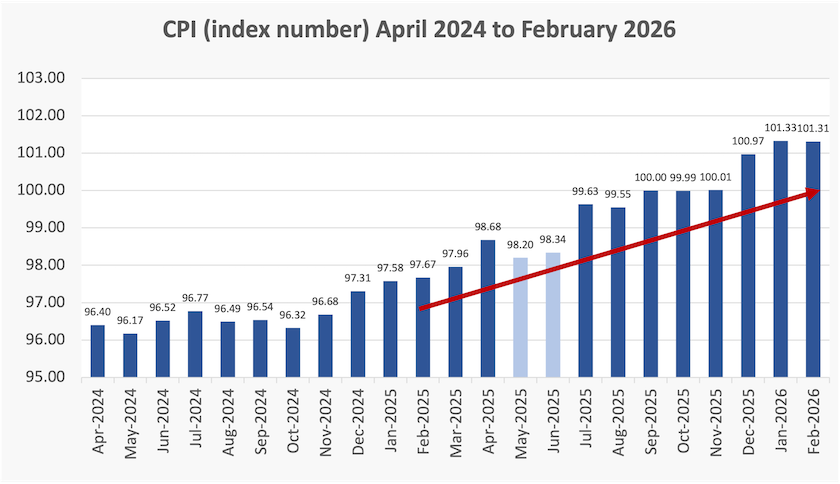
The arithmetic is orthodox. It provides a first-order indicator of year-on-year price movements, but it’s quite wrong to call it a measure of inflation. It’s historical, subject to sampling error, and in any event the CPI is an estimate of household cost-of-living, not inflation – limitations that have been covered in previous roundups.
Eyeballing that series tells us more than crude arithmetic calculation can. It appears that the CPI jumped late last year, and was pretty stable in the following three months. In view of this stable index number, it’s hard to see how the RBA justified raising interest rates.
It is also informative to look at those comparatively low index numbers for May and June last year (the pale blue bars). When the ABS produces a CPI for May and June this year, it will be off those low bases. A substantial rise is therefore already built into the figures, which is justification for the RBA to predict confidently that inflation will rise in the middle of the year.
In any event, since the data for the February CPI was gathered, Donald Trump has ensured that the next few CPI figures will show a big jump. Will the RBA in its May meeting react to those high figures by sending the economy into a recession? Or will it use its analytical capacity to assess whether changes in the interest rate can do anything to influence these supply-side induced price rises?
Predicting what will happen is hard. Spare a thought for Sydney Morning Herald/Age journalist Shane Wright, who found all he could write was covered by the headline Inflation was easing before start of war in Iran, but everything has already changed. Some speculation on how the RBA will deal with war-induced price rises is in Mike Secombe’s Saturday Paperarticle The “double whammy” of rising fuel costs and interest rates. Independent economists fear that we are facing a period of stagflation – a combination of rising prices and rising unemployment. Most economists stress that because this is a supply-side shock and is likely to be temporary the case for higher interest rates is weak.